Page loaded successfully. Showing biography for Segundo Planes.
Segundo Planes BIOGRAPHY
Born 1965 Pinar del Rio, Cuba. Known for: Abstract surrealist painting, portraits, figures.
Segundo Planes. b. 1965. Resides in the United States. Segundo Planes’ work could be categorized as belonging to the surrealist* vein of Latin American art. Like an iceberg, this artistic style has... Read full biography
Segundo Planes. b. 1965. Resides in the United States. Segundo Planes’ work could be categorized as belonging to the surrealist* vein of Latin American art. Like an iceberg, this artistic style has surfaced in different countries and moments to become a “tradition” in the course of the 20th... Read full biography
Segundo Planes. b. 1965. Resides in the United States. Segundo Planes’ work could be categorized as belonging to the surrealist* vein of Latin American art. Like an iceberg, this artistic style has surfaced in different countries and moments to become a “tradition” in the course of the 20th century. Described as “super-surrealist, super-expressionist, and super-baroque” (Mosquera, 1987), Planes and several of his colleagues have been undeniably influenced by such artists as Jonathan Borofsky... Read full biography
Segundo Planes. b. 1965. Resides in the United States. Segundo Planes’ work could be categorized as belonging to the surrealist* vein of Latin American art. Like an iceberg, this artistic style has surfaced in different countries and moments to become a “tradition” in the course of the 20th century. Described as “super-surrealist, super-expressionist, and super-baroque” (Mosquera, 1987), Planes and several of his colleagues have been undeniably influenced by such artists as Jonathan Borofsky and Kenny Scharf. These influences are reflected in a freewheeling figurative style; an intense emotional engagement, encompassing Renaissance-style perspective as well as the rules of “good” painting; and an intimate acquaintance with Pop Art’s warmer... Read full biography
Segundo Planes. b. 1965. Resides in the United States. Segundo Planes’ work could be categorized as belonging to the surrealist* vein of Latin American art. Like an iceberg, this artistic style has surfaced in different countries and moments to become a “tradition” in the course of the 20th century. Described as “super-surrealist, super-expressionist, and super-baroque” (Mosquera, 1987), Planes and several of his colleagues have been undeniably influenced by such artists as Jonathan Borofsky and Kenny Scharf. These influences are reflected in a freewheeling figurative style; an intense emotional engagement, encompassing Renaissance-style perspective as well as the rules of “good” painting; and an intimate acquaintance with Pop Art’s warmer tendencies. In Planes’ case, we are not presented with magical realism*, or the dreamlike fantasies that people tend to identify w... Read full biography
Artist Biography
Biography page for Segundo Planes ((Born 1965)), known for Abstract surrealist painting, portraits, figures. Showing 2 biographical entries and 0 sample artworks.
Segundo Planes - Artist Info
About Segundo Planes
Name variants
Segundo Planes Herrera
Biography from the Archives of askART
 Segundo Planes
b. 1965. Resides in the United States.
Segundo Planes’ work could be categorized as belonging to the surrealist* vein of Latin American art. Like an iceberg, this artistic style has surfaced in different countries and moments to become a “tradition” in the course of the 20th century. Described as “super-surrealist, super-expressionist, and super-baroque” (Mosquera, 1987), Planes and several of his colleagues have been undeniably influenced by such artists as Jonathan Borofsky and Kenny Scharf. These influences are reflected in a freewheeling figurative style; an intense emotional engagement, encompassing Renaissance-style perspective as well as the rules of “good” painting; and an intimate acquaintance with Pop Art’s warmer tendencies.
In Planes’ case, we are not presented with magical realism*, or the dreamlike fantasies that people tend to identify with Latin American art. Nor does he show any interest in the concepts of national identity so dear to certain aspects of Cuban art of the 20th century.
Planes’ work places him as an artist in the romantic vein: a medium whose spontaneous disorder of the senses allows him singular access to distortions in the social sphere. “He combines grand portraits with philosophy, sex, scatology and poetry in an endless baroque flow.” (Camnitzer, 2003)
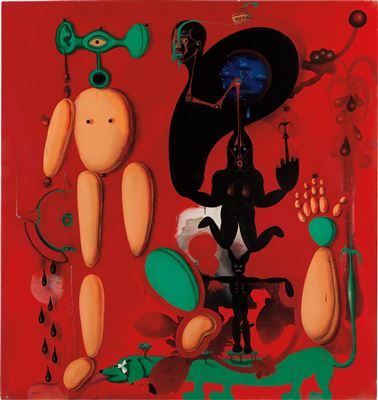
His style does not resort to Salvador Dalí’s Technicolor techniques, nor to the fortuitous encounter of dissimilar objects. Instead, his works are installations composed of several canvases, images on the floor, and added objects. In these works he unleashes a boundless, multicolored figuration, in which he mixes episodes of his personal life, reflections on his education as an artist, and references to interior body cavities—as if, as in Untitled (1990), the viewer were witnessing an endoscopy guiding him to the other side of the visible.
Of the multiple eyes placed in this interior, only one seems to have an active pupil capable of vision. Over the open membrane, perhaps the optic cavity, nerves crisscross in the shape of the hammer and sickle, symbols of the Soviet Union until its dissolution in 1991.
Source:
Website of The Farber Collection: Cuba Avant-Garde, 2020
For more in-depth information about these terms and others, see AskART.com. Glossary http://www.askart.com/AskART/lists/Art_Definition.aspxBiography from Morton Subastas
Segundo Planes grew up in the first socialist society in America, Cuba, where he studied at the Provincial School of Art in his hometown and later at the National School of Art in Havana.
He adopted Mexico as the second country, specifically Monterrey, where he has made much of his artistic production. His work has been exhibited since 1983 in Cuba, the United States, Spain, Ecuador, Dominican Republic, Mexico, among others. "
Source consulted: MENESES, Aldo. "Second Plans, The Fragility of the Great." Miami. 2015.