Page loaded successfully. Showing biography for Simon De Vos.
Simon De Vos BIOGRAPHY
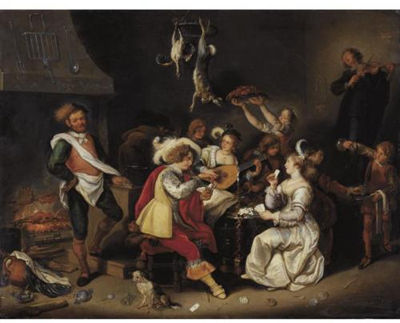
1603 Antwerp, Belgium - 1676 Antwerp, Belgium. Known for: Baroque genre and cabinet picture painting, historical events.
Simon de Vos was a Flemish Baroque painter of genre and cabinet pictures. From 1615 until 1620, he studied with Cornelis de Vos (1603-76), to whom he is not related. In 1620 he joined Antwerp's Guild... Read full biography
Simon de Vos was a Flemish Baroque painter of genre and cabinet pictures. From 1615 until 1620, he studied with Cornelis de Vos (1603-76), to whom he is not related. In 1620 he joined Antwerp's Guild of St. Luke, and then he probably traveled to Rome where he came under the influence of the... Read full biography
Simon de Vos was a Flemish Baroque painter of genre and cabinet pictures. From 1615 until 1620, he studied with Cornelis de Vos (1603-76), to whom he is not related. In 1620 he joined Antwerp's Guild of St. Luke, and then he probably traveled to Rome where he came under the influence of the "low-life" genre paintings of the Bentvueghels and the bambocciate. A Caravaggesque influence, by way of the German painter Johann Liss—active in Italy during the 1620s—is discernible in De Vos's paintings... Read full biography
Simon de Vos was a Flemish Baroque painter of genre and cabinet pictures. From 1615 until 1620, he studied with Cornelis de Vos (1603-76), to whom he is not related. In 1620 he joined Antwerp's Guild of St. Luke, and then he probably traveled to Rome where he came under the influence of the "low-life" genre paintings of the Bentvueghels and the bambocciate. A Caravaggesque influence, by way of the German painter Johann Liss—active in Italy during the 1620s—is discernible in De Vos's paintings from this time on. In contrast to the earlier "low-life" paintings, works from the late 1620s until around 1640, which were made after returning to Antwerp, are mostly small "merry company" and courtly genre scenes reminiscent of contemporary Dutch... Read full biography
Simon de Vos was a Flemish Baroque painter of genre and cabinet pictures. From 1615 until 1620, he studied with Cornelis de Vos (1603-76), to whom he is not related. In 1620 he joined Antwerp's Guild of St. Luke, and then he probably traveled to Rome where he came under the influence of the "low-life" genre paintings of the Bentvueghels and the bambocciate. A Caravaggesque influence, by way of the German painter Johann Liss—active in Italy during the 1620s—is discernible in De Vos's paintings from this time on. In contrast to the earlier "low-life" paintings, works from the late 1620s until around 1640, which were made after returning to Antwerp, are mostly small "merry company" and courtly genre scenes reminiscent of contemporary Dutch painters Dirck Hals and Pieter Codde. After 1640, De Vos turned away from genre scenes altogether and painted mostly small cabinet painting... Read full biography
Artist Biography
Biography page for Simon De Vos ((1603 - 1676)), known for Baroque genre and cabinet picture painting, historical events. Showing 2 biographical entries and 0 sample artworks.
Simon De Vos - Artist Info
About Simon De Vos
Name variants
Simon Vos
Biography from the Archives of askART
 Simon de Vos was a Flemish Baroque painter of genre and cabinet pictures. From 1615 until 1620, he studied with Cornelis de Vos (1603-76), to whom he is not related. In 1620 he joined Antwerp's Guild of St. Luke, and then he probably traveled to Rome where he came under the influence of the "low-life" genre paintings of the Bentvueghels and the bambocciate.
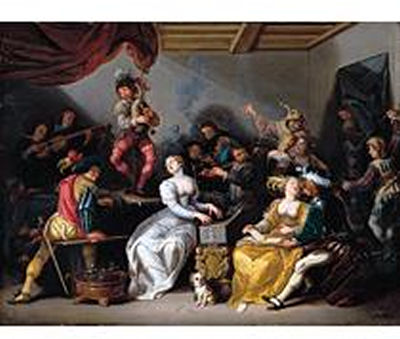
A Caravaggesque influence, by way of the German painter Johann Liss—active in Italy during the 1620s—is discernible in De Vos's paintings from this time on. In contrast to the earlier "low-life" paintings, works from the late 1620s until around 1640, which were made after returning to Antwerp, are mostly small "merry company" and courtly genre scenes reminiscent of contemporary Dutch painters Dirck Hals and Pieter Codde.
After 1640, De Vos turned away from genre scenes altogether and painted mostly small cabinet paintings of history subjects, influenced stylistically at first by Peter Paul Rubens and then increasingly by Anthony van Dyck. Examples include The Beheading of St. Paul (1648) in the Royal Museum of Fine Arts, Antwerp.
He married Catharina van Utrecht, the sister of Adriaen van Utrecht, in 1628.[3]
Source:
http://en.wikipedia.org/wiki/Simon_de_VosBiography from Galerie Arcimboldo, s.r.o.
Simon de Vos lived from 1603 - 1676. Flemish painter and art collector Simon de Vos was trained by portrait painter Cornelis de Vos, with whom, however, he had no family connection. De Vos initially devoted himself to small format cabinet paintings and genre scenes. The color palette is rich and the brush strokes delicate.
His early period œuvre is close to Frans Francken the Younger and the German painter Johann Liss, who worked in Italy in the 1620's. There is also an obvious influence of the Caravaggists. Later de Vos began painting historical subjects, which he executed in larger formats in the Flemish Baroque style, influenced mainly by Rubens and Anthony van Dyck.