Page loaded successfully. Showing biography for Simon Hantai.
Simon Hantai BIOGRAPHY
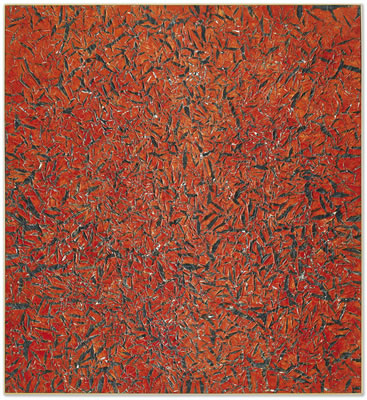
1922 Bia, Hungary - 2008 Paris, France. Known for: Abstract painting on folding canvas.
1922. Birth of Simon Hantaï on December 7, Bia, Hungary. 1942-1948. Studies at the School of Fine Arts in Budapest. 1948. Leaves Hungary and travels through Italy before settling in France.... Read full biography
1922. Birth of Simon Hantaï on December 7, Bia, Hungary. 1942-1948. Studies at the School of Fine Arts in Budapest. 1948. Leaves Hungary and travels through Italy before settling in France. 1950-1951. First "Surrealizing" works, trying out different techniques: collage, frottage, scraping with... Read full biography
1922. Birth of Simon Hantaï on December 7, Bia, Hungary. 1942-1948. Studies at the School of Fine Arts in Budapest. 1948. Leaves Hungary and travels through Italy before settling in France. 1950-1951. First "Surrealizing" works, trying out different techniques: collage, frottage, scraping with razor blades, dripping and even folding. Becomes interested in gestural painting. 1953. First exhibition, "Peintures" at the Surrealist gallery L'Etoile Scellée, Paris, presented by André Breton.... Read full biography
1922. Birth of Simon Hantaï on December 7, Bia, Hungary. 1942-1948. Studies at the School of Fine Arts in Budapest. 1948. Leaves Hungary and travels through Italy before settling in France. 1950-1951. First "Surrealizing" works, trying out different techniques: collage, frottage, scraping with razor blades, dripping and even folding. Becomes interested in gestural painting. 1953. First exhibition, "Peintures" at the Surrealist gallery L'Etoile Scellée, Paris, presented by André Breton. November: publication of issue no. 1 of the journal Médium: communication surréaliste, known as the "Simon Hantaï issue," with a cover and illustrations by the artist. 1954. Simon Hantaï meets Jean Fournier, then director of Galerie Kléber, Paris. 1955. The... Read full biography
1922. Birth of Simon Hantaï on December 7, Bia, Hungary. 1942-1948. Studies at the School of Fine Arts in Budapest. 1948. Leaves Hungary and travels through Italy before settling in France. 1950-1951. First "Surrealizing" works, trying out different techniques: collage, frottage, scraping with razor blades, dripping and even folding. Becomes interested in gestural painting. 1953. First exhibition, "Peintures" at the Surrealist gallery L'Etoile Scellée, Paris, presented by André Breton. November: publication of issue no. 1 of the journal Médium: communication surréaliste, known as the "Simon Hantaï issue," with a cover and illustrations by the artist. 1954. Simon Hantaï meets Jean Fournier, then director of Galerie Kléber, Paris. 1955. The "Alice in Wonderland" exhibition is organized at the Galerie Kléber by Charles EstiennePaul Kasmin Gallery.... Read full biography
Artist Biography
Biography page for Simon Hantai ((1922 - 2008)), known for Abstract painting on folding canvas. Showing 1 biographical entries and 0 sample artworks.
Simon Hantai - Artist Info
About Simon Hantai
Biography from the Archives of askART
 1922
1922
Birth of Simon Hantaï on December 7, Bia, Hungary
1942-1948
Studies at the School of Fine Arts in Budapest.
1948
Leaves Hungary and travels through Italy before settling in France
1950-1951
First "Surrealizing" works, trying out different techniques: collage, frottage, scraping with razor blades, dripping and even folding. Becomes interested in gestural painting.
1953
First exhibition, "Peintures" at the Surrealist gallery L'Etoile Scellée, Paris, presented by André Breton.
November: publication of issue no. 1 of the journal Médium: communication surréaliste, known as the "Simon Hantaï issue," with a cover and illustrations by the artist.
1954
Simon Hantaï meets Jean Fournier, then director of Galerie Kléber, Paris.
1955
The "Alice in Wonderland" exhibition is organized at the Galerie Kléber by Charles Estienne. Hantaï breaks with Surrealism.
1956
"Sexe-Prime, Hommage à Jean-Pierre Brisset et autres peintures de Simon Hantaï": exhibition at Galerie Kléber, Paris.
1957
"Les Cérémonies commémoratives de la deuxième condamnation de Siger de Brabant", a collaborative Happening with Georges Mathieu, Galerie Kléber, Paris.
1958
Exhibition: "Souvenir de l'Avenir" at the Galerie Kléber. Hantaï shows gestural paintings, many of which are presented in homage to theological texts. Moves away from gestural painting and begins covering the canvas by means of juxtaposed daubs of paint, over which are applied colored glazes or washes. Other paintings are covered with hand-written text, as in the central example of the large painting Écriture Rose (Pink Writing, 1958-59).
1959
First retrospective: "Peintures 1949 - 1959," Galerie Kléber, Paris.
1960
Hantaï adopts the folding "method".
1962
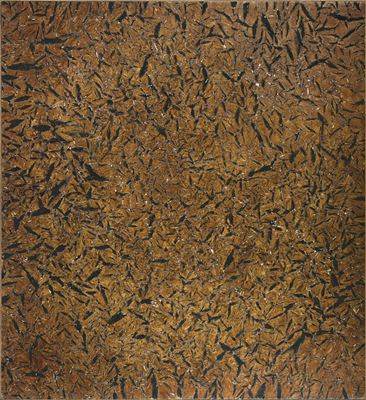
Exhibits, at the Galerie Kléber, Peintures Mariales, from the suite entitled, Le mur dits : Manteaux de la Vierge [Walls or Mantles of the Virgin]. Once the canvas has been folded (or more precisely, crumpled from edge to edge), all visible parts are painted. The canvas is then unfolded and stretched, revealing an all-over surface traversed by areas of reserve.
Finished paintings are identified by a letter indicating the folding "method" employed in their making (A for uniformly folded canvases, B for monochromes, C for twice-folded canvases, and D for canvases dripped or splashed with paint prior to the folding process), followed by a number indicating the order.
1963-1964
In the series called La Porte, dits: les Catamurons [The Door, or Catamurons] - inspired by the name of a place and the image of a towel on a white wall - the folded canvas is painted, then covered again with a layer of white paint; next, the four edges of the canvas are folded back, and the remaining square crumpled anew and again painted several times. Sometimes, the four sides are folded without being painted or primed.
1964-1965
The suite Maman! Maman!, dits: La Saucisse [Mummy! Mummy! called The Sausage] reflects Hantaï's interest in the work of French poet Henri Michaux and the latter's notion of the "cosmic sausage" - i.e., the need to go back to an embryonic, cellular level and build anew from there, refusing preconceived formal solutions. The canvas is knotted in four corners to make a formless sack or pouch, then painted and folded several times over before being unfolded and stretched. The forms thus obtained float in the unpainted space. These works are later called Panses (Paunches).
1965
Two exhibitions at the Galerie Jean Fournier take place in Paris: "138 peintures de petit format, jalons des années 1962 - 1965" and "12 peintures récentes de grand format."
1967
Hantaï begins work on a new series, called Meuns, after the hamlet in the Forêt de Fontainebleau where he had moved with his family in 1965. The canvas is knotted in the corners, around the periphery, and sometimes in the center, then covered with monochrome paint. White, already prominent around the edges, now penetrates the form.
For the exhibition "Peintures 1960 - 1967," at Galerie Jean Fournier, Hantaï publishes a text "Silences rétiniens" [Retinal Silences], in which he gives the generic title Peintures mariales to all four of the 1960-62 suites and introduces the formula, "Folding as Method."
1967
Participates in the exhibition "Dix ans d'art vivant (1955-1965)" at the Fondation Maeght in Saint-Paul de Vence, where he is the first artist laureate.
1968 - 1969
Solo show at the Fondation Maeght.
1969
At the Galerie Jean Fournier, the exhibition "Pour Pierre Reverdy" features the Etudes, variations on a formal and chromatic theme: the canvas is crumpled more or less evenly, then covered with a single color (red, blue, green, purple or black). After unfolding, the unpainted or "reserved" zones appear and interact with the painted zones across the canvas as a whole.
1970
"Etudes pour un mur," exhibition of very large-format canvases at ARC/Musée d'Art Moderne de la Ville de Paris.
Other exhibitions: "Art et architecture : bilan et problèmes du 1 %," Les Halles de Paris; "Un art subjectif," Abbaye de Beaulieu, Rouergue; and "Paintings, 1960 - 1970," Pierre Matisse Gallery, New York.
1971-72
Series of watercolours on canvas.
1972
Paints the wall for the Maison de France in Jerusalem.
Blancs series [Whites, 1972-73]: the folding is conceived in such a way that the limited zones of color activate the white areas and reveal the multiplicity of its composite values. Here the colored fragments play the role usually attributed to the unpainted parts.
Paints the first Tabulas (1972-74). The title refers to the Latin word for "table" and also evokes his mother's apron, or tablier. Knots placed at regular intervals produce, once the canvas has been covered with monochrome paint and then unfolded, a large number of small squares or rectangles. The grid-like effect, which is counter-balanced by the irregular "starring" of the white at the intersections, underscores the interaction between ground, color and form.
1973
Hantaï retrospective at the Musée d'Art et d'Industrie in Saint-Etienne.
1976
Jean-Michel Meurice makes the film Simon Hantaï ou Les Silences rétiniens. Exhibition at the Musée National d'Art Moderne, Paris.
Hantaï stops painting for three and a half years.
1979
Settles in Paris.
1980
Begins the second series of Tabulas (1980-82), which explore the relation between two tabular forms and their intervals at greatly increased dimensions.
1981
"Simon Hantaï 1960 - 76," his exhibition at the CAPC in Bordeaux, includes very large-format works.
1982
Represents France at the Venice Biennale with his Tabulas 1974-1981.
Exhibition: "Tabulas lilas" at Galerie Jean Fournier. In this series Hantaï paints Tabulas that are white on white.
Hantaï withdraws from exhibition.
1998
Exhibition: "Laissées et autre peintures" at Renn Espace, Paris. The Laissées ["Left-over" or "Remnant" paintings] are constituted of fragments cut from earlier works.
Exhibition: "Donation Simon Hantaï", commemorating an important gift by the painter to the Musée d'Art Moderne de la Ville de Paris.
Exhibition of works by Hantaï from the collections of the Musée National d'Art Moderne and other French public collections at the Musée d'Art Moderne, Céret
1999
Retrospective of works by Simon Hantaï from 1960 to 1995 at the Westfälisches Landesmuseum für Kunst und Kulturgeschichte, Münster.
2001
For the exhibition "Les Fables du Lieu," curated by Georges Didi-Huberman at Le Fresnoy in Tourcoing, Hantaï makes digital prints on canvas called Suaires [Shrouds]. These are based on the Tabulas Lilas exhibited in 1982.
Exhibition: "Simon Hantaï - Michel Parmentier," Musée National d'Art Moderne, Centre Georges Pompidou, Paris.
Hantaï's work features in the exhibition "As Painting: Division and Displacement," curated by Philip Armstrong, Laura Lisbon, and Stephen Melville at the Wexner Center for the Arts, Ohio State University, Columbus, Ohio.
2005
Exhibition: "Simon Hantaï - François Rouan, Conversation," Galerie Jean Fournier, Paris.
2006
March: Death of Jean Fournier. Major works by Hantaï are included in "La couleur toujours recommencée. Hommage à Jean Fournier, marchand à Paris (1922 - 2006)," an exhibition at the Musée Fabre, Montpellier, 2007.
2008
September: Death of Simon Hantaï at his home in Paris.
Exhibition catalogues
Simon Hantaï: Peintures 1960-67, Galerie Jean Fournier (Paris, 1967). Introduction by
Jean-François Revel, "Pour Hantaï."
Hantaï, Fondation Maeght (Saint Paul de Vence, 1968). Introduction by François
Mathey.
Hantaï. Paintings 1960 - 1970, Pierre Matisse Gallery (New York, 1970). Text by François
Mathey.
Hantaï. Paintings, Watercolors 1971 - 1975, Pierre Matisse Gallery (New York, 1975). Text by
Geneviève Bonnefoi.
Hantaï, Musée d'art et d'industrie (Saint-Etienne, 1973). Texts by Daniel Abadie, "Les
réserves de la peinture," and Alfred Pacquement, "Le pliage comme méthode. "
Hantaï, Musée national d'art moderne (Paris, 1976). Introduction by Pontus Hulten,
Foreword by François Mathey. Texts by Dominique Fourcade, "Un coup de
pinceau c'est la pensée" and Marcelin Pleynet, "La levée et l'interprétation des signes ou Les manteaux de la Vierge."
Hantaï 1960-76, Centre d'Arts Plastiques Contemporains de Bordeaux (Bordeaux, 1981).
Texts by Jean-Louis Froment, "Simon Hantaï, légendes," Marcelin Pleynet, "Simon Hantaï là aujourd'hui où c'était," and Jean-Marc Poinsot, "L'œuvre de Simon Hantaï."
Tendances de l'art en France 1968-1978-9: Les partis pris de Marcelin Pleynet, ARC,
Musée d'art moderne de la Ville de Paris (Paris, 1979).
Simon Hantaï, Venice Bienal (Paris, 1982). Introduction by Dominique Bozo. Text by
Yves Michaud, "Métaphysique de Hantaï."
Hantaï, ARCA (Marseilles, 1983). Text by Marcelin Pleynet, "Identité de la lumière."
Donation Simon Hantaï, Musée d'art moderne de la Ville de Paris (Paris, 1998).
Introduction by Suzanne Pagé. Texts by Alain Cueff, "Simon Hantaï—Le dépli
de l'horizon du pli," and Marcelin Pleynet, "Perspectives du temps dans l'œuvre
de Simon Hantaï." Includes notes by Simon Hantaï.
Hantaï: Collections du Centre Georges Pompidou, Musée de Céret (Paris, 1998).
Introduction by Nadine Pouillon and Joséphine Matamoros. Text by Eric de Chassey.
Simon Hantaï: Werke von 1960 bis 1995, Westfälisches Landesmuseum für Kunst und
Kulturgeschichte (Münster, 1999). Foreword by Klaus Bussmann. Texts by
Heinz Knobeloch, "Die Falten entfalten"; Erich Franz, "Die active Neutralität
des Dazwischen"; and Alfred Pacquement, "In ständigem Wandel, Fragmente (für Simn Hantaï).", Simon Hantaï, "Briefe und Notizen".
La peinture après l'abstraction, 1955-1975, Musée d'art moderne de la Ville de Paris (Paris,
1999). Introduction by Suzanne Pagé. Texts by Alain Cueff, "La peinture après
l'Abstraction, 1955 - 1975" and "La peinture "réinventée"." ; by Benjamin H.D.
Buchloh "Hantaï / Villeglé et la dialectique de la dispersion de la peinture." ; by Ann
Hindry, "Le ravissement du sujet." ; and by Robert Fleck "Une même rupture
historique.".
Fables du lieu, Le Fresnoy (Fresnoy, 2001). Introduction by Alain Fleischer. Text by
Georges Didi-Huberman.
As Painting: Division and Displacement, Wexner Center for the Arts, The Ohio State University
(Columbus, 2001). Foreword by Sherri Geldin. Texts by Stephen Melville, "Counting/As/Painting"; Philip Armstrong and Laura Lisbon, "As Painting: Problematics." Entry on Simon Hantaï by Stephen Melville. Includes a selection of French criticism in translation.
Simon Hantaï/François Rouan: Conversation, Galerie Jean Fournier (Paris, 2005). Text
by Hubert Damisch, "Rencontre en champ/contrechamp: La peinture en mal
d'explic(it)ation."
La Couleur toujours recommencée: Hommage à Jean Fournier, marchand à Paris
(1922-2006), Musée Fabre (Arles, 2007). Foreword by Michel Hilaire. Texts by
Dominique Fourcade, "Scabieuses pour lui, " Alfred Pacquement, "Un marchand à Paris," Marcelin Pleynet, "Jean Fournier, maître d'œuvre, " Yves Michaud, "Une partie de chemin avec Jean Fournier," Pierre Wat, "La maison."
Ils ont regardé Matisse: Une réception abstraite États-Unis/Europe 1948-1968, Musée
Départemental Matisse (Cateau-Cambrésis, 2009). Preface by Dominique Szymusiak
and Émilie Ovaere. Chronology by Lucile Encrevé. Texts by Éric de Chassey, "The Matisse Effect: Abstraction and Decoration"; Émilie Ovaere, "The Love of Materials for Their Own Sake"; Karim Ghaddab, "Vénus Striptease."
Selected Bibliography
Clair, Jean. "Simon Hantaï" Art en France, une nouvelle génération (Paris, Éditions du Chêne,
1972) : 93-96.
Bonnefoi, Geneviève. Hantaï (Artistes d'Aujourd'hui, Collection de Beaulieu, Montauban,
1973).
Rodgers, Paul. "Towards a Theory/Practice of Painting in France", parts 1 and 2, Artforum 17,
no. 8 (April 1979), and Artforum 18, no 7 (March 1980).
Semin, Didier, "Hantaï regardé dans le blanc de la peinture" Arstudio no. 1 (Summer 1986):
20 - 25
Baldassari, Anne. Simon Hantaï (Jalons. Collections du Musée National d'Art Moderne et du
Centre de Creation Industrielle, Éditions du Centre Georges Pompidou, Paris, 1992).
Millet, Catherine. "Le Choix de Simon Hantaï" Artpress special issue no.15 (1994): 56-59.
Millet, Catherine. "Tableaux récents" Artpress special issue no.16 (1995): 154-156.
Ghaddab, Karim. "Simon Hantaï, la fente peinte en point de fuite." Art press 233 (March
1998): 26-31.
Didi-Huberman, Georges. L'Étoilement: Conversation avec Hantaï (Les éditions de Minuit,
Paris, 1998).
McDonough, Tom. "Hantaï's Challenge to Painting" Art in America (March 1999): 96 - 99
Sjölin, Hans Gunnar. "Writing the Painting: Materials for a Study of Simon Hantaï's
Work 1953-1959," Konsthistorisk Tidskrift 70 (2001): 130-56.
Derrida, Jacques, Jean-Luc Nancy, and Simon Hantaï. La connaissance des textes:
lecture d'un manuscrit illisible (Éditions Galilée, Paris, 2001).
Singerman, Howard. "Non-Compositional Effects, or the Process of Painting in 1970,"
Oxford Art Journal 26 (2003): 125-50.
"Dossier Simon Hantaï." La Part de l'Œil: Revue de pensée des arts plastiques no. 20 (2004-
2005) : 27-53. Texts by Jean-Luc Nancy, "Hantaï 1958: 'La peinture se dépouillait…'" and Simon Hantaï, "Notes confusionelles accélérantes et autres pour une avant-garde 'réactionnaire' non réductible."
Fourcade, Dominique. sans lasso et sans flash (Éditions P.O.L., Paris, 2005).
Cixous, Hélène, Le Tablier de Simon Hantaï. Annagrammes suivi de H.C. S.H. lettres (Éditions
Galilée, Paris, 2005).
Warnock, Molly. Pensée par la peinture : l'œuvre de Simon Hantaï (forthcoming from
Gallimard, Paris, 2010).
Film
Meurice, Jean-Michel. Simon Hantaï ou Les Silences rétiniens, 1976.