Page loaded successfully. Showing biography for Stanislaw Borysowski.
Stanislaw Borysowski BIOGRAPHY
1906 - 1988. Known for: Painting.
The work of Stanislaw Borysowski matured in the orbit of the Krakow art scene in the 1920s and 1930s. The painter studied at the local Academy of Fine Arts in 1926-31. He was a student of Wladyslaw... Read full biography
The work of Stanislaw Borysowski matured in the orbit of the Krakow art scene in the 1920s and 1930s. The painter studied at the local Academy of Fine Arts in 1926-31. He was a student of Wladyslaw Jarocki, Ignacy Pienkowski and Stanislaw Kamocki. In 1933-34, under the auspices of Józef Pankiewicz,... Read full biography
The work of Stanislaw Borysowski matured in the orbit of the Krakow art scene in the 1920s and 1930s. The painter studied at the local Academy of Fine Arts in 1926-31. He was a student of Wladyslaw Jarocki, Ignacy Pienkowski and Stanislaw Kamocki. In 1933-34, under the auspices of Józef Pankiewicz, he trained in the Paris branch of the Krakow academy. In 1932 he received a scholarship from the National Culture Fund in Italy. From the time of World War II, Stanislaw Borysowski was associated... Read full biography
The work of Stanislaw Borysowski matured in the orbit of the Krakow art scene in the 1920s and 1930s. The painter studied at the local Academy of Fine Arts in 1926-31. He was a student of Wladyslaw Jarocki, Ignacy Pienkowski and Stanislaw Kamocki. In 1933-34, under the auspices of Józef Pankiewicz, he trained in the Paris branch of the Krakow academy. In 1932 he received a scholarship from the National Culture Fund in Italy. From the time of World War II, Stanislaw Borysowski was associated with the most important artistic centers in the country, both in practical and academic terms - from 1946 he was a professor and head of the Department of Painting at the Faculty of Fine Arts of the Nicolaus Copernicus University in Torun. In 1953,... Read full biography
The work of Stanislaw Borysowski matured in the orbit of the Krakow art scene in the 1920s and 1930s. The painter studied at the local Academy of Fine Arts in 1926-31. He was a student of Wladyslaw Jarocki, Ignacy Pienkowski and Stanislaw Kamocki. In 1933-34, under the auspices of Józef Pankiewicz, he trained in the Paris branch of the Krakow academy. In 1932 he received a scholarship from the National Culture Fund in Italy. From the time of World War II, Stanislaw Borysowski was associated with the most important artistic centers in the country, both in practical and academic terms - from 1946 he was a professor and head of the Department of Painting at the Faculty of Fine Arts of the Nicolaus Copernicus University in Torun. In 1953, together with other colorists, he moved to the coast, where in the years 1954-72 he was the dean of the Faculty of Painting at the State Highe... Read full biography
Artist Biography
Biography page for Stanislaw Borysowski ((1906 - 1988)), known for Painting. Showing 1 biographical entries and 0 sample artworks.
Stanislaw Borysowski - Artist Info
About Stanislaw Borysowski
Biography from Desa Unicum
The work of Stanislaw Borysowski matured in the orbit of the Krakow art scene in the 1920s and 1930s. The painter studied at the local Academy of Fine Arts in 1926-31. He was a student of Wladyslaw Jarocki, Ignacy Pienkowski and Stanislaw Kamocki. In 1933-34, under the auspices of Józef Pankiewicz, he trained in the Paris branch of the Krakow academy.
In 1932 he received a scholarship from the National Culture Fund in Italy. From the time of World War II, Stanislaw Borysowski was associated with the most important artistic centers in the country, both in practical and academic terms - from 1946 he was a professor and head of the Department of Painting at the Faculty of Fine Arts of the Nicolaus Copernicus University in Torun. In 1953, together with other colorists, he moved to the coast, where in the years 1954-72 he was the dean of the Faculty of Painting at the State Higher School of Fine Arts.
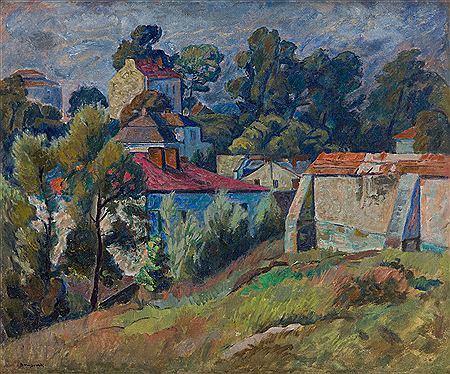
Stanislaw Borysowski is considered to be one of the artists particularly sensitive to the issue of color and light. Against the background of others, he was distinguished by a lively passion and, as is often indicated in literature, by the sensuality of attacking reality. The artist expressed himself with sweeping brushstrokes and saturated, often contrasting, colors.
Until around 1955, the artist remained faithful to themes characteristic of colourists, painting landscapes, interiors and still lifes. With time, he moved away from figuration and began to create abstract compositions, in which, however, he often included subject suggestions. The paintings were built of clearly defined, flat fields, varied in color, value and texture,