Page loaded successfully. Showing biography for Stanislaw Ignacy Witkiewicz.
Stanislaw Ignacy Witkiewicz BIOGRAPHY
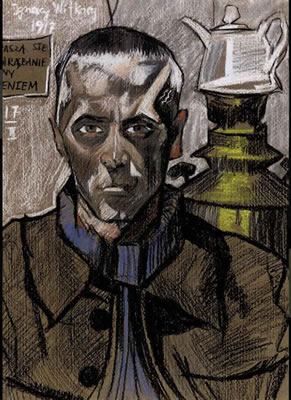
1885 Zakopane, Poland - 1939 Jeziory, Poland. Known for: Pastel portrait painting, expedition artist, photography, writing.
Born February 24, 1885, Stanislaw Ignacy Witkiewicz, commonly known as Witkacy, was a Polish writer, painter,philosopher, playwright, novelist, and photographer. Born in Warsaw, he was a son of the... Read full biography
Born February 24, 1885, Stanislaw Ignacy Witkiewicz, commonly known as Witkacy, was a Polish writer, painter,philosopher, playwright, novelist, and photographer. Born in Warsaw, he was a son of the painter, architect and an art critic Stanislaw Witkiewicz. His mother was Maria Pietrzkiewicz... Read full biography
Born February 24, 1885, Stanislaw Ignacy Witkiewicz, commonly known as Witkacy, was a Polish writer, painter,philosopher, playwright, novelist, and photographer. Born in Warsaw, he was a son of the painter, architect and an art critic Stanislaw Witkiewicz. His mother was Maria Pietrzkiewicz Witkiewiczowa. Both of his parents were born in the Samogitian region of Lithuania. His godmother was the internationally famous actress Helena Modrzejewska. Witkiewicz was reared at the family home in... Read full biography
Born February 24, 1885, Stanislaw Ignacy Witkiewicz, commonly known as Witkacy, was a Polish writer, painter,philosopher, playwright, novelist, and photographer. Born in Warsaw, he was a son of the painter, architect and an art critic Stanislaw Witkiewicz. His mother was Maria Pietrzkiewicz Witkiewiczowa. Both of his parents were born in the Samogitian region of Lithuania. His godmother was the internationally famous actress Helena Modrzejewska. Witkiewicz was reared at the family home in Zakopane. In accordance with his father's antipathy to the "servitude of the school," the boy was home-schooled and encouraged to develop his talents across a range of creative fields. Witkiewicz was close friends with Karol Szymanowski and, from... Read full biography
Born February 24, 1885, Stanislaw Ignacy Witkiewicz, commonly known as Witkacy, was a Polish writer, painter,philosopher, playwright, novelist, and photographer. Born in Warsaw, he was a son of the painter, architect and an art critic Stanislaw Witkiewicz. His mother was Maria Pietrzkiewicz Witkiewiczowa. Both of his parents were born in the Samogitian region of Lithuania. His godmother was the internationally famous actress Helena Modrzejewska. Witkiewicz was reared at the family home in Zakopane. In accordance with his father's antipathy to the "servitude of the school," the boy was home-schooled and encouraged to develop his talents across a range of creative fields. Witkiewicz was close friends with Karol Szymanowski and, from childhood, with Bronislaw Malinowski and Zofia Romer. Following a crisis in Witki... Read full biography
Artist Biography
Biography page for Stanislaw Ignacy Witkiewicz ((1885 - 1939)), known for Pastel portrait painting, expedition artist, photography, writing. Showing 4 biographical entries and 0 sample artworks.
Stanislaw Ignacy Witkiewicz - Artist Info
About Stanislaw Ignacy Witkiewicz
Name variants
Witkacy, Stanislaw Witkiewicz
Biography from the Archives of askART
 Born February 24, 1885, Stanislaw Ignacy Witkiewicz, commonly known as Witkacy, was a Polish writer, painter,philosopher, playwright, novelist, and photographer.
Born in Warsaw, he was a son of the painter, architect and an art critic Stanislaw Witkiewicz. His mother was Maria Pietrzkiewicz Witkiewiczowa. Both of his parents were born in the Samogitian region of Lithuania. His godmother was the internationally famous actress Helena Modrzejewska.
Witkiewicz was reared at the family home in Zakopane. In accordance with his father's antipathy to the "servitude of the school," the boy was home-schooled and encouraged to develop his talents across a range of creative fields.
Witkiewicz was close friends with Karol Szymanowski and, from childhood, with Bronislaw Malinowski and Zofia Romer. Following a crisis in Witkiewicz's personal life due to the suicide of his fiancée Jadwiga Janczewska, he was invited by Malinowski to act as draftsman and photographer on a 1914 expedition to Oceania, a venture that was interrupted by the onset of World War I.
On his return, Witkiewicz, a citizen of the Russian Empire, went to St Petersburg and was commissioned an officer in the Imperial army. His ailing father, a Polish nationalist, was deeply grieved by the youngster's decision and died in 1915 without seeing his son again.
Witkiewicz lived through the Russian Revolution in St Petersburg. He claimed that he worked out his philosophical principles during an artillery barrage, and that when the Revolution broke out he was elected political commissar of his regiment. His later works would show his fear of social revolution and foreign invasion, often couched in absurdist language.
He had begun to support himself through portrait painting and continued to do so on his return to Zakopane in Poland. He soon entered into a major creative phase, setting out his principles in New Forms in Painting and Introduction to the Theory of Pure Form in the Theatre. He associated with a group of "formist" artists in the early 1920s and wrote most of his plays during this period. Of about forty plays written by Witkiewicz between 1918 and 1925, twenty-one survive, and only Jan Maciej Karol Hellcat met with any public success during the author's lifetime. The original Polish manuscript of The Crazy Locomotive was also lost; the play, back-translated from two French versions, was not published until 1962.
After 1925, and taking the name 'Witkacy', the artist ironically re-branded the paintings which provided his economic sustenance as The S.I. Witkiewicz Portrait Painting Firm, with the motto: "The customer must always be satisfied". Several grades of portrait were offered, from the merely representational to the more expressionistic and the narcotics assisted. Many of his paintings were annotated with mnemonics listing the drugs taken while painting a particular painting, even if this happened to be only a cup of coffee. He also varied the spelling of his name, signing himself Witkac, Witkatze, Witkacjusz, Vitkacius and Vitecasse — the last being French for "breaks quickly".
In the late 1920s he turned to the novel, writing two works, Farewell to Autumn and Insatiability. The latter major work encompasses geopolitics, psychoactive drugs, and philosophy. In 1935 he was awarded the Golden Laurel of the Polish Academy of Literature for his novels.
During the 1930s, Witkiewicz published a text on his experiences of narcotics, including peyote, and pursued his interests in philosophy. He also promoted emerging writers such as Bruno Schulz. Shortly after Poland was invaded by Germany in September 1939, he escaped with his young lover Czeslawa to the rural frontier town of Jeziory, in what was then eastern Poland. After hearing the news of the Soviet invasion of Poland on 17 September 1939, Witkacy committed suicide on 18 September by taking a drug overdose and trying to slit his wrists. He convinced Czeslawa to attempt suicide with him by consuming Luminal, but she survived.
Witkiewicz had died in some obscurity but his reputation began to rise soon after the war, which had destroyed his life and devastated Poland. Czeslaw Milosz framed his argument in The Captive Mind around a discussion of Witkiewicz's novel, Insatiability. The artist and theater director Tadeusz Kantor was inspired by the Cricot group, through which Witkiewicz had presented his final plays in Kraków. Kantor brought many of the plays back into currency, first in Poland and then internationally.
In the postwar period, Communist Poland's Ministry of Culture decided to exhume Witkiewicz's body, move it to Zakopane, and give it a solemn funeral. This was carried out according to plan, though no one was allowed to open the coffin that had been delivered by the Soviet authorities.
On 26 November 1994, the Polish Ministry of Culture and Art ordered the exhumation of the presumed grave of Witkiewicz in Zakopane. Genetic tests on the remaining bones proved that the body had belonged to an unknown woman — a final absurdist joke, fifty years after the publication of Witkacy's last novel.
Source:
wikipedia.orgBiography from Sopocki Dom Aukcyjny
Stanislaw Ignacy Witkiewicz, known by his artistic pseudonym Witkacy, was a Polish painter, critic, and writer who flourished in the 20th century. He was a student of the Tsarist Page Corps in St. Petersburg and an officer in the Tsarist Guard during World War I. Witkacy was an art theoretician, known for his Formist theory and contributions to the "Pure Form" theory. He believed in the expression of "metaphysical feeling" through artistic creation. Witkacy's early works were described as intermediate between modernism and surrealism, but he later gained worldwide fame through his literary works. He tragically committed suicide in 1939 in response to the Soviet invasion of Poland, which he saw as the end of civilization.Biography from Kunsthaus Lempertz
Stanislaw Ignacy Witkiewicz (Witkacy) was a writer, philosopher and artist blessed with a number of creative talents. In 1924 Witkacy founded the company “S.I. Witkiewicz”, in whose name he accepted portrait commissions in order to support himself financially. As his only employee he personally compiled something like a set of contractual guidelines for his clients, containing 17 paragraphs.
These dictated, for example, that clients had no right to have the work destroyed if they were unsatisfied, that they were not allowed to see it before completion, that they were to appear punctually as models and that they were not allowed to express any criticism of the final artistic product.
In addition, Witkacy defined seven types of portraits: clients could choose among them and the price was also determined according to them (cf. Stanislaw Ignacy Witkiewicz, Rules of the S.I. Witkiewicz Portrait-Painting Firm, Warschau 1932 [trans. from Polish by Beata Zgodzinska and Beata Brodniewicz], cited in: The Polish Journal of Aesthetics, vol. 31 4/2014, pp. 53-58).
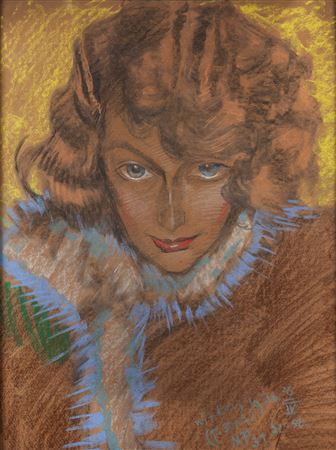
The artist often consumed various stimulants or other drugs during the process of creating his work, and he always placed their abbreviations prominently in his pictures, together with his signature, the date and the selected portrait type.
The inscription on our intense portrait indicates that Witkacy found himself in a more abstinent phase of his work and that, in the context of this portrait's production, he did not smoke (“NP”), did not drink alcohol (“NTT”) and did drink tea (“herb.”) (cf. Stanislaw Ignacy Witkiewicz, Narcotics - Nicotine, Alcohol, Cocaine, Peyote, Morphine, Ether + Appendices, Prag 2018, trans. from Polish by Soren Gauger, pp. 9 f.).
As a type “B+d”, this work brings out the character of the female model and simultaneously underscores her beauty. Portraits from this category can display caricature-like tendencies, for example, in the slight enlargement of individual passages of the face (cf. op. cit., pp. 54-58).
Witkacy put an end to his life with a decisiveness resembling that of his personal perspective on art. Fleeing from advancing German troops, he died in 1939 from an overdose of sleeping pills. His lover Czeslawa Okninska survived the attempted double suicide.Biography from Agra Art S.A.
Stanislaw Ignacy Witkiewicz was a painter, art theorist, writer, playwright, and philosopher. He was the son of Stanislaw Witkiewicz, the painter and art theorist. He studied in Fine Art Academy in Cracow at Josef Mehoffer (1905-1909), and made several trips to Italy, France and Germany during this period.
In 1914 he took part in the expedition to Australia led by the famous ethnographer Bronislaw Malinowski. In 1914-1918 he lived in St.Petersburg serving in Russian Army as an officer. From this period come the first pastel works, portraits and expressionist compositions.
In the years 1918-1924 Witkiewicz joined the group "Formists", creating oil compositions according to, and invented by himself, the theory of "pure form". After 1924 he limited his work to "Portrait manufacture of S.I.Witkiewicz", creating pastel portraits of 5 basic types: A,B,C,D. He used to portrait famous people of the time.
In 1928-1932 Witkiewicz experimented with drug effect to painting, using drugs like cocaine or peyotl on himself and painting. His works of this period often bear artist's mention about the kind and dose of drugs he was using when working at the painting.