Page loaded successfully. Showing biography for Stephane Mandelbaum.
Stephane Mandelbaum BIOGRAPHY
1961 Brussels, Belgium - 1986. Known for: Disfigured self portralits, drawings, cartoons, paintings.
"Stéphane Mandelbaum, Edgy Art and a Life Violently Cut Short," Art & Design Section, The New York Times, by Jason Farago, December 20, 2023. In 1980s Belgium, this Jewish artist dared to blur the... Read full biography
"Stéphane Mandelbaum, Edgy Art and a Life Violently Cut Short," Art & Design Section, The New York Times, by Jason Farago, December 20, 2023. In 1980s Belgium, this Jewish artist dared to blur the lines between victims and villains. A bracing retrospective is now at the Drawing Center. (see below).... Read full biography
"Stéphane Mandelbaum, Edgy Art and a Life Violently Cut Short," Art & Design Section, The New York Times, by Jason Farago, December 20, 2023. In 1980s Belgium, this Jewish artist dared to blur the lines between victims and villains. A bracing retrospective is now at the Drawing Center. (see below). Egon Schiele or Ana Mendieta, Amy Winehouse or the Notorious B.I.G.: When an artist dies young, dies dreadfully, it can be hard not to project the end onto all that came before. With the Belgian... Read full biography
"Stéphane Mandelbaum, Edgy Art and a Life Violently Cut Short," Art & Design Section, The New York Times, by Jason Farago, December 20, 2023. In 1980s Belgium, this Jewish artist dared to blur the lines between victims and villains. A bracing retrospective is now at the Drawing Center. (see below). Egon Schiele or Ana Mendieta, Amy Winehouse or the Notorious B.I.G.: When an artist dies young, dies dreadfully, it can be hard not to project the end onto all that came before. With the Belgian artist Stéphane Mandelbaum, the subject of a jolting retrospective at the Drawing Center, the trouble is the same. In the early 1980s, he frantically drew disfigured self-portraits, fraught images of Jews and Nazis, and scenes of seedy Brussels... Read full biography
"Stéphane Mandelbaum, Edgy Art and a Life Violently Cut Short," Art & Design Section, The New York Times, by Jason Farago, December 20, 2023. In 1980s Belgium, this Jewish artist dared to blur the lines between victims and villains. A bracing retrospective is now at the Drawing Center. (see below). Egon Schiele or Ana Mendieta, Amy Winehouse or the Notorious B.I.G.: When an artist dies young, dies dreadfully, it can be hard not to project the end onto all that came before. With the Belgian artist Stéphane Mandelbaum, the subject of a jolting retrospective at the Drawing Center, the trouble is the same. In the early 1980s, he frantically drew disfigured self-portraits, fraught images of Jews and Nazis, and scenes of seedy Brussels nightlife. He worked at large scale, though with nothing fancier than... Read full biography
Artist Biography
Biography page for Stephane Mandelbaum ((1961 - 1986)), known for Disfigured self portralits, drawings, cartoons, paintings. Showing 3 biographical entries and 0 sample artworks.
Stephane Mandelbaum - Artist Info
About Stephane Mandelbaum
Biography from the Archives of askART
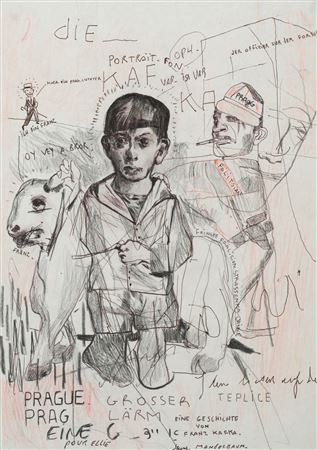
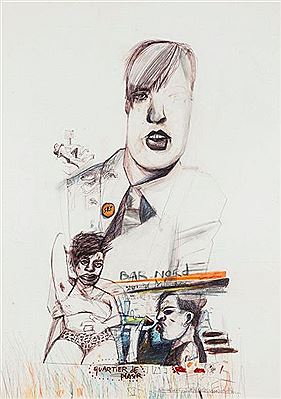 "Stéphane Mandelbaum, Edgy Art and a Life Violently Cut Short," Art & Design Section, The New York Times, by Jason Farago, December 20, 2023.In 1980s Belgium, this Jewish artist dared to blur the lines between victims and villains. A bracing retrospective is now at the Drawing Center. (see below)Egon Schiele or Ana Mendieta, Amy Winehouse or the Notorious B.I.G.: When an artist dies young, dies dreadfully, it can be hard not to project the end onto all that came before. With the Belgian artist Stéphane Mandelbaum, the subject of a jolting retrospective at the Drawing Center, the trouble is the same.In the early 1980s, he frantically drew disfigured self-portraits, fraught images of Jews and Nazis, and scenes of seedy Brussels nightlife. He worked at large scale, though with nothing fancier than a ballpoint pen; his drawings were a little punk but a lot more tragic; he faced down the history of the Holocaust, as well as the legacy of Belgian colonialism, with a frankness and fearlessness that only a few artists could muster.He was something of a savant — as well as a fabulist and a house burglar, who got mixed up in the theft of a Modigliani that turned out to be a fake. At the start of 1987, children at play found his corpse in a vacant lot, his face disfigured by splashes of acid. He was 25.Debauched, nefarious, weirdly tender and impressively hard to shake, this is the first American solo exhibition of Mandelbaum’s drawings, following eye-opening shows in Paris and Frankfurt. (It has been organized by Laura Hoptman, the center’s director, and comes with the first English-language publication on his work.) It includes grandly proportioned portraits of family members, celebrities, and both Jews and Nazis, as well as notebook pages dense with Third Reich death camps, Central African statuary, a hangman’s noose, and the names of women he’d slept with (or tried to). There are gnarled and often obscene annotations, in French and also in Yiddish; there are pornographic clippings and all sorts of slurs.
No denying this is a young man’s art, a life’s work compressed into someone’s early 20s. Yet the historical force of these drawings outstrips their youthful preoccupations, and they offer a burning riposte — Who am I? Who made me this? — to the safety and self-confidence of so much autobiographical art today.
Stéphane Mandelbaum was born in Brussels in 1961 into a family of artists and illustrators. (His father, the painter Arié Mandelbaum, had a show earlier this year at the Jewish Museum in Brussels.) He was not raised in the Jewish faith, but he grew close to his grandfather, Szulim (Salomon) Mandelbaum, a Polish immigrant who survived the Holocaust. In two drawings here of his grandfather, Salomon wears the impassive expression of an identity photograph. His shirt collar comes right up to his chin, and Mandelbaum’s dense and vigorous hatching makes his lips appear slashed or swollen. In the better of the two portraits, his grandfather’s face is drowning in a sheet of white, though Mandelbaum included dozens of little doodles to one side: Panzers, riflemen.
He studied boxing, he studied Yiddish, and he drew at a hectic pace. Bouncers and prostitutes and small-time gangsters appear with filthy annotations; Black and Turkish residents of Brussels, not to mention colonists in pith helmets, also recur in his scenes of clubs and bars. (Mandelbaum would marry a woman of Congolese descent and adopt her daughter; the artist traveled to what was then Zaire in 1986.) Pierre Goldman, a hero of the French left assassinated in broad daylight in 1979, became a larger-than-life inspiration to Mandelbaum, who dedicated one of his largest portraits to him, complete with collaged porn. He also constructed a pantheon of gay artist-outlaws: Arthur Rimbaud, Francis Bacon, Pier Paolo Pasolini, Yukio Mishima, Rainer Werner Fassbinder. The handsome Pasolini, himself murdered in 1975, is unrecognizable in Mandelbaum’s two portraits of him: hair thinned, cheeks distended, nose turned bulbous.A more disturbing gay doppelgänger is Ernst Röhm, the subject of two of Mandelbaum’s most sizable drawings. The founder of the Sturmabteilung (Hitler’s brown-shirted storm troopers) appears bloated and exhausted on both of these large sheets, though each drawing is more humane, and therefore scarier, than a caricature. In one of them the artist again uses heavy shading around the eyes and lips, and numerous eraser marks make him appear fractured, deliquescent. In the other the word “kosher” appears, in Hebrew letters, over the Nazi’s vest; an ejaculating phallus edges toward his swastika armband.In Mandelbaum’s hand, the Nazi officer bears an uncomfortable resemblance to the artist’s survivor grandfather. In fact everyone here, from Röhm to Pasolini to Goldman to the Bruxellois night owls, looks a little bit alike, with swollen cheeks, tired eyes, greasy hair, drunkards’ noses.The line between victim and oppressor, innocent and guilty, gets hopelessly blurred. Even the Holocaust, about which no moral ambiguity should be possible, became for Mandelbaum a wellspring of self-doubt and paranoia. When you look at his drawings of Joseph Goebbels in profile, midsentence in some hysterical rant, you cannot miss the resemblance to the open-mouthed profiles of Mandelbaum himself: as a gueule cassée, a mutilated survivor, who looks at the past and can do nothing but scream.This stuff is “beyond edgy,” as Hoptman acknowledges in an excellent catalog essay on drawing, identity, and the challenge of bearing witness to history.In a manner not unlike Kara Walker and Pope.L in this country, Mandelbaum saw his own identity not as solid ground but as something fraught and undisciplined, and you could hold off nightmares for only so long. The artist’s killing will always frame his reception, but there are six million earlier deaths that haunt his agitated, scornful, hard-to-shake pictures. And still, for Mandelbaum, the Nazi as much as the Jew was a possible avatar — because every drawing was a self-portrait, and art could be nothing else.Exhibition: Stéphane Mandelbaum Through Feb. 18, 2024 at the Drawing Center, 35 Wooster Street, SoHo; drawingcenter.org.Biography from Bonhams Brussels
Atypical, personal, moving, the work of Stéphane Mandelbaum fascinates well beyond the Belgian borders. As evidenced by the exhibition that the Center Pompidou is dedicating to him in 2019, and the one currently underway at the Drawing Center in New York.
The intimate work, which brings together his A4 format drawings made compulsively with a ballpoint pen on loose sheets, which he nicknamed his “scraboutchas”, are the expression of his most personal concerns. There we find the themes that have obsessed him since adolescence: the Shoah, Jewishness, sex, crime, etc.
He draws up inventories – furniture, clothing, African fetishes, revolvers – and lists – Nazi officers , survivors of the Shoah, concentration camps, murdered, suicides, artists or writers he admires – mixed with drawings of disarming expressiveness.
These themes compose a sort of personal mythology, between fiction and reality. They symbolize his spirit of revolt, his anger against anti-Semitism, refer to his identity as a gangster and the crimes he claims, up to the one which led to his assassination in 1986, the theft of a Modigliani.
The four drawings presented date from the year when he died at the age of 25, intense both artistically and biographically. In one of the drawings, he illustrates, in the style of 15th century portolan maps, the trip he made that year to the Congo, the country of origin of his wife Claudia. He brought back statuettes, which he quickly drew, alongside swastikas and Yiddish words affirming his Jewish roots.Biography from Les Ventes Ferraton-Damien Voglaire
Stephane Mandelbaum was born in 1961. A gifted, "bad boy", instinctive and beautiful cartoonist, painter close to Bacon, Soutine and Schiele, Stéphane Mandelbaum (1961-1986) died assassinated at the age of 25 in an obscure history of trafficking of works. The Center Pompidou organized a retrospective of the artist from March 6 to May 20, 2019.