Page loaded successfully. Showing biography for Susan Charna Rothenberg.
Susan Charna Rothenberg BIOGRAPHY
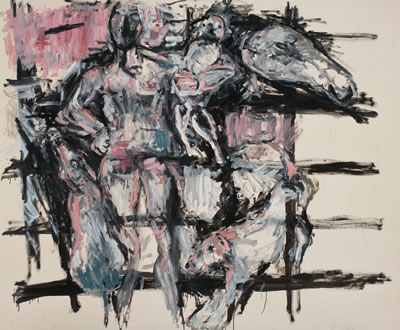
1945 Buffalo, New York - 2020 Galisteo, New Mexico. Known for: Modernist figure painting, horses, fragments, sculpture.
Susan Rothenberg, Acclaimed Figurative Painter, Dies at 75, Online obituary, The New York Times, by RAndy Kennedy, May 21, 2020. Her raw renditions of horses and other figures breathed new life into... Read full biography
Susan Rothenberg, Acclaimed Figurative Painter, Dies at 75, Online obituary, The New York Times, by RAndy Kennedy, May 21, 2020. Her raw renditions of horses and other figures breathed new life into painting when the genre was under siege in 1970s SoHo. Susan Rothenberg, whose flayed, lushly... Read full biography
Susan Rothenberg, Acclaimed Figurative Painter, Dies at 75, Online obituary, The New York Times, by RAndy Kennedy, May 21, 2020. Her raw renditions of horses and other figures breathed new life into painting when the genre was under siege in 1970s SoHo. Susan Rothenberg, whose flayed, lushly foreboding paintings radiated a Paleolithic grandeur and helped usher figuration back into an art world that had declared it extinct in the 1970s, died on Monday at her home in Galisteo, N.M. She was 75.... Read full biography
Susan Rothenberg, Acclaimed Figurative Painter, Dies at 75, Online obituary, The New York Times, by RAndy Kennedy, May 21, 2020. Her raw renditions of horses and other figures breathed new life into painting when the genre was under siege in 1970s SoHo. Susan Rothenberg, whose flayed, lushly foreboding paintings radiated a Paleolithic grandeur and helped usher figuration back into an art world that had declared it extinct in the 1970s, died on Monday at her home in Galisteo, N.M. She was 75. Her death was confirmed by the Sperone Westwater gallery, which has represented her for more than 30 years. A specific cause was not given, though she had been ill for some time. As an art student at Cornell University, Ms. Rothenberg dreamed of... Read full biography
Susan Rothenberg, Acclaimed Figurative Painter, Dies at 75, Online obituary, The New York Times, by RAndy Kennedy, May 21, 2020. Her raw renditions of horses and other figures breathed new life into painting when the genre was under siege in 1970s SoHo. Susan Rothenberg, whose flayed, lushly foreboding paintings radiated a Paleolithic grandeur and helped usher figuration back into an art world that had declared it extinct in the 1970s, died on Monday at her home in Galisteo, N.M. She was 75. Her death was confirmed by the Sperone Westwater gallery, which has represented her for more than 30 years. A specific cause was not given, though she had been ill for some time. As an art student at Cornell University, Ms. Rothenberg dreamed of becoming a sculptor but switched to painting after the head of the sculpture department flunked her, seemingly displeased w... Read full biography
Artist Biography
Biography page for Susan Charna Rothenberg ((1945 - 2020)), known for Modernist figure painting, horses, fragments, sculpture. Showing 2 biographical entries and 0 sample artworks.
Susan Charna Rothenberg - Artist Info
About Susan Charna Rothenberg
Biography from the Archives of askART
 Susan Rothenberg, Acclaimed Figurative Painter, Dies at 75, Online obituary, The New York Times, by RAndy Kennedy, May 21, 2020
Her raw renditions of horses and other figures breathed new life into painting when the genre was under siege in 1970s SoHo.
Susan Rothenberg, whose flayed, lushly foreboding paintings radiated a Paleolithic grandeur and helped usher figuration back into an art world that had declared it extinct in the 1970s, died on Monday at her home in Galisteo, N.M. She was 75.
Her death was confirmed by the Sperone Westwater gallery, which has represented her for more than 30 years. A specific cause was not given, though she had been ill for some time.
As an art student at Cornell University, Ms. Rothenberg dreamed of becoming a sculptor but switched to painting after the head of the sculpture department flunked her, seemingly displeased with fetishistic pieces resembling alarm clocks with teeth that she had made under the influence of Lucas Samaras.
“I was devastated,” she said in a 1992 interview with The Buffalo News. “It completely changed my life. I have no idea how I might have offended him.”
But the early discouragement fueled a resolve to push hard against received notions of painting in the late 1960s, when painting itself was being consigned to historical oblivion by the dominant movements of Minimalism* and Conceptualism*.
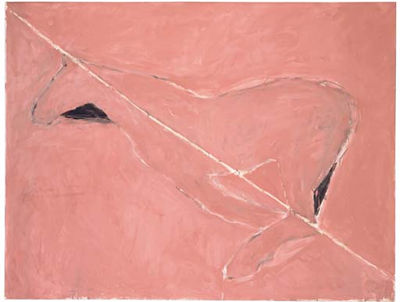
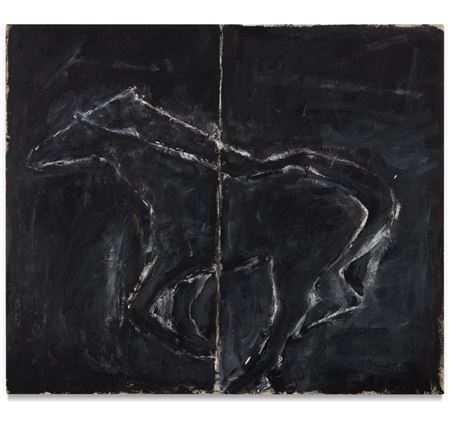
Her first solo show in 1975, at the ragtag experimental SoHo art space 112 Greene Street, consisted of three large, scabrous canvases depicting the pared-down form of a horse cleaved by a vertical or horizontal line. The paintings arrived from so out of the blue that they shocked many who saw them.
The critic Peter Schjeldahl wrote later that the show was a eureka moment, adding that “the mere reference to something actually existing was astonishing.” Hilton Kramer, the critic for The New York Times, whose tastes could be combatively conservative, praised her paintings to such a degree that, as Ms. Rothenberg recalled, “in the downtown art world I was commiserated with.”
Though she had no special affection for horses or even horse paintings, she chose the form, she said, as something like a stand-in for the figure, in the way Andy Warhol’s soup cans served as symbols of pop culture, or Jasper Johns’s flags and targets represented what he called “things the mind already knows.”
“But this image of a horse was also more emotionally charged,” she said in the 1992 interview. “People look at the image of a horse and they have associations — of power, movement, heaviness. It’s a living thing.”
In a 1987 oral history interview for the Archives of American Art, she added: “I wasn’t expecting much. I didn’t even know if they were any good.”
But within a year of the Greene Street show, she was represented by the prestigious Willard Gallery, and not long afterward William Rubin, the powerful director of the Museum of Modern Art’s painting and sculpture department, came to her tiny TriBeCa loft himself to select a painting for the collection.
“My home was my studio, and my bed and my kitchen; it was all in one space,” she said. “I had to pull out furniture and tables and my bed, and just put all of these horse paintings all over the studio.”
“He pointed his cane at them,” she added. “My mouth was wide open.”
Susan Charna Rothenberg was born on Jan. 20, 1945, in Buffalo, N.Y., to Adele (Cohen) Rothenberg, a president of the Buffalo Red Cross and one-time assistant to the city’s mayor, and Leonard Rothenberg, an owner of a supermarket chain.
Ms. Rothenberg took art lessons as a child but harbored no serious hopes of becoming a professional. She was a high-school cheerleader and a “party girl” in college, she said. After graduation she wandered for a couple of years, and then, as she told Grace Glueck in an article in The New York Times Magazine in 1984, she came up with the idea of penetrating deep into the Nova Scotia woods to “teach English in some backwater town.” But then, on another whim, she changed trains in Montreal for New York City.
Almost instantly she tapped into the churning SoHo* art crowd, working as an assistant to the sculptor Nancy Graves and participating in performances by Joan Jonas.
“I was so open and so receptive to all of this good stuff that poured right in,” said Ms. Rothenberg, who was once described by a writer as having a “golden laugh” tempered by “straight-on streetwise moxie.”
Through Ms. Jonas she met the sculptor George Trakas, and they were married at City Hall in 1971. Their daughter, Maggie, was born in 1972. The marriage ended in divorce in 1979, but Ms. Rothenberg and Mr. Trakas remained close.
Would you like recommendations for more stories like this?
Ms. Rothenberg moved into a loft on West Broadway that at various points was home to the artists Mary Heilmann, Richard Serra, Nancy Graves and Richard Lippold. In 1978, she was included in “New Image Painting,” a prescient exhibition at the Whitney Museum of American Art that put its finger on the turn toward experimental figurative painting then underway in New York.
By the 1980s, Ms. Rothenberg’s horse motif gave way to a multitude of other figures — heads, hands, boats, bones, birds, dogs, goats, human forms — in raw brushwork that had affinities with that of Giacometti, early Cy Twombly and late Philip Guston but was unmistakably her own.
She made several paintings depicting Piet Mondrian, whose work she admired deeply despite its elemental difference from hers. In her hands, Mondrian became a wiry specter, distant and poignant. “The viewer should be challenged away from it,” she told Ms. Glueck, “almost repelled by its stiffness and gassiness.”
Ms. Rothenberg chafed at often being the only woman included in group paintings shows, and in the 1980s she withdrew her work from exhibitions in which that was the case. “I’m not going to tell them who they should put in,” she said. “But from now on I won’t be the only woman.”
In 1988, the gallery owner Angela Westwater introduced Ms. Rothenberg to Bruce Nauman at a dinner party after a show of his artwork. Three months later the two were married.
Mr. Nauman had by then removed himself far from the art world and was living in rural Pecos, N.M., spending part of his time training quarter horses. Ms. Rothenberg relocated to New Mexico with him, and they worked in separate studios behind a modest house that they had designed for themselves in Galisteo, outside of Santa Fe.
After so many years in New York, Ms. Rothenberg said she enjoyed the peace and isolation of the Southwestern high desert. In a 2009 profile of the couple in The New Yorker, Calvin Tomkins wrote that a hand-lettered sign just inside her studio read: “Hi, honey. You’re home!”
Of Mr. Nauman, she said: “I’m very satisfied with him, and very happy living about 92 percent of my life by myself. I don’t think I’ll ever know Bruce, but he’s mine, and he’s a beauty.”
Mr. Nauman and Ms. Rothenberg’s daughter are her only immediate survivors.
Her work has been included in museum collections worldwide, and she was one of the artists who represented the United States in the 1980 Venice Biennale*. Major surveys of her work originated at the Albright-Knox Art Gallery in Buffalo in 1992 and the Modern Art Museum of Fort Worth in 2009.
In the 1984 Times Magazine interview, Ms. Rothenberg said she considered herself a groundbreaking artist partly in the sense that she had had the confidence to paint for herself.
“I almost feel I can take the most banal subject matter and made a good painting out of it,” she said. “Growth is more important to me than talent. I was not the best kid at art school, by any means. I’d love to know what that best kid is doing now.”___
For more in-depth information about these terms and others, see AskART.com. Glossary http://www.askart.com/AskART/lists/Art_Definition.aspxBiography from the Archives of askART
 Susan Rothenberg was born in Buffalo, New York on January 29, 1945, the daughter of a wealthy produce wholesaler. She started out studying sculpture at Cornell University, but she was told she had no talent and went off to a Greek island for five months.
She next tried the Corcoran School of Art, but was not satisfied there. She went to New York where she lucked out as a studio assistant to Nancy Graves. In 1971 she married the sculptor George Trakas and had a daughter, Maggie in 1972. She and Trakas divorced in 1979. She is married now to Bruce Nauman.
Rothenberg's best work involves timeless, almost mythical figures and symbols; her best is also her simplest. She is an instinctive painter with an unerring touch. When broken down to their constituent parts, many of her works are bizarre. Her standard characters include horses, dogs, birds; her works are littered with severed limbs, skulls and dead animals.
Written and submitted by Jean Ershler Schatz, artist and researcher from Laguna Woods, California.
Sources include:
Peter Plagens in Newsweek, February 22, 1993
Eleanor Heartney in Art News, October 1990
ARTnews magazine, February 1995
Who's Who in American Art, R.R. Bowker 1980