Page loaded successfully. Showing biography for Talal Chaibia.
Talal Chaibia BIOGRAPHY
1929 - 2004. Known for: Naive, bold color paintings and ink drawings on large canvases.
Moroccan Painter. The arrival of Chaïbia in the art world is quite a legend: several signs predestined the young woman. In a zaouia, a Muslim sanctuary, a blind and deaf woman told her that she had a... Read full biography
Moroccan Painter. The arrival of Chaïbia in the art world is quite a legend: several signs predestined the young woman. In a zaouia, a Muslim sanctuary, a blind and deaf woman told her that she had a hidden talent. One night, Chaïbia dreamt that voices urged her to pick up a canvas and paintbrush.... Read full biography
Moroccan Painter. The arrival of Chaïbia in the art world is quite a legend: several signs predestined the young woman. In a zaouia, a Muslim sanctuary, a blind and deaf woman told her that she had a hidden talent. One night, Chaïbia dreamt that voices urged her to pick up a canvas and paintbrush. The next day, encouraged by her artist son, she began painting with her fingers on cardboard and wood. Married at the age of 13, Chaïbia was a widowed mother by 15. To make a living, she cleaned wool.... Read full biography
Moroccan Painter. The arrival of Chaïbia in the art world is quite a legend: several signs predestined the young woman. In a zaouia, a Muslim sanctuary, a blind and deaf woman told her that she had a hidden talent. One night, Chaïbia dreamt that voices urged her to pick up a canvas and paintbrush. The next day, encouraged by her artist son, she began painting with her fingers on cardboard and wood. Married at the age of 13, Chaïbia was a widowed mother by 15. To make a living, she cleaned wool. She never went to school and was illiterate for all of her life. Her son had a painting studio. One day, the painter Ahmed Cherkaoui (1934–1967), accompanied by the curator and critic Pierre Gaudibert, visited the studio, where they discovered the... Read full biography
Moroccan Painter. The arrival of Chaïbia in the art world is quite a legend: several signs predestined the young woman. In a zaouia, a Muslim sanctuary, a blind and deaf woman told her that she had a hidden talent. One night, Chaïbia dreamt that voices urged her to pick up a canvas and paintbrush. The next day, encouraged by her artist son, she began painting with her fingers on cardboard and wood. Married at the age of 13, Chaïbia was a widowed mother by 15. To make a living, she cleaned wool. She never went to school and was illiterate for all of her life. Her son had a painting studio. One day, the painter Ahmed Cherkaoui (1934–1967), accompanied by the curator and critic Pierre Gaudibert, visited the studio, where they discovered the canvases of Chaïbia. Gaudibert encouraged her to exhibit her work. In 1966, her pieces were shown with success at the Goethe Inst... Read full biography
Artist Biography
Biography page for Talal Chaibia ((1929 - 2004)), known for Naive, bold color paintings and ink drawings on large canvases. Showing 2 biographical entries and 0 sample artworks.
Talal Chaibia - Artist Info
About Talal Chaibia
Name variants
Chaibiatallal Chaibiatallal, Chaibia Talal, Chaibia Tallal
Biography from the Archives of askART
 Moroccan Painter.
The arrival of Chaïbia in the art world is quite a legend: several signs predestined the young woman. In a zaouia, a Muslim sanctuary, a blind and deaf woman told her that she had a hidden talent. One night, Chaïbia dreamt that voices urged her to pick up a canvas and paintbrush. The next day, encouraged by her artist son, she began painting with her fingers on cardboard and wood.
Married at the age of 13, Chaïbia was a widowed mother by 15. To make a living, she cleaned wool. She never went to school and was illiterate for all of her life. Her son had a painting studio. One day, the painter Ahmed Cherkaoui (1934–1967), accompanied by the curator and critic Pierre Gaudibert, visited the studio, where they discovered the canvases of Chaïbia.
Gaudibert encouraged her to exhibit her work. In 1966, her pieces were shown with success at the Goethe Institut in Casablanca. Afterwards, she participated in important art brut exhibitions. Several people emphasized the closeness of her works to the Cobra group, and it is said that one day Guillaume Cornelis van Beverloo dropped to his knees before her paintings.
However, in Morocco the reception of her works was quite ambivalent. In the 1960s, the mostly male leaders of Moroccan artistic movements rejected her paintings, stating that they contributed to the underdeveloped image of Morocco.
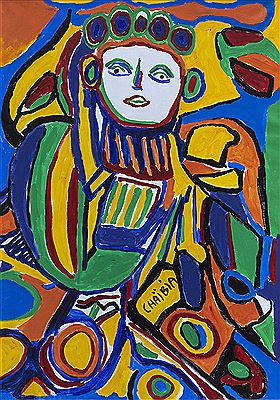
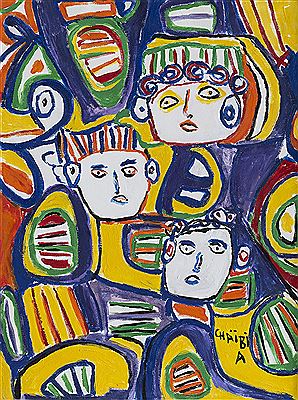
Self-taught painter and bold colourist, Chaïbia realised a body of work that can be considered spontaneous, naïve and sensorial. She painted outdoors, often on large canvases, in gouache and India ink.
She used colours as they came out of their tubes without mixing them, and it is this chromatism that is most important in her art. Applied on canvases often in large colour fields surrounded by black, her tones are at once vicious and effective. Their intuitive disposition recreates the universe in which the painter came to this world: the Moroccan countryside.
Chaïbia represents traditional protagonists in a number of portraits: the bride, the storyteller, the dancer, the young girl in Casablanca, amongst others. La Femme berbere is one of her first canvases and is perhaps a self-portrait: it depicts a frightened woman with her eyes closed who nonetheless seems about to express herself and, believing in the splendour of the colours, to express a very lively imagination. Humour is also an important part of her work. The taste for celebrations, such as the Moroccan fantasias, is also a recurring theme.
By Lamia Balafrej
Translated from French by Katia Porro.
From the Dictionnaire universel des créatrices
© 2013 Des femmes – Antoinette Fouque
© Archives of Women Artists, Research and ExhibitionsBiography from Sotheby's Doha
"During numerous interviews throughout her career, she [Chaibia Tallal] explained that she painted all that the vastness of the fields, the freshness of the rain, the smell of wet hay, and above all her incommensurable love for the sea, the earth, the rivers, the trees, the flowers, particularly daisies and poppies.
Due to this love, her fellow villagers nicknamed her mahbula, the holy fool. Nobody behaved as she did in Chtuka. Far from regretting her originality, she asserted throughout her life that it was important not be afraid of being different." Osire Glacier