Page loaded successfully. Showing biography for Theodor Axentowicz.
Theodor Axentowicz BIOGRAPHY
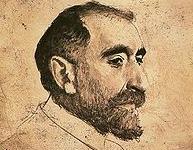
1859 Brasov, Romania - 1938 Krakow, Poland. Known for: Symbolist-inflected portraiture and genre scenes, often rendered in oil and pastel.
Teodor Axentowicz (Armenian: ?????? ??????????; May 13, 1859 in Bra?ov, Austrian Empire – August 26, 1938 in Kraków, Second Polish Republic) was a Polish-Armenian painter and university professor. A... Read full biography
Teodor Axentowicz (Armenian: ?????? ??????????; May 13, 1859 in Bra?ov, Austrian Empire – August 26, 1938 in Kraków, Second Polish Republic) was a Polish-Armenian painter and university professor. A renowned artist of his times, he was also the rector of the Academy of Fine Arts in Kraków. As an... Read full biography
Teodor Axentowicz (Armenian: ?????? ??????????; May 13, 1859 in Bra?ov, Austrian Empire – August 26, 1938 in Kraków, Second Polish Republic) was a Polish-Armenian painter and university professor. A renowned artist of his times, he was also the rector of the Academy of Fine Arts in Kraków. As an artist, Axentowicz was famous for his portraits and subtle scenes of Hutsul life, set in the Carpathians. Axentowicz was born May 13, 1859 in Bra?ov, Hungary (now Romania), to a family of... Read full biography
Teodor Axentowicz (Armenian: ?????? ??????????; May 13, 1859 in Bra?ov, Austrian Empire – August 26, 1938 in Kraków, Second Polish Republic) was a Polish-Armenian painter and university professor. A renowned artist of his times, he was also the rector of the Academy of Fine Arts in Kraków. As an artist, Axentowicz was famous for his portraits and subtle scenes of Hutsul life, set in the Carpathians. Axentowicz was born May 13, 1859 in Bra?ov, Hungary (now Romania), to a family of Polish-Armenian ancestry. In 1893 in Chelsea, London, he married Iza Henrietta Gielgud, aunt of Val Gielgud and John Gielgud of the theatrical dynasty. A son, Philip S.A.D. Axentowicz, was born in Chelsea in 1893. Between 1879 and 1882 he studied at the Academy of... Read full biography
Teodor Axentowicz (Armenian: ?????? ??????????; May 13, 1859 in Bra?ov, Austrian Empire – August 26, 1938 in Kraków, Second Polish Republic) was a Polish-Armenian painter and university professor. A renowned artist of his times, he was also the rector of the Academy of Fine Arts in Kraków. As an artist, Axentowicz was famous for his portraits and subtle scenes of Hutsul life, set in the Carpathians. Axentowicz was born May 13, 1859 in Bra?ov, Hungary (now Romania), to a family of Polish-Armenian ancestry. In 1893 in Chelsea, London, he married Iza Henrietta Gielgud, aunt of Val Gielgud and John Gielgud of the theatrical dynasty. A son, Philip S.A.D. Axentowicz, was born in Chelsea in 1893. Between 1879 and 1882 he studied at the Academy of Fine Arts in Munich. From there he moved to Paris, where he was a student of Carolus-Duran and continued his education until 1895. Durin... Read full biography
Artist Biography
Biography page for Theodor Axentowicz ((1859 - 1938)), known for Symbolist-inflected portraiture and genre scenes, often rendered in oil and pastel. Showing 5 biographical entries and 0 sample artworks.
Theodor Axentowicz - Artist Info
About Theodor Axentowicz
Name variants
Teodor Axentowicz
Biography from the Archives of askART
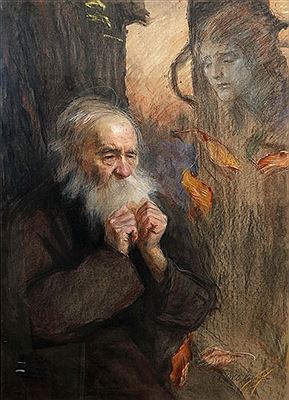 Teodor Axentowicz (Armenian: Թեոդոր Աքսենտովիչ; May 13, 1859 in Brașov, Austrian Empire – August 26, 1938 in Kraków, Second Polish Republic) was a Polish-Armenian painter and university professor. A renowned artist of his times, he was also the rector of the Academy of Fine Arts in Kraków. As an artist, Axentowicz was famous for his portraits and subtle scenes of Hutsul life, set in the Carpathians.
Axentowicz was born May 13, 1859 in Brașov, Hungary (now Romania), to a family of Polish-Armenian ancestry. In 1893 in Chelsea, London, he married Iza Henrietta Gielgud, aunt of Val Gielgud and John Gielgud of the theatrical dynasty. A son, Philip S.A.D. Axentowicz, was born in Chelsea in 1893.
Between 1879 and 1882 he studied at the Academy of Fine Arts in Munich. From there he moved to Paris, where he was a student of Carolus-Duran and continued his education until 1895. During that time he started a long-time cooperation with various journals and started his career as a copyist, duplicating the works of Tizian and Botticelli for Le Monde illustré.
He also made numerous travels to London and Rome, where he prepared a set of portraits, one of the first in his career.
In 1894 he started collaboration with Wojciech Kossak and Jan Styka during the preparation of the Racławice Panorama, one of the largest panoramic paintings in the history of Polish art. The following year he moved to Kraków, where he became a professor at the local Academy of Fine Arts. He was also active in the local society and cooperated with various societies devoted to propagation of arts and crafts.
In 1897 he founded an artistic conservatory for women and soon afterwards became one of the founders of the Sztuka society, whose members were such artists as Józef Chełmoński, Julian Fałat, Jacek Malczewski, Józef Mehoffer, Jan Stanisławski, Włodzimierz Tetmajer, Leon Wyczółkowski and Stanisław Wyspiański. In 1910 he became the rector of the Academy and since 1928 was also an honorary member of the Zachęta Society. He died August 26, 1938 in Kraków.
Throughout his life he had numerous exhibitions, both in Poland and abroad. He was awarded many gold metals at both national and international exhibitions. The most notable were organized in: Berlin (1896, 1913), St. Louis (1904), Munich (1905, 1935), London (1906), Vienna (1908), Rome (1911), Venice (1914, 1926), Paris (1921), Chicago (1927), and Prague (1927). His paintings can be found in almost all public collections in Poland and in numerous private ones there and abroad.
In 1904 at the St. Louis World's Fair, Axentowicz received a Special Commemorative Award in recognition of distinguished service in connection with various national sections of the Department of Art.
While in Paris, he received the prestigious title of Officier d'Académie Ordre des Palmes académiques and Member of Académie des Beaux-Arts.
In addition to Society of Polish Artists "Sztuka", he was also a member of Hagenbund and a founding member of the Vienna Secession.[1]
Awards
1909, knighted by Franz Joseph I of Austria to Order of the Iron Crown (Austria).
1923, the Commander's Cross with Star of the Order of Merit of the Republic of Poland.
1929, Medal of the Decade by the Second Polish Republic.
1929, the Grand Gold Metal at the Universal Exhibition in Poznań.
1936, Order of Polonia Restituta.
Source:
Wikipedia, 2020Biography from Sopocki Dom Aukcyjny
Theodor Axentowicz was a Polish-Armenian painter whose career bridged academic training, cosmopolitan artistic circles, and a long period of influence as a professor in Kraków. From 1878 to 1882 he studied at the Academy of Fine Arts in Munich under Gabriel Hackl, Alexander Wagner, and Gyula Benczúr, receiving a rigorous academic foundation. In 1882 he continued his studies in Venice and Paris, working in the atelier of Carolus-Duran and remaining in Paris until 1895. During these years he supported himself by illustrating and by copying works of the old masters, activities that sharpened his technical precision and broadened his stylistic vocabulary.
In 1895 Axentowicz was appointed professor at the Academy of Fine Arts in Kraków by Julian Falat, a position he held until 1934. He played a central role in shaping the artistic life of the city and co-founded the Society of Polish Artists “Sztuka,” an important forum for modern artistic expression in Poland. His commitment to artistic education extended further with the founding of a painting school for women in 1897, reflecting his engagement with expanding access to professional training.
Axentowicz traveled widely—to London, Italy, and the United States—experiences that informed both his portraiture and his genre scenes. He worked primarily in oils, though from 1890 onward he increasingly employed pastels, a medium well suited to the atmospheric refinement and subtle tonal transitions characteristic of his mature style. Elements of Art Nouveau and Symbolism appear throughout his work, particularly in his portraits and allegorical compositions. His portrait of Wiktor Oslawski (1890) earned him membership in the Société Nationale des Beaux-Arts, marking his recognition within the broader European art world.Biography from Agra Art S.A.
Theodor Axentowicz was a Polish portrait painter specializing in pastel. He was a graduate of several fine art schools in Krakow and Munich. He started from realistic portraits focusing on Carpathian mountaineer types as well as historical scenes. His art was clearly influenced by English fine art from the 18th Century and also by artists of the same age like Boldoni, Whistler, and Sargent. He was well known for his visions of high society ladies as well as sweet children portraits.
One of the most famous Polish portrait-painters specializing in pastel. A graduate of several fine art schools (Cracow, Munich). Started from realistic portraits focusing on Carpathian mountaneers types as well as historical scenes. His art was clearly influenced by the English fine art from 18 th Century and also by artists of the same age like Boldoni, Whistler and Sargent. Well known by his visions of high society ladies as well as sweet children portraits. Works by Axentowicz are highly appreciated for a perfectly subtle line and well-balanced pastel colour.Biography from Desa Unicum
Teodor Axentowicz studied at the Munich Academy under Gabriel von Hackel and with professors Sandor Wagner and Guyla Benczur in 1879-82. In 1883 he went to Paris, where he studied in the studio of Emil Augustus Carolus-Duran.
He went on many artistic journeys, including: to Italy, London. In 1895, he took up the position of professor of drawing at the Krakow Academy of Fine Arts, and in 1910 he became its first elected rector. He was a co-founder of the Society of Polish Artists "Sztuka" and a member of the Vienna "Secession".
He was one of the most outstanding Polish portrait painters; he also painted genre and historical scenes. The artist's favorite subject were scenes with Hutsul motifs - studies of characters, customs, beliefs - painted with attention to detail and at the same time very freely, as well as symbolic representations.Biography from Desa Unicum
Teodor Axentowicz studied at the Munich Academy under Gabriel von Hackel and with professors Sandor Wagner and Guyla Benczur in 1879-82. In 1883 he went to Paris, where he studied in the studio of Emil Augustus Carolus-Duran. He went on many artistic journeys, including: to Italy, London. In 1895, he took up the position of professor of drawing at the Krakow Academy of Fine Arts, and in 1910 he became its first elected rector.
He was a co-founder of the Society of Polish Artists "Sztuka" and a member of the Vienna "Secession". He was one of the most outstanding Polish portrait painters; he also painted genre and historical scenes. The artist's favorite subject were scenes with Hutsul motifs - studies of characters, customs, beliefs - painted with attention to detail and at the same time very freely, as well as symbolic