Page loaded successfully. Showing biography for Thomas Chambers.
Thomas Chambers BIOGRAPHY
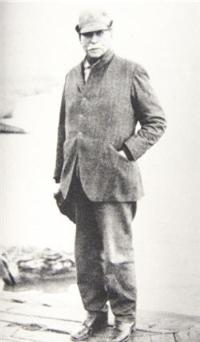
1860 Toronto, Ontario - 1948 Toronto, Ontario. Known for: Decoy carving.
Lots Sold: 95%, High Price: Subscribe.
Thomas Chambers (1860 - 1948) (1). An important wildfowl decoy carver, Thomas Chambers grew up in Toronto, Ontario and retired there; however he lived much of his life in southern Ontario near Lake... Read full biography
Thomas Chambers (1860 - 1948) (1). An important wildfowl decoy carver, Thomas Chambers grew up in Toronto, Ontario and retired there; however he lived much of his life in southern Ontario near Lake St. Clair and in the town of Wallaceburg. Chambers' decoys have sold at auction far in excess of... Read full biography
Thomas Chambers (1860 - 1948) (1). An important wildfowl decoy carver, Thomas Chambers grew up in Toronto, Ontario and retired there; however he lived much of his life in southern Ontario near Lake St. Clair and in the town of Wallaceburg. Chambers' decoys have sold at auction far in excess of $100,000.00 and one ranks among the "Top 50 Decoys Ever Sold at Auction". (2). Attached below are biographies courtesy of the Ward Museum of Wildfowl Art and of Sporting Classics Daily. From The Ward... Read full biography
Thomas Chambers (1860 - 1948) (1). An important wildfowl decoy carver, Thomas Chambers grew up in Toronto, Ontario and retired there; however he lived much of his life in southern Ontario near Lake St. Clair and in the town of Wallaceburg. Chambers' decoys have sold at auction far in excess of $100,000.00 and one ranks among the "Top 50 Decoys Ever Sold at Auction". (2). Attached below are biographies courtesy of the Ward Museum of Wildfowl Art and of Sporting Classics Daily. From The Ward Museum:. Thomas Chambers (1860 - 1948) Wallaceburg, Ontario. Thomas Chambers led a quiet and solitary life and spent his early years as a market hunter in the Toronto Harbor. He was associated with St. Anne's Club at Lake St. Clair in the early 1880s,... Read full biography
Thomas Chambers (1860 - 1948) (1). An important wildfowl decoy carver, Thomas Chambers grew up in Toronto, Ontario and retired there; however he lived much of his life in southern Ontario near Lake St. Clair and in the town of Wallaceburg. Chambers' decoys have sold at auction far in excess of $100,000.00 and one ranks among the "Top 50 Decoys Ever Sold at Auction". (2). Attached below are biographies courtesy of the Ward Museum of Wildfowl Art and of Sporting Classics Daily. From The Ward Museum:. Thomas Chambers (1860 - 1948) Wallaceburg, Ontario. Thomas Chambers led a quiet and solitary life and spent his early years as a market hunter in the Toronto Harbor. He was associated with St. Anne's Club at Lake St. Clair in the early 1880s, but when the club burned to the ground, he sought a position at the St. Clair Flats Shooting Co. Chambers stayed on t... Read full biography
Artist Biography
Biography page for Thomas Chambers ((1860 - 1948)), known for Decoy carving. Showing 1 biographical entries and 0 sample artworks.
Thomas Chambers - Artist Info
About Thomas Chambers
Biography from the Archives of askART
 Thomas Chambers (1860 - 1948) (1)
An important wildfowl decoy carver, Thomas Chambers grew up in Toronto, Ontario and retired there; however he lived much of his life in southern Ontario near Lake St. Clair and in the town of Wallaceburg. Chambers' decoys have sold at auction far in excess of $100,000.00 and one ranks among the "Top 50 Decoys Ever Sold at Auction". (2)
Attached below are biographies courtesy of the Ward Museum of Wildfowl Art and of Sporting Classics Daily.
From The Ward Museum:
Thomas Chambers (1860 - 1948) Wallaceburg, Ontario
Thomas Chambers led a quiet and solitary life and spent his early years as a market hunter in the Toronto Harbor. He was associated with St. Anne's Club at Lake St. Clair in the early 1880s, but when the club burned to the ground, he sought a position at the St. Clair Flats Shooting Co. Chambers stayed on there as manager and carver for forty years (Fleming 141).
Chambers was friends with George Warin, John R. Wells and David Ward, but he still managed to set himself apart by the delicate shape of the head and beak and numerous head positions. His decoys are either solid or hollow, but all of them have an extended lower neck for a head seat. Early decoys have rounded heads and extensive bill carving. Later ones have flatter heads, little detailed carving and a smaller overall construction. With these decoys, Chambers had to forego a more elegant look to accommodate the needs of a hunter. Colors are muted with feather combing on the backs and the wings. The dull red and grey Chambers blended and scratch painted afford a very life-like decoy. He marked some of his pieces "Thos. Chambers Maker" and sold them for $75 a dozen (Haid 15). Chambers' decoys are both aesthetically pleasing and functional. He created a wide variety of these fine decoys replicating black ducks, bluebills, Canada geese, canvasbacks, mallards, pintails, redheads and a few teal and wood ducks. Thomas Chambers retired in 1943, but the collecting surge near the time of his death reassures him continued fame (Fleming 141).
Source: The Ward Museum of Wildfowl Art, Salisbury, MD.
Attached below is courtesy of Sporting Classics Daily (online):
Canada's Most Famous Decoy Maker, by Alain Haid
Tom Chambers (1860 - 1948) was one of western Ontario's most important decoy makers and probably the most famous in all of Canada. He spent his early years in the Toronto area, hunting ducks and geese on Toronto Bay. Chambers became a proficient hunter and before long was selling waterfowl to the market.
Late in the 19th century Chambers moved to western Ontario where the St. Clair River forms the boundary between the U.S. and Canada. In the northeast corner of Lake St. Clair, where the river empties into the lake, is an extensive marsh called the St. Clair Flats. It is a major waterfowl breeding ground as well as a staging area for migrating ducks and geese. The huge concentration of waterfowl drew market hunters and sportsmen by the hundreds. Hunting was mainly in marshy, protected areas. Accordingly, the lake's waterfowlers preferred lightweight, hollow, flat-bottomed decoys that could be carried in small boats. This type of decoy came to be known as the "St. Clair Flats" style. Although Tom Chambers did not invent this style, he developed and refined it to a high level.
Prominent decoy historian Bernard W. Crandall, who has done extensive research on Chambers, says that one of Tom's first jobs was with the St. Anne's Club in the northeast portion of the flats. When the St. Anne's clubhouse burned down in 1900, Chambers became club superintendent and marsh manager for the St. Clair Flats Shooting Company, Ltd., a position he held for 43 years.
St. Clair Flats Shooting Company is one of the oldest duck clubs in Canada. Officially incorporated in 1976, its origin has been traced back to the 1830s when a group of Toronto sportsmen first traveled to the area by rail and boat. While there, the hunters lived in a houseboat and enjoyed unparalleled shooting. Later they built a clubhouse and hired Chambers to run the operation.
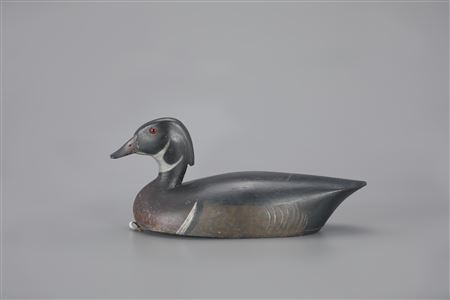
Chambers made most of his decoys while at the St. Clair Flats Club. He concentrated on canvasbacks and redheads, but carved mallards, black ducks, pintails, bluebills, goldeneyes and Canada geese. He also created a few working wood ducks, which today rank among the finest decoys made anywhere.
Most of Chambers' earlier decoys, circa 1910, were hollow with a thin bottom board. They had more rounded heads and more extensive bill-carving with pronounced, diamond-shaped nostrils. His later decoys, circa 1935, had shorter bodies and flatter foreheads. He also made a few solid decoys during this period. Some of his carvings are branded "Thos. Chambers Maker."
Chambers' decoys were artistically painted with clean, bold lines. The fact that they survived years of hard use is a tribute to his craftsmanship. In fact, his decoys were so highly regarded that they brought $75 a dozen during the Depression.
For many years Chambers, his wife and three children lived on the club grounds in Wallaceburg. He retired in 1943 at age 83, then moved back to Toronto. His daughter Charlotte took over the club and ran it until 1948.
Most of Chambers' decoys have found their way into prominent collections. A recent surge in collector interest has pushed the prices of Chambers' ducks with original paint to $1,000 each and Canada geese to more than $3,000. One can only speculate as to what someone might pay for one of his spectacular wood ducks.
Source:
Sporting Classics Daily (online) - http://sportingclassicsdaily.com/issue/new-issue/article/canada-s-most-famous-decoy-maker
Footnotes:
(1) The Great Book of Wildfowl Decoys (see AskART book references) notes Chambers' life dates as "(1864 - 1950)"; it is the only source that uses those dates.
(2) Chambers' record auction result is $187,000.00, which currently ranks as the 47th highest in the world. The item was a Hollow Carved Wood Duck sold at Guyette, Schmidt & Deeter in the April 22 and 23, 2004 auction held in St. Charles, Illinois. If decoy carvers were included in the "Top 100 Canadian Artists' Records at Auction: 1977 - 1912" Chambers would rank 44th among all Canadian artists! Sources: Guyette, Schmidt & Deeter, St. Michaels, Maryland; and the 2013 edition of the Canadian Art Sales Index, Westbridge Publications Ltd, Vancouver.
Additional sources:
Decoys - North America's One Hundred Greatest (2011), by Loy S. Harrell Jr. (see AskART book references)
Collecting Antique Bird Decoys and Duck Calls: An Identification and Price Guide (2003), by Carl Luckey and Russell E. Lewis (see AskART book references)
The Great Book of Wildfowl Decoys (2000), edited by Joe Engers (see AskART book references)
Decoys (1992), by Gene and Linda Kangas (see AskART book references)
Decoying: St Clair to the St Lawrence 1988), by Bernard W. Crandall (see AskART book references)
Traditions in Wood: A History of Wildfowl Decoys in Canada (1987), edited by Patricia Fleming (see AskART book references)
"Decoys of the Mississippi Flyway" (1981), Alan G. Haid (see AskART book references)
The Bird Decoy: An American Art Form (1976), by Paul A. Johnsgard (see AskART book references)
Prepared and contributed May 3, 2013 by M.D. Silverbrooke.