Page loaded successfully. Showing biography for Thomas Nast.
Thomas Nast BIOGRAPHY

1840 Bavaria, Germany - 1902 Guyaquil, Ecuador. Known for: Editorial cartoons, military genre, illustration.
The foremost political cartoonist of his time, the late 19th century, Thomas Nast was the creator of three lasting symbols: the Republican elephant, the Democrat donkey, and Santa Claus, having done... Read full biography
The foremost political cartoonist of his time, the late 19th century, Thomas Nast was the creator of three lasting symbols: the Republican elephant, the Democrat donkey, and Santa Claus, having done the illustrations for Clement Moore's, The Night Before Christmas. President Abraham Lincoln... Read full biography
The foremost political cartoonist of his time, the late 19th century, Thomas Nast was the creator of three lasting symbols: the Republican elephant, the Democrat donkey, and Santa Claus, having done the illustrations for Clement Moore's, The Night Before Christmas. President Abraham Lincoln regarded Nast's recruitment posters and newspaper promos as one of the most effective recruitment devices of the Civil War. Nast was born in Landau, Bavaria and emigrated with his family to America in 1846.... Read full biography
The foremost political cartoonist of his time, the late 19th century, Thomas Nast was the creator of three lasting symbols: the Republican elephant, the Democrat donkey, and Santa Claus, having done the illustrations for Clement Moore's, The Night Before Christmas. President Abraham Lincoln regarded Nast's recruitment posters and newspaper promos as one of the most effective recruitment devices of the Civil War. Nast was born in Landau, Bavaria and emigrated with his family to America in 1846. At age 15, he began his illustration career as a draftsman at Leslie's Illustrated Magazine. Several years later he moved to the New York Illustrated News, and his first assignment was in England at the Heenan-Sayers boxing match. After that, he went... Read full biography
The foremost political cartoonist of his time, the late 19th century, Thomas Nast was the creator of three lasting symbols: the Republican elephant, the Democrat donkey, and Santa Claus, having done the illustrations for Clement Moore's, The Night Before Christmas. President Abraham Lincoln regarded Nast's recruitment posters and newspaper promos as one of the most effective recruitment devices of the Civil War. Nast was born in Landau, Bavaria and emigrated with his family to America in 1846. At age 15, he began his illustration career as a draftsman at Leslie's Illustrated Magazine. Several years later he moved to the New York Illustrated News, and his first assignment was in England at the Heenan-Sayers boxing match. After that, he went to Italy to cover Garibaldi's campaign to unite Italy, an experience that strengthened his ow... Read full biography
Artist Biography
Biography page for Thomas Nast ((1840 - 1902)), known for Editorial cartoons, military genre, illustration. Showing 4 biographical entries and 0 sample artworks.
Thomas Nast - Artist Info
About Thomas Nast
Biography from the Archives of askART
 The foremost political cartoonist of his time, the late 19th century, Thomas Nast was the creator of three lasting symbols: the Republican elephant, the Democrat donkey, and Santa Claus, having done the illustrations for Clement Moore's, The Night Before Christmas. President Abraham Lincoln regarded Nast's recruitment posters and newspaper promos as one of the most effective recruitment devices of the Civil War.
Nast was born in Landau, Bavaria and emigrated with his family to America in 1846. At age 15, he began his illustration career as a draftsman at Leslie's Illustrated Magazine. Several years later he moved to the New York Illustrated News, and his first assignment was in England at the Heenan-Sayers boxing match. After that, he went to Italy to cover Garibaldi's campaign to unite Italy, an experience that strengthened his own commitment to political ideals of freedom.
Returning to New York in 1862, he joined Harper's Weekly magazine where he was a regular for 25 years and drew several-thousand cartoons. He focused on the evils of political corruption and was a great supporter of Abraham Lincoln and his goals of freedom and equality. During the Civil War, Nast produced many war-related illustrations for Harper's Weekly. One of Nast's assignments during the war was translating the hurried drawings of reporters into finished drawings for the engravers. However, this endeavor made him unpopular with his peers because he sometimes applied his own signature to the work.
According to documents in the Seventh Regiment Library of the New York Historical Society, "Thomas Nast enlisted as a private in the seventh company (G) of the Seventh Regiment of New York (7th Regt.NYNG) in September 1864, and serving a full enlistment, was discharged in September,1871, still a private."
He joined the Veterans Association (The Veterans of the Seventh Regiment), and was a member of its Uniformed Battalion, until it was asked to disband. His most famous canvas is of The Departure of the Seventh Regiment for the Seat of War, which hangs in the Seventh Regiment Armory. (As a matter of interest, the central figure in the canvas is another noted artist, Henry Colton Shumway, who was the captain of the 8th, H company. (FitzGerald)
After the Civil War, Thomas Nast was nationally famous, and his criticism of Andrew Johnson was a key factor in Ulysses S. Grant winning the presidency. In the 1870s, he uncovered the conspiracies of New York's Tammany Hall Ring and the corrupt Boss Tweed, whom Nast portrayed in his cartoons as a bloated Caesar. Nast is credited with eventually forcing Tweed out of office.
In 1886, Nast left Harper's Weekly and spent his later years in poverty and doing free-lance illustration. In 1888, he was in northern California, staying briefly in Stockton and Fresno. In Stockton, he gave a demonstration on drawing caricatures. He also had a pension from the Veterans Association. In 1902, President Teddy Roosevelt appointed him to a consular post in Ecuador, and six months later, Nast died of Yellow Fever in Guayaquil, Ecuador.
Sources include:
Walt Reed, The Illustrator in America, 1860-2000
Michael David Zellman, 300 Years of American Art
Edan Hughes, Artists in California, 1786-1940
Kenyon B. FitzGerald Jr., Representative of the Seventh Regiment Fund, information sent to AskARTBiography from the Archives of askART
 The following biography is from the Barnes & Noble website (BarnesandNoble.com) review of the book, Thomas Nast: His Period and His Pictures by Albert Paine and Daniel Aaron.
His pen gave America the donkey and the elephant, symbols to this day of the Democrats and Republicans, respectively. But Thomas Nast's (1840-1902) contributions to American politics extend well beyond those icons. Although he was born in Germany and died in Ecuador, Nast's impact on American politics is unquestionable--and in a burst of non-political creativity he created the fat and jolly image of Santa Claus that still endures. According to historian and biographer Morton Keller, Nast "is the most powerful and influential cartoonist America has ever had."
Illustrators, Leonardo da Vinci among them, have used caricature as a political weapon for centuries. Martin Luther and his supporters circulated illustrated pamphlets during their 16th-century battle against the Roman Catholic Church--a battle known today as the Protestant Reformation. Benjamin Franklin's 1754 cartoon of a snake chopped into pieces, and captioned "Join or Die!" marked an effort to unify support within the American colonies for the French and Indian War. But Nast, who began drawing for Harper's Weekly in 1858 at the age of 18, established cartooning's place in America's political conversation.
A staunch supporter of the Union during the Civil War, Nast won praise from President Abraham Lincoln, who called him "our best recruiting sergeant." Nast gained lasting fame for his 15-year battle against the corruption of Tammany Hall, the political machine that controlled New York City after the Civil War. His stinging cartoons helped send Tammany leader Boss Tweed to prison and brought Tweed's machine to its knees.
Nast, who lived much of his life with his wife and children in Morristown, New Jersey, lost all of his money in bad investments. President Theodore Roosevelt appointed Nast as Counsel General to Ecuador in 1902; Nast died there that same year.Biography from the Archives of askART
 Born in Landau, Bavaria on September 27, 1840. Nast came to the U.S. in 1846. He grew up in New York City and studied at the National Academy of Design. He reported for Harper's from the onset of the Civil War until 1886.
In spring of 1888 he visited northern California. Coming through Stockton, he was in Fresno only briefly. While there, he gave a two-hour demonstration on caricature and entertained with an elegant dinner.
Nationally famous for his political cartoons, he created the Democratic donkey and Republican elephant as political symbols.
Nast died on Dec. 7, 1902 in Guayaquil, Ecuador where he was the American Consul-General.
Exhibitions: Brandywine River Museum (PA), 1999 (retrospective).
Source:
Edan Hughes, Artists in California, 1786-1940Biography from Fred R. Kline & Co
 “Thomas Nast was the father of American political cartooning, and the strongest
cartoonist of nineteenth-century America. In the post-Civil War Period, with its
violent issues and open corruption, he exercised an influence unequaled by any
cartoonist before or since. [Notably, during the Civil War, both Lincoln and Grant
offered high praise for Nast’s pro-Union cartoons; Grant famously credited Nast’s
cartoons with helping to win the Civil War.]
Absolutely fearless, uncompromising in his beliefs, he pictured men and events with mordant wit and crushing force. He had the cartoonist’s essential gift, that of presenting ideas in concrete pictorial images;and he invented or first gave wide currency to many of the symbols used today, such as the Republican elephant, the Democratic donkey, and the Tammany tiger. [Nast’s image of Santa Claus, as well, was widely disseminated in books and cartoons and
became an iconic image of Christmas across the United States.]
The wealth of his imagery and the massive power of his draftsmanship and design rank him among the leading American artists of his time in any field.”
Lloyd Goodrich, Advisory Director, Whitney Museum of American Art, from Introduction and Commentary, Five Paintings from Thomas Nast’s Grand Caricaturama, Whitney Museum Exhibition Catalogue, July and August 1970 Exhibition.
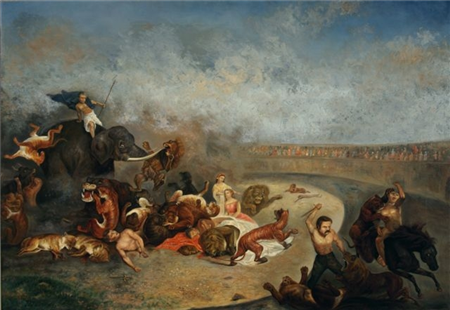
“Thomas Nast had a cottage on 125th Street [circa 1867-1870-NYC] and a studio in
the backyard where he painted bloodcurdling pictures which no one would buy so he
hung them in his own house. The place was fairly covered with them. They covered
every inch of wall in parlor, hallways, dining and bedrooms, they climbed the
staircases and were fastened to the doors. The kitchen and bakeroom were
completely supplied and the garret was packed with them like sardines.
It was easy to note from them that Mr. Thomas Nast was not afflicted with any disrespect for Tom Nast the artist. Charles Dawson Shanly used to say that Nast was the only man who
could have slept overnight in a house filled with his own works and not have gone
crazy. ”
Source: Published in the The Journalist, New York City, August 21, 1886
By Alfred Trumble (1844-1897): NYC Journalist, Art Critic, Author, Ed. of The Collector.
Ref. to Charles Dawson Shanly (1811-1875): NYC Journalist, Author, Poet-Artist, Critic, Ed. of Vanity Fair.
Submitted by: Fred Kline