Page loaded successfully. Showing biography for Thorwald Hellesen.
Thorwald Hellesen BIOGRAPHY
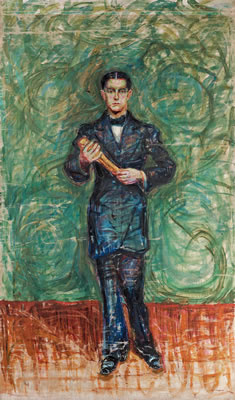
1888 Oslo, Norway - 1937 Oslo, Norway. Known for: Collage, abstract painting.
Thorvald Hellesen's artistic career began in 1910 when he enrolled at the Academy of Art in Oslo. In 1914, Hellesen received a scholarship to study painting in Paris. In that year he created two... Read full biography
Thorvald Hellesen's artistic career began in 1910 when he enrolled at the Academy of Art in Oslo. In 1914, Hellesen received a scholarship to study painting in Paris. In that year he created two Cubist portraits, which already showed a mastery and an ability to enhance depth by the decomposition... Read full biography
Thorvald Hellesen's artistic career began in 1910 when he enrolled at the Academy of Art in Oslo. In 1914, Hellesen received a scholarship to study painting in Paris. In that year he created two Cubist portraits, which already showed a mastery and an ability to enhance depth by the decomposition and multiplicity of planes. During this period of self-discovery, Hellesen seems to have been influenced most of all by Picasso and Braque. In 1915-1916, he created his collages of musical instruments,... Read full biography
Thorvald Hellesen's artistic career began in 1910 when he enrolled at the Academy of Art in Oslo. In 1914, Hellesen received a scholarship to study painting in Paris. In that year he created two Cubist portraits, which already showed a mastery and an ability to enhance depth by the decomposition and multiplicity of planes. During this period of self-discovery, Hellesen seems to have been influenced most of all by Picasso and Braque. In 1915-1916, he created his collages of musical instruments, showing his understanding of the structure and form of Synthetic Cubism. During the war years in Paris, Hellesen married the artist Hélène Perdriat, who brought him into the very heart of the Cubist milieu. By the end of the war, he had become good... Read full biography
Thorvald Hellesen's artistic career began in 1910 when he enrolled at the Academy of Art in Oslo. In 1914, Hellesen received a scholarship to study painting in Paris. In that year he created two Cubist portraits, which already showed a mastery and an ability to enhance depth by the decomposition and multiplicity of planes. During this period of self-discovery, Hellesen seems to have been influenced most of all by Picasso and Braque. In 1915-1916, he created his collages of musical instruments, showing his understanding of the structure and form of Synthetic Cubism. During the war years in Paris, Hellesen married the artist Hélène Perdriat, who brought him into the very heart of the Cubist milieu. By the end of the war, he had become good friends with Fernand Léger. Together they returned to Norway in 1919 to participate in an exhibition at the Tivoli Hall of Kristiania, "Le... Read full biography
Artist Biography
Biography page for Thorwald Hellesen ((1888 - 1937)), known for Collage, abstract painting. Showing 1 biographical entries and 0 sample artworks.
Thorwald Hellesen - Artist Info
About Thorwald Hellesen
Biography from Papillon Gallery
Thorvald Hellesen's artistic career began in 1910 when he enrolled at the Academy of Art in Oslo.
In 1914, Hellesen received a scholarship to study painting in Paris. In that year he created two Cubist portraits, which already showed a mastery and an ability to enhance depth by the decomposition and multiplicity of planes. During this period of self-discovery, Hellesen seems to have been influenced most of all by Picasso and Braque. In 1915-1916, he created his collages of musical instruments, showing his understanding of the structure and form of Synthetic Cubism.
During the war years in Paris, Hellesen married the artist Hélène Perdriat, who brought him into the very heart of the Cubist milieu. By the end of the war, he had become good friends with Fernand Léger. Together they returned to Norway in 1919 to participate in an exhibition at the Tivoli Hall of Kristiania, "Leger and the Modern Spirit," for which Hellesen designed the invitation. Hellesen's paintings show Léger's strong influence during this period.
Hellesen's work dating to the early 1920's is remarkable for its absence of all treatment of volume and shadow; it is also distinctive for his use of pinks, purples, and violets. His originality is found in his breaking from the scholastic tradition of the avant-garde, which limited the palette to more "regular" tones, or to only the primary colors. After subsequent exhibitions by Hellesen, the critic Theo van Doesburg wrote that " the young generation is going further in an artistic expression than Picasso or Braque….Hellesen and Léger are playing an important role in the evolution of Cubism." A critic from L'espirit Nouveau (1921) wrote: "Among the Cubists, Hellesen is one of the most interesting, for he seems to have a well-defined aesthetic, where color and form blend in systematic fashion."
Hellesen befriended Leonce Rosenberg, director of Galerie l'Effort Moderne, and a promoter of both Cubism (including Picasso, Braque, Léger, Gleizes and Metzinger), and Puriam (Le Corbusier and Ozen fant), who included Hellesen in a traveling exhibition of French art. After 1920, Hellesen became increasingly influenced by Albert Gleizes, while Gleizes' influence is seen in the movement and rotation of planes in Hellesen's paintings. In 1923, Hellesen created murals to decorate the building of Navington at Kristiania. After a 1925 exhibition, he no longer showed his paintings, and dedicated himself to the creation of illustrations, publicity posters, and paintings to decorate public offices, salons, and stores.
There has been a recent rediscovery of Hellesen; in 1980-1981, two of his paintings were acquired by the National Gallery of Oslo, and another was purchased by the Musée d'Art Moderne de la Ville in Paris.