Page loaded successfully. Showing biography for Tom Schroeder.
Tom Schroeder BIOGRAPHY
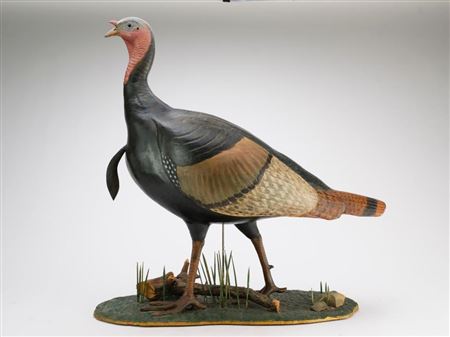
1885 East Detroit, Michigan - 1976 Detroit, Michgan. Known for: Decoy wood carving of Teal and Canvasbacks, Fish, cartoons.
Lots Sold: 96%, High Price: Subscribe.
Tom Schroeder. Tom was born in East Detroit and spent much of his youth outdoors, quickly becoming an accomplished hunter and fisherman. It is unknown if he had any formal training in art but by... Read full biography
Tom Schroeder. Tom was born in East Detroit and spent much of his youth outdoors, quickly becoming an accomplished hunter and fisherman. It is unknown if he had any formal training in art but by 1905, and continuing through 1920, he worked as staff sport cartoonist for the Detroit Free Press.... Read full biography
Tom Schroeder. Tom was born in East Detroit and spent much of his youth outdoors, quickly becoming an accomplished hunter and fisherman. It is unknown if he had any formal training in art but by 1905, and continuing through 1920, he worked as staff sport cartoonist for the Detroit Free Press. Through the early 1930's he became active in the local boxing clubs and between 1925 and 1931, he was the manager of local boxer, Mickey Goldberg. He became a well-known figure in Detroit's journalistic,... Read full biography
Tom Schroeder. Tom was born in East Detroit and spent much of his youth outdoors, quickly becoming an accomplished hunter and fisherman. It is unknown if he had any formal training in art but by 1905, and continuing through 1920, he worked as staff sport cartoonist for the Detroit Free Press. Through the early 1930's he became active in the local boxing clubs and between 1925 and 1931, he was the manager of local boxer, Mickey Goldberg. He became a well-known figure in Detroit's journalistic, artistic and shooting fraternities and was one of the original members of the local cultural center, the Scarab Club (established in 1928). After his stint at the Newspaper, he opened his own Advertising studio which was so successful it boosted the... Read full biography
Tom Schroeder. Tom was born in East Detroit and spent much of his youth outdoors, quickly becoming an accomplished hunter and fisherman. It is unknown if he had any formal training in art but by 1905, and continuing through 1920, he worked as staff sport cartoonist for the Detroit Free Press. Through the early 1930's he became active in the local boxing clubs and between 1925 and 1931, he was the manager of local boxer, Mickey Goldberg. He became a well-known figure in Detroit's journalistic, artistic and shooting fraternities and was one of the original members of the local cultural center, the Scarab Club (established in 1928). After his stint at the Newspaper, he opened his own Advertising studio which was so successful it boosted the fame and fortune of a number of companies. He first attempts at carving were executed in bars of soap "borrowed" from his mot... Read full biography
Artist Biography
Biography page for Tom Schroeder ((1885 - 1976)), known for Decoy wood carving of Teal and Canvasbacks, Fish, cartoons. Showing 1 biographical entries and 0 sample artworks.
Tom Schroeder - Artist Info
About Tom Schroeder
Biography from Guyette & Deeter, Inc.
Tom Schroeder
Tom was born in East Detroit and spent much of his youth outdoors, quickly becoming an accomplished hunter and fisherman. It is unknown if he had any formal training in art but by 1905, and continuing through 1920, he worked as staff sport cartoonist for the Detroit Free Press. Through the early 1930's he became active in the local boxing clubs and between 1925 and 1931, he was the manager of local boxer, Mickey Goldberg.
He became a well-known figure in Detroit's journalistic, artistic and shooting fraternities and was one of the original members of the local cultural center, the Scarab Club (established in 1928). After his stint at the Newspaper, he opened his own Advertising studio which was so successful it boosted the fame and fortune of a number of companies.
He first attempts at carving were executed in bars of soap "borrowed" from his mother. He began to duck hunt by the age of twelve and it is believed that he carved his first decoy shortly thereafter, but the earliest decoys that can be positively identified as being carved by him date to between 1910 and 1920. This was the beginning of a hobby/pastime that would stretch over a 50 year period.
During that time Schroeder, ever the perfectionist, experimented with a variety of styles, all intended to improve the effectiveness of the decoys. Changes and adaptations were incorporated into the carvings that were intended to facilitate attractiveness, stability, steadiness and improved line storage. He termed most of these later changes, "hydrodynamic" improvements.
The turning point in his carving career occurred in 1948-49 when he became aware of the International Decoy Makers Contest held in New York City. He became infuriated when Joel Barber informed him that, in his opinion, the best decoys ever created came from the knife of "Shang" Wheeler. He promptly sent off multiple entries for the 1949 New York competition and took a number of first, "Best Amateur" and in later shows, "Best of Show".
He continued to compete through 1956. He never sold a decoy but is recorded as gifting a few to friends or hunting partners. He was friendly with a number of well-known Michigan carvers such as Ben Schmidt, Ferdinand Bach, Jim Kelson and Ralph Reghi and his influence can be seen in their work. In his later years, he entered the realm of decorative and miniature carving as well as producing fish decoys. His decorative career lasted until just two years prior to his death. At one point, he painted the murals for the Detroit Zoological Park.
Once he entered the competitive carving community, he lost all interest in the newspaper or the advertising business and moved to the Vernier Hotel in Fair Haven on Anchor Bay, Lake St Clair. Here he could concentrate on hunting, fishing, and carving. His private life is hard to decipher. He was known to be gregarious with a somewhat sarcastic view of the world and one who could not pass up a practical joke. He refused to sign up for a social security card because he did not want to be known as a number! Likewise, he seems to have scrupulously avoided the State and Federal Census because he cannot be located in any of them. In 1916, he married Ethel Williamson, but filed for divorce from her in 1921 claiming "extreme cruelty".
He can probably best be described by the wording of one of his own poems which began "I do not choose to be a common man. It is my right to be uncommon – if I can".
He lived out his final years in the home of his niece before being placed in the Moroun Nursing Home in Detroit where he died.