Page loaded successfully. Showing biography for Valton Tyler.
Valton Tyler BIOGRAPHY
1944 Texas City, Texas - 2017. Known for: Surrealist painting, prints.
VALTON TYLER'S OTHERWORDLY ART: From the Heart of Texas by Edward M. Gómez Valton Tyler. The following review is from The Brooklyn Rail, April 2011, New York City. "Those are some good drinking... Read full biography
VALTON TYLER'S OTHERWORDLY ART: From the Heart of Texas by Edward M. Gómez Valton Tyler. The following review is from The Brooklyn Rail, April 2011, New York City. "Those are some good drinking songs," the painter Valton Tyler observes, referring to some of country music's classic,... Read full biography
VALTON TYLER'S OTHERWORDLY ART: From the Heart of Texas by Edward M. Gómez Valton Tyler. The following review is from The Brooklyn Rail, April 2011, New York City. "Those are some good drinking songs," the painter Valton Tyler observes, referring to some of country music's classic, she-broke-my-heart, my-baby-left-me weepers that come streaming through his radio as he barrels down a six-lane highway amidst the urban sprawl of Garland, Texas. Today, Tyler lives in a small house, with a modest... Read full biography
VALTON TYLER'S OTHERWORDLY ART: From the Heart of Texas by Edward M. Gómez Valton Tyler. The following review is from The Brooklyn Rail, April 2011, New York City. "Those are some good drinking songs," the painter Valton Tyler observes, referring to some of country music's classic, she-broke-my-heart, my-baby-left-me weepers that come streaming through his radio as he barrels down a six-lane highway amidst the urban sprawl of Garland, Texas. Today, Tyler lives in a small house, with a modest studio, on a tree-lined street in this nondescript, suburban patch of low-rise factories, fast-food joints, and plain tract housing about half an hour's drive to the northeast of downtown Dallas. Quiet and tucked away, it feels like David Lynch-Eric... Read full biography
VALTON TYLER'S OTHERWORDLY ART: From the Heart of Texas by Edward M. Gómez Valton Tyler. The following review is from The Brooklyn Rail, April 2011, New York City. "Those are some good drinking songs," the painter Valton Tyler observes, referring to some of country music's classic, she-broke-my-heart, my-baby-left-me weepers that come streaming through his radio as he barrels down a six-lane highway amidst the urban sprawl of Garland, Texas. Today, Tyler lives in a small house, with a modest studio, on a tree-lined street in this nondescript, suburban patch of low-rise factories, fast-food joints, and plain tract housing about half an hour's drive to the northeast of downtown Dallas. Quiet and tucked away, it feels like David Lynch-Eric Fischl territory, ripe for the picking of stories about the Mexican-immigrant fa... Read full biography
Artist Biography
Biography page for Valton Tyler ((1944 - 2017)), known for Surrealist painting, prints. Showing 2 biographical entries and 0 sample artworks.
Valton Tyler - Artist Info
About Valton Tyler
Biography from the Archives of askART
 VALTON TYLER'S OTHERWORDLY ART: From the Heart of Texas by Edward M. Gómez Valton Tyler.
The following review is from The Brooklyn Rail, April 2011, New York City
"Those are some good drinking songs," the painter Valton Tyler observes, referring to some of country music's classic, she-broke-my-heart, my-baby-left-me weepers that come streaming through his radio as he barrels down a six-lane highway amidst the urban sprawl of Garland, Texas. Today, Tyler lives in a small house, with a modest studio, on a tree-lined street in this nondescript, suburban patch of low-rise factories, fast-food joints, and plain tract housing about half an hour's drive to the northeast of downtown Dallas.
Quiet and tucked away, it feels like David Lynch-Eric Fischl territory, ripe for the picking of stories about the Mexican-immigrant families who have come here to chase what's left of the American Dream; or the very private scholar-curator nearby who has amassed a precious collection of Russian loom shuttles; or the chubby girls at the local Waffle House who get together to knock back piles of greasy hash browns topped with sausage gravy, while SUVs and pick-ups buzz around outside in an endless odyssey between strip malls, convenience stores, and all-you-can-eat buffets. The town's government, in search of the identity it seems to be sure is lurking somewhere in the brume of the area's ineffable charms, has launched a "Brand Garland" campaign. Its proposed new motto: "Texas Made Here."
Tyler's unusual paintings are made here, too, but they are not what a visitor might expect to find emerging from a region whose visual-art legacy, looking back over a couple of centuries, has featured religious and folkloric creations influenced by the styles and themes of Spanish-colonial Mexico, sentimental-to-celebratory depictions of the rugged Texas landscape and, more recently, variations on the postmodernist-pastiche and "post-studio" conceptualist confections that have prevailed in contemporary art centers like New York or Los Angeles.
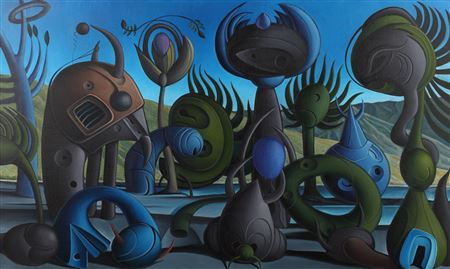
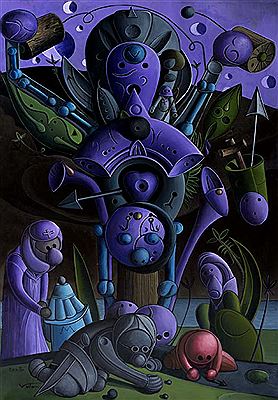
In fact, Tyler's finely crafted oil-on-canvas paintings, some as large as the most ambitious abstract-expressionist canvases, defy easy classification. His images of mechanical-architectural-vegetal structures, which suggest Star Trek spaceships on steroids or aberrant growths from a futuristic Amazon, are surreal, cartoonish, sci-fi fantastic, and apocalyptic-baroque. Existing in a world that appears timeless, they exude a wistful, yearning, metaphysical air. If anything, they are the work of a completely original, genuinely visionary outsider artist. (In Tyler's case, the overused "visionary" tag really fits.)
Tyler has always made art primarily for himself, apparently out of some irrepressible compulsion to do so. "I must draw and paint," he says. "If I don't, I become depressed." His peculiar pictures seem to find him as he plucks them from the depths of a fertile imagination. "In my mind, I see a complete composition and I try to reproduce what I see," the artist told me when I first met him several years ago.
As an art-maker, Tyler, who is 67 and struggles with diabetes, pains associated with a partial hip replacement and other ailments, has almost never worked consciously in dialogue with canonical art history or in response to the trends of the fickle art market. As a young man in Dallas, he used to leave his drawings along the sides of the city's main roads so that anyone who passed by and wanted to take them could stop and pick them up.
What really distinguishes Tyler's work, even—or perhaps especially—in the outsider-art camp, is that it is made using some rather sophisticated techniques, including glazing (the building up of numerous layers of transparent washes to create luminous, vividly modeled forms) and the mixing of straight-out-of-the-tube oils right on the canvas while he is painting. Historically, a method like glazing is normally associated with Renaissance painters, especially those of the Netherlandish school of the 15th century. It does not typically characterize the work of Tyler's self-taught peers in and from the American South, whose materials are often cheap house paint or mud applied to any available scrap of board.
Tyler was born in 1944 in Texas City, on the gulf coast of Texas, a town dominated by a large oil refinery. His father ran an auto-body repair shop and was a skilled mixer of colors for car exteriors. Shortly after Valton's third birthday, a freighter in the port, loaded with more than 2,000 tons of ammonium nitrate (fertilizer), ignited and exploded, setting off massive fires as other ships, a nearby chemical plant and the refinery went up in flames. The blast shattered windows as far away as Houston and was felt 100 miles to the northeast, in Louisiana. "I was an infant but I remember it very well," Tyler says of what became known as the Texas City Disaster, the worst industrial incident of its kind in U.S. history. He says: "My parents thought it was the end of the world; the flames were bright red at the bottom of the fire, which covered the flat landscape, and black at the top, stretching high into the sky. I still have nightmares."
A few years after the disaster, Tyler's father, who had received electric-shock treatments for depression before Valton was born, became an alcoholic and slipped deeper into mental-emotional gloom. Valton, who claims he had an out-of-body experience at the time of the Texas City fires and, later, as a teenager, was visited by an angel who pinned him to his bed (but pressed no special message upon him), would eventually drop out of high school. Later, he earned a high school diploma after moving with his mother and sister to Dallas; his older brother, Robert, an architectural draftsman, had already settled there.
In Dallas, Valton enrolled in a commercial art school but almost never attended classes and soon left. ("I wasn't interested in their social gathering," he sniffs.) Later, he worked at a local engraving company. On his own, outside of school, he went to a library and read about modern art. He eagerly made his own drawings, still motivated by an epiphany he had had when he was 16 years old. At that time, during a visit to his grandmother's home in northern Texas, he had made drawings with a heightened sense of consciousness about what he was doing. "As I drew lines in a plain school notebook," Tyler recalls, "I watched as, magically, they became something with a shape and a spirit of their own. I became aware that what I was doing was something special, something I would never want to stop doing."
In 1968, a classmate from the commercial art school introduced Tyler to Lucille Teasel, a former drugstore owner from Canada who had become an antiques dealer. A local cultural doyenne, Teasel died in 2006 just before her 101st birthday. An obituary in the Dallas Morning News identified her as an "art patron, decorator, antiques dealer, and silver appraiser," and, even before listing her survivors, noted that she would "be missed by artist Valton Tyler." When Teasel met Tyler, she immediately recognized his talent, installed him in her home, which also served as her antiques "gallery," as she called it, and supplied him with art materials in exchange for help around the shop. "She was the first guardian angel who saved me and made it possible for me to really focus on making art," the artist recalls. (When I met Teasel in 2000, she told me, as I noted in a New York Times article: "After all these years, I still don't understand Valton's art. Sometimes I don't even like it. But I know he's good at it and that he has to do it. He is someone who has to paint.")
What Teasel saved Tyler from was, in part, himself. At the time, he often went on some record-breaking benders. Waking up the morning after a boozy misadventure, he says, he always felt more depressed than when he had started—and more eager than ever to get back to drawing and painting. In 1970, Robert Tyler showed some of his brother's drawings to the late Donald Vogel, the founder of Valley House Gallery in Dallas and an accomplished painter who often worked in an impressionist style. Founded in 1957, Vogel's gallery had become a leading showcase for modern art in a still small art market. Vogel responded enthusiastically to Valton Tyler's unusual ink-on-paper drawings, which portrayed, the artist recalls, "primitive versions of what later became my more complex shapes."
Vogel arranged for Tyler to use the print-making facilities at Southern Methodist University (S.M.U.) in Dallas, where, in just about a year's time, the young artist effectively taught himself etching, aquatint, and other techniques and, remarkably, produced editions of 54 separate print images. They depicted deftly modeled, vaguely anthropomorphic or architectural forms with wiry outlines, often placed in proscenium-like settings. Rebecca Reynolds, then Valley House's in-house curator-historian, wrote in a 1972 book of reproductions of Tyler's prints that these works represented designs the artist dreamed of being able to realize as sculptures. "I want to come as close as I can to sculpture without sacrificing the beauty and emotion of the etched lines," Tyler said of his prints at that time. He still believes his "shapes," as he calls his drawn or painted creations, could be realized three-dimensionally on a monumental scale.
Vogel also encouraged Tyler to make oil paintings and offered routinely to purchase such works. That arrangement, which lasted almost two decades, provided the young artist with some income and Valley House with a growing inventory of his paintings. Today, the gallery still has a large supply of Tyler's canvases from that era.
Claude C. Albritton, III, the founder and president of the board of the McKinney Avenue Contemporary ("The MAC"), an independent contemporary-arts center in Dallas, owns what is considered to be the best private collection anywhere of works by Texan artists, especially those depicting Texas. Over the years, he has commissioned numerous paintings from Tyler. "His work is extraordinary," Albritton told me late last year at his home, where pictures by the modernist Marsden Hartley, the contemporary painter David Bates, and "the father of Texas painting," Julian Onderdonk (1882 - 1922), who studied with the American impressionist William Merritt Chase, were on display. Albritton added: "Valton's a Texan, who lives and works here, but he doesn't paint Texas, although one could argue that all of his pictures are somehow a reaction to the Texas City Fire. The beautifully monstrous shapes he paints, almost silhouetted against the landscape—they're the oil refineries on the coast!"
Tyler calls the strange structures he conjures up "my shapes." "I believe they're alive and have feelings," he says. In 2000, on the occasion of a retrospective of his work at the MAC, he told the veteran dealer Phyllis Kind (who would go on to show his paintings at her New York gallery): "My forms communicate with one another. They are having fun together, and I feel free and happy when I am making them but I have to leave them and let them go their way." About developing a picture, Tyler stated: "[I] blur my vision and look at everything at once… [A]ll of a sudden, I see something that's in a whole other world; the shape tells me what it wants to be…."
Tyler has long been known for his marathon work sessions. In 1971, when he was making prints at SMU, students would arrive for classes in the morning, only to find the artist slumped over a table, where he had fallen asleep the night before. Last year, he fell and injured his hip—an accident that led to surgery—while trying to move a large painting in his studio by himself at two o'clock in the morning. Lately he has been working on a new painting, a triptych. For a change, it is based on an external source, the Bible's 22nd Psalm. "It's a text that foreshadows the crucifixion," Tyler says.
Despite considerable pain on his injured hip side, making it hard for him to stand for lengthy periods of time—Tyler likes to work at an easel or on a stretched canvas hung flat against a wall—he still puts in long hours and works late into the night. When he is not painting, he fills sketchbooks with plain-pencil or colored-pencil drawings of his otherworldly "shapes."
"Let's go get something to eat," he suggests one morning, after having worked past midnight. (Before going to bed, I heard him remind his dog about the so-called Mayan Prophecy, which claims that the world will end in December 2012). It's to his favorite diner that Tyler heads out in his boxy Honda sedan, an ever-present Diet Coke, a bottle of sugar-free syrup and myself in tow. Once seated in the fluorescent-lit pancake parlor, he pulls out a pen and starts drawing on a paper napkin. "I'm seeing some new shapes," he says, "and I want to get them down." I mention Garland's proposed new motto. Tyler offers a crumpled smile, tosses his head back, laughs and replies in a vowel-stretching drawl, "I don't know about Texas, but art is definitely being made right here, in this Waffle House."
This text is excerpted from the critic and journalist Edward M. Gómez's forthcoming book of art-themed essays, Big Soul: Meditations on Art and Artists in Post-postmodernist Times. This essay will first be published in its entirety as a limited-edition chapbook, available through his website (www.edwardmgomez.com).Biography from Valley House Gallery & Sculpture Garden
Born:
March 30, 1944, Texas City, Texas
Education:
Self taught
Early Biography:
1971 Completion of the first fifty plates. SMU scheduled his first one man show for February, 1972. In June, Valley House Gallery, Dallas, held a one man show.
1970 Through his older brother, Valton met Donald Vogel, who introduced his work to Laurence Scholder and Dr. William Jordan, making it possible for him to work with the facilities of the Department of Printmaking at Southern Methodist University in Dallas, Prior to 1970 Valton had never worked with the printmaking techniques. It was in March of this year that he worked and completed his first plates and pulled the first etchings.
1967 Received the G.E.D. (General Education Diploma). For six months he attended the Dallas Art Institute in Dallas; however, he took very little interest in the school's program as the emphasis was on commercial art.
1964-67 Worked part-time with hand-embossing and layouts for an engraving company; acquired experience in working with blueprinting machines.
1961 Attended Crozier Technical High School
1959 Family moved to Tyler, Texas where he attended high school
Print Exhibitions:
2009 Art + Advocacy, auction for Dallas Children's Advocacy Center, Three Three Three First Avenue, Dallas, Texas
2005 O'Kane Gallery, (one person show) University of Houston, Houston, Texas
1975 Valley House Gallery (one person show), Dallas, Texas
1974 Oklahoma Art Center (one person show), Oklahoma City, Oklahoma
1974 Blaffer Gallery (one person show), University of Houston, Houston, Texas
1974 Charles B. Goddard Center (one person show), Ardmore, Oklahoma
1973 Philbrook (one person show), Tulsa, Oklahoma
1973 Cokesbury's Book Store (one person show), Dallas, Texas
1973 Allegheny College (one person show), Meadville, Pennsylvania
1973 San Antonio Art League (one person show), Belgian Pavillion
1972 Tyler Museum of Art (one person show), Tyler, Texas
1972 New Talent in Printmaking 1972, Associated American Artists (group show), New York, New York
1972 Pollock Galleries (one person show), Southern Methodist University, Dallas, Texas
1971 Valley House Gallery (one person show), Dallas, Texas
1971 Gimpel-Weitzenhoffer Gallery (group show), New York City, New York
Painting Exhibitions:
2011 Dallas Art Fair, Fashion Industry Gallery, Dallas, Texas (Valley House Gallery)
2010 Valton Tyler and Miguel Zapata: Beauty and Power, Fort Worth Community Arts Center, Fort Worth, Texas
2010 Channeling Other Worlds: Contrasting paintings, drawings, and prints by Dallas artist Valton Tyler with Tribal Works from around the World, a collaborative exhibition between Valley House Gallery and Shango Galleries, Valley House Gallery & Sculpture Garden, Dallas, Texas
2009 Wish! Auction, Dallas Center for Contemporary Art, Dallas, Texas
2009 Thank You Fort Worth: An Appreciation from Valley House Gallery & Sculpture Garden, Group Exhibition, Fort Worth Community Arts Center, Fort Worth, Texas
2008 College Art Association's 96th Annual Conference, Adam's Mark Hotel, Dallas, Texas
2007 CADD Contemporary Art Dealers of Dallas Inaugural Art Fair, Three Three Three First Avenue, Dallas, Texas (Valley House Gallery)
2005 Valley House Exhibition, Masur Museum, Monroe, Louisiana
2005 Introductions, Valley House Gallery, Dallas, Texas
2004 Art Chicago, art fair, Navy Pier, Chicago, Illinois (Valley House Gallery)
2004 50th Anniversary Exhibition, Valley House Gallery, Dallas, Texas
2002 Valton Tyler: Exuberant Color, Phyllis Kind Gallery, New York, New York
2002 Other Sights: Renzo Barchi, Lynn Randolph, Valton Tyler, O'Kane Gallery, University of Houston, Downtown, Houston, Texas
2002 Beyond the Apple & Bottle: Still Life Invitational, Valley House Gallery, Dallas, Texas
2001 Folk Fest, Art Fair, Atlanta, GA. (Valley House Gallery)
2001 One Person Show, Phyllis Kind Gallery, New York, New York
2001 Hands Across the Sea, Phyllis Kind Gallery, New York, New York
2001 Outsider Art Fair 2001, Puck Building, New York (Phyllis Kind Gallery)
2000 The Art Show, art fair, ADAA, 7th Regiment Armory, New York (Valley House Gallery)
2000 Valton Tyler Visionary Landscapes, The McKinney Avenue Contemporary, one person show, curated by Murray Smither, Dallas, Texas
Literature:
Art & Antiques, May 2011, "Valton Tyler," by Edward Gomez.
50th Anniversary Exhibition, exhibition catalogue, Valley House Gallery, Dallas, Texas 2004, no. 11, Helping the Fear reproduced in color.
Raw Vision, Summer 2001, #35, "Valton Tyler's Techno-Organic Landscapes," by Edward M. Gomez, pp. 34-39, ills.
The New York Times, Tuesday, June 13, 2000, "Arts in America: Futuristic Forms Frolic Under Eerie Texas Skies," by Edward M. Gomez, The Living Arts, page B2, ills.
Translation Review, Number Fifty-Eight, 1999, published by The University of Texas at Dallas, Richardson, Texas, for the American Literary Translators Association, Space Eagles (1971, etching) reproduced on the cover
The Met, March 22, 2000 - March 29, 2000, "On View: Valton Tyler Visionary Landscapes," by Killian Piraro, p. 30, ills.
Dallas Observer, March 9 - 15, 2000, "Magnificent obsession: The MAC serves up the contradictory visions of eccentric, self-taught artist Valton Tyler," by Annabelle Massey Helber, p. 81, ills.
The Dallas Morning News, March 10, 2000, "Painter's work all mixed up," by Joel Weinstein, pp. 1C-2C, ills.
The Dallas Morning News Guide, February 25, 2000, "Quick Sketch: Valton Tyler," by Mike Daniel, p. 56, ills.
Valton Tyler Visionary Landscapes, exhibition catalogue, The McKinney Avenue Contemporary, February 2000, Dallas, Texas, essay by Phyllis Kind.
Entertainment Chronicle, Volume II, Number 34, April 30, 1998. "Organic mechanics," by Rachel Palmer, pp. 12-13, ills.
40th Anniversary Exhibition, exhibition catalogue, Valley House Gallery, Dallas, Texas, 1994, no.16, Motor Scooter reproduced in color.
Outside: In exhibition catalogue, Laguna Gloria Art Museum, Austin, Texas, 1994, On the Edge of Landscape, reproduced in color.
The Ties That Bind: Folk Art in Contemporary American Culture, The Contemporary Arts Center, Cincinnati, Ohio, exhibition catalogue, 1986, checklist pg. 64-65, no. 115 and 155.
Dallas Morning News, November 18, 1989. "Road Crew," by Sophia Dembling, pp. 1C, 2C.
Dallas Times Herald, May 3, 1986. "A Most Colorful 'Outsider'; Valton Tyler gets deserved attention" by Bill Marvel, Art Critic, pp. 1E,4E, ills.
Arts Magazine, February, 1986. "Valton Tyler" by Joseph Teplow, p. 133, ills.
Ultra Magazine, Vol. 1, No. 4, December, 1981, "Valton Tyler" by Stephen Aechternacht, pp. 70-72, ills.
Mundus Artium: A Journal of International Literature and the Arts, Volume XI, Number 1, 1979, pp.24, 25, 52, 53, 90, 91, 6 illustrations.
The Work of Valton Tyler; Paintings of the Last Six Years, Eric Vogel, Valley House Gallery, 14 illustrations, 1979.
Art Voices/South, September/October, 1977, West Palm Beach, Florida.
Jalons et Actualites Des Arts, January, 1977, No. 30, Brussels, Belgium.
Interstate 5, Vol. 2, No. 1, 1976. Publication of Noumenon Foundation, Austin, Texas. The Dance reproduced in color.
Artes Visuales, July/September 1976, Chalultec, Mexico.
The First Fifty Prints of Valton Tyler, Rebecca Reynolds, published for Valley House Gallery by Southern Methodist University, Dallas, Texas, Copyright 1972.
Awards:
1989 One of four winners of the Gift of Art competition sponsored by Patrick Media Group of Dallas; billboards will be on display for 1 year around Dallas; $500 prize; jurors: James Chefchis, Pamela Nelson, and Gail Sachson.
1988 Art of the Metroplex, Texas Christian University, Fort Worth, Texas, 2nd place, Mr. and Mrs. F. Howard Walsh award, $500 prize
Public Collections
Allegheny College
American Airlines, Admirals Club, Dallas, Texas
Associated American Artists
Chas. B Goddard Center, Ardmore, Oklahoma
Lomas & Nettleton, Dallas, Texas
Museum of Arts and Science, Daytona Beach, Florida
Philbrook Museum, Tulsa, Oklahoma
Oklahoma Art Center
San Antonio Art League, San Antonio, Texas
Seay Biomedical Building, University of Texas Southwestern Medical Center, Dallas, Texas
Southern Methodist University, Dallas, Texas
Tyler Museum of Art, Tyler, Texas
University of Florida, Gainsville, Florida