Page loaded successfully. Showing biography for Virginia True.
Virginia True BIOGRAPHY

1900 St. Louis, Missouri - 1989 Gillett, Pennsylvania. Known for: Landscape, cowboys, and mining town painting, murals, teaching.
Virginia True, painter and teacher, was born in St. Louis, Missouri on February 7, 1900 and grew up there and in Hannibal, Missouri where she attended high school. In 1918, she enrolled in the John... Read full biography
Virginia True, painter and teacher, was born in St. Louis, Missouri on February 7, 1900 and grew up there and in Hannibal, Missouri where she attended high school. In 1918, she enrolled in the John Herron Art Institute at Indianapolis and winning scholarships for three years, was a pupil of William... Read full biography
Virginia True, painter and teacher, was born in St. Louis, Missouri on February 7, 1900 and grew up there and in Hannibal, Missouri where she attended high school. In 1918, she enrolled in the John Herron Art Institute at Indianapolis and winning scholarships for three years, was a pupil of William Forsyth. (In 1931, she completed credits for a BA degree from the Herron Institute). Other influenctial art teachers were Daniel Garber, R S Meryman, Hugh Breckenridge and Charles Grafly. In 1925... Read full biography
Virginia True, painter and teacher, was born in St. Louis, Missouri on February 7, 1900 and grew up there and in Hannibal, Missouri where she attended high school. In 1918, she enrolled in the John Herron Art Institute at Indianapolis and winning scholarships for three years, was a pupil of William Forsyth. (In 1931, she completed credits for a BA degree from the Herron Institute). Other influenctial art teachers were Daniel Garber, R S Meryman, Hugh Breckenridge and Charles Grafly. In 1925 True earned a scholarship to attend the Pennsylvania Academy for one year, and for the succeeding four years was a private teacher at Shortridge High School in Indianapolis. Then she moved to Boulder Colorado, where she taught art at the University and... Read full biography
Virginia True, painter and teacher, was born in St. Louis, Missouri on February 7, 1900 and grew up there and in Hannibal, Missouri where she attended high school. In 1918, she enrolled in the John Herron Art Institute at Indianapolis and winning scholarships for three years, was a pupil of William Forsyth. (In 1931, she completed credits for a BA degree from the Herron Institute). Other influenctial art teachers were Daniel Garber, R S Meryman, Hugh Breckenridge and Charles Grafly. In 1925 True earned a scholarship to attend the Pennsylvania Academy for one year, and for the succeeding four years was a private teacher at Shortridge High School in Indianapolis. Then she moved to Boulder Colorado, where she taught art at the University and was a member and President of the Boulder, Colorado Artists Group. She was also a member of the Boulder, Colorado Arti... Read full biography
Artist Biography
Biography page for Virginia True ((1900 - 1989)), known for Landscape, cowboys, and mining town painting, murals, teaching. Showing 2 biographical entries and 0 sample artworks.
Virginia True - Artist Info
About Virginia True
Biography from the Archives of askART
 Virginia True, painter and teacher, was born in St. Louis, Missouri on February 7, 1900 and grew up there and in Hannibal, Missouri where she attended high school. In 1918, she enrolled in the John Herron Art Institute at Indianapolis and winning scholarships for three years, was a pupil of William Forsyth. (In 1931, she completed credits for a BA degree from the Herron Institute). Other influenctial art teachers were Daniel Garber, R S Meryman, Hugh Breckenridge and Charles Grafly.
In 1925 True earned a scholarship to attend the Pennsylvania Academy for one year, and for the succeeding four years was a private teacher at Shortridge High School in Indianapolis.
Then she moved to Boulder Colorado, where she taught art at the University and was a member and President of the Boulder, Colorado Artists Group. She was also a member of the Boulder, Colorado Artist Association.
In 1936, Virginia True joined the faculty of the College of Home Economics at Cornell University in Ithaca, New York, and in 1947, became Chair of the Department. She remained at the school, retiring in 1965 as Professor Emeritus, and spent her retirement years at Cape Cod and Del Ray, Florida, continuing to paint and give art lessons.
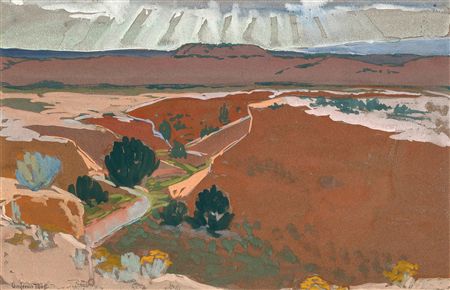
A traveler, in 1928, as part of a visit to Colorado, she began painting and sketching in the American West. After joining the Colorado faculty the following year, she chose subjects of landscapes, mining towns, cowboys, and botanics. Of this time, she said she was "pretty thoroughly acquainted with Colorado, Wyoming, New Mexico, Arizona and 'edges' of Utah and Montana." (Kovinick, 308)
Among her exhibition venues were the Denver Art Museum, National Association of Women Painters and Sculptors, Prospectors, Hoosier Salon, Carnegie Institute and Midwestern Artists. Awards included Honorable Mention, Annual Colorado Artists Exhibition, 1932-33; and First Prize, Midwest Art Exhibition, Kansas City Art Institute, 1935.
Sources:
Phil Kovinick and Marian Yoshiki Kovinick, An Encyclopedia of Women Artists of the American West
Information submitted by Katherine Tozier whose source was Who's Who in American Art, 1936-37Biography from William R Talbot Fine Art
Born in St. Louis, Missouri, Virginia True (1900-1989) studied art in the early 1920s at the John Herron Art Institute in Indianapolis and the Pennsylvania Academy of Fine Arts in Philadelphia. The former was known at the time as a bastion of the realist tradition and it was in this mode that True began her career. However, a trip to Colorado and New Mexico in the summer of 1928 exposed the artist to the tenets of southwestern modernism and she entered into a period of stylistic transition. That summer she produced a group of watercolors that signal her journey toward "the more abstract style that she would eventually make her own," as Robin West has written.
The next year True moved from Indianapolis to Boulder to take a position at the University of Colorado. Now within easy reach of the New Mexican landscape that had instantly attracted her, she made frequent trips into the mountains to produce plein-air watercolors and drawings of the scenery she observed.
Following the lead of the New Mexican modernist painter Victor Higgins, True created images in which she reduced both natural and man-made elements to grand geometric blocks and powerful sweeping lines. Among those images were charcoal drawings that captured in form and composition True's "thrill and deep feeling of the grand things I have beheld."
In 1935, True returned east to complete a master's degree at Cornell University, where she eventually received a faculty appointment. Her attention turned increasingly to the demands of her academic career. She retired to Cape Cod in 1965, where she lived until her death in 1989.
Ref.: Robin West, Virginia True (2001).