Page loaded successfully. Showing biography for Vu Cao Dam.
Vu Cao Dam BIOGRAPHY
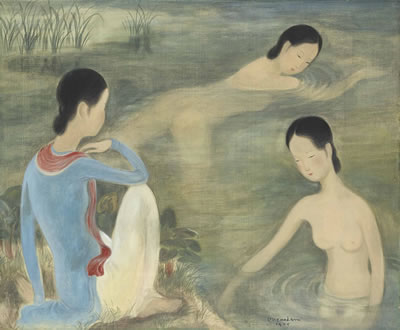
1908 Hanoi North Vietnam - 2000 France. Known for: Modernist figure, landscape and portrait bust sculpture.
Vu Cao Dam was born on January 8, 1908 in Hanoi, the capital of Tonkin. He grew up in a family that had been converted to Catholicism since the 18th century and his father, who spoke French... Read full biography
Vu Cao Dam was born on January 8, 1908 in Hanoi, the capital of Tonkin. He grew up in a family that had been converted to Catholicism since the 18th century and his father, who spoke French admirably, was sent to Paris for the 1889 Universal Exhibition. His father founded and directed the Hanoi... Read full biography
Vu Cao Dam was born on January 8, 1908 in Hanoi, the capital of Tonkin. He grew up in a family that had been converted to Catholicism since the 18th century and his father, who spoke French admirably, was sent to Paris for the 1889 Universal Exhibition. His father founded and directed the Hanoi School of Interpreters which trained the mandarins of the colonial regime. It is thus within this privileged universe, where Chinese calligraphy permeates daily life, that Vu Cao Dam evolved. In 1926, he... Read full biography
Vu Cao Dam was born on January 8, 1908 in Hanoi, the capital of Tonkin. He grew up in a family that had been converted to Catholicism since the 18th century and his father, who spoke French admirably, was sent to Paris for the 1889 Universal Exhibition. His father founded and directed the Hanoi School of Interpreters which trained the mandarins of the colonial regime. It is thus within this privileged universe, where Chinese calligraphy permeates daily life, that Vu Cao Dam evolved. In 1926, he joined the second class of the Hanoi School of Fine Arts, which was directed by the painter Victor Tardieu. There he rubbed shoulders with Mai Trung Thu, Nguyen Phan Chanh, Le Pho and learned western academic techniques thanks to lessons in... Read full biography
Vu Cao Dam was born on January 8, 1908 in Hanoi, the capital of Tonkin. He grew up in a family that had been converted to Catholicism since the 18th century and his father, who spoke French admirably, was sent to Paris for the 1889 Universal Exhibition. His father founded and directed the Hanoi School of Interpreters which trained the mandarins of the colonial regime. It is thus within this privileged universe, where Chinese calligraphy permeates daily life, that Vu Cao Dam evolved. In 1926, he joined the second class of the Hanoi School of Fine Arts, which was directed by the painter Victor Tardieu. There he rubbed shoulders with Mai Trung Thu, Nguyen Phan Chanh, Le Pho and learned western academic techniques thanks to lessons in decoration from the painter Joseph Inguimberty or in anatomy from Doctor Phénix. His ease in modelling was quickly noti... Read full biography
Artist Biography
Biography page for Vu Cao Dam ((1908 - 2000)), known for Modernist figure, landscape and portrait bust sculpture. Showing 3 biographical entries and 0 sample artworks.
Vu Cao Dam - Artist Info
About Vu Cao Dam
Name variants
Cao Dam Vu
Biography from Geringer Art, Ltd.
VU CAO DAM (Vietnamese, 1908-2000).
Painter and sculptor Vu Cao Dam was born in Hanoi in 1908. He attended the Ece des Beaux Arts de Indochine between 1926 and 1931. In 1932 he obtained a scholarship to further his studies as a sculptor in France. Eventually he specialized in painting. His painting during this period was mainly on silk, and showed the influence of ancient Chinese art.
In July 1946 Vu Cao Dam executed a bust of Ho Chi Minh at the Fountainbleu Conference held in Paris. After the French re-occupied Vietnam, the portrait bust was hidden at the house of a French farmer who was a member of the French Communist Party. In 1975, after the liberation of South Viet Nam the bust was reclaimed by Vu Cao Cam's artist daughter, Yannick Vu Jakaber who had it cast in Spain.
In 1949 Vu Cao Dam moved permanently to the south of France and became an acquaintance of Marc Chagall who influenced his painting. His paintings from this period have a lyrical, soft touch and pastel coloring.
Vu Cao Dam died, in France in 2000.Biography from Guillaume Le Floc'h (Paris & Saint-Cloud)
Vu Cao Dam was born on January 8, 1908 in Hanoi, the capital of Tonkin. He grew up in a family that had been converted to Catholicism since the 18th century and his father, who spoke French admirably, was sent to Paris for the 1889 Universal Exhibition. His father founded and directed the Hanoi School of Interpreters which trained the mandarins of the colonial regime. It is thus within this privileged universe, where Chinese calligraphy permeates daily life, that Vu Cao Dam evolved.
In 1926, he joined the second class of the Hanoi School of Fine Arts, which was directed by the painter Victor Tardieu. There he rubbed shoulders with Mai Trung Thu, Nguyen Phan Chanh, Le Pho and learned western academic techniques thanks to lessons in decoration from the painter Joseph Inguimberty or in anatomy from Doctor Phénix.
His ease in modelling was quickly noticed by Victor Tardieu, who encouraged him to join the school's brand new "sculpture" section and did not hesitate to send him to Paris where he exhibited his bronze works at the Angkor Pavilion during the 1931 International Colonial Exhibition. After studying at the École du Louvre, where he admired the Italian primitives as well as the contributions of impressionist and post-impressionist painters, he discovered the works of Rodin, Charles Despiau and Giacometti.
The bronze requisitions of the Second World War pushed the young artist to use other materials such as terracotta, which he shaped with great sensitivity. It was at this time that he produced his most beautiful pieces, which he described as "unique works". By freezing in clay the graceful silhouette of the Tonkinese, he creates a deep link between the Chinese court ladies of the Tang period and the Child Virgins of European culture. The traces of modelling that have been left behind betray the modernity of the creative act, while the highlights of colour underline the finesse and serenity of the face. These busts become an allegory of Tonkin, where tradition and modernity peacefully confront each other.
In 1946, Vu Cao Dam was the most prominent Vietnamese artist in Paris. He took advantage of his fame to meet Ho Chi Minh, then president of the new Republic, and freeze for history the new figure of Vietnam.Biography from Claude Aguttes
Vu Cao Ðàm, born in 1908 in Hanoi, Vietnam, was a renowned Vietnamese painter and sculptor. He came from a large, Catholic, and well-off family with a strong influence of French culture. Vu Cao Ðàm studied at the Hanoi School of Fine Arts under Victor Tardieu and Joseph Inguimberty, graduating in 1931. He continued his artistic development in France, where he settled permanently after exhibiting his sculptures at the 1931 International Colonial Exhibition. Inspired by European masterpieces and avant-garde movements like Fauvism, his work reflected a blend of Western and Vietnamese influences. Vu Cao Ðàm gained international recognition, exhibited in prestigious galleries, and is considered one of the greatest Vietnamese artists of his time.