Page loaded successfully. Showing biography for Walter Henry Williams.
Walter Henry Williams BIOGRAPHY
1920 Brooklyn, New York - 1998 Copenhagen, Denmark. Known for: Black child figures playing, landscape, genre, animal, fowl painting, woodcuts.
WALTER HENRY WILLIAMS, JR. (1920-1998). Walter Henry Williams favorite subjects were black children playing in fields of flowers—reflective perhaps of his own restricted childhood and his lifelong... Read full biography
WALTER HENRY WILLIAMS, JR. (1920-1998). Walter Henry Williams favorite subjects were black children playing in fields of flowers—reflective perhaps of his own restricted childhood and his lifelong desire for freedom. His mother had encouraged his art making, but she died when he was age five; his... Read full biography
WALTER HENRY WILLIAMS, JR. (1920-1998). Walter Henry Williams favorite subjects were black children playing in fields of flowers—reflective perhaps of his own restricted childhood and his lifelong desire for freedom. His mother had encouraged his art making, but she died when he was age five; his father gained custody and was very strict. As a result, Williams became introverted, retreating into a dream world of his own making. Williams was born in Brooklyn, New York, and grew up there, working... Read full biography
WALTER HENRY WILLIAMS, JR. (1920-1998). Walter Henry Williams favorite subjects were black children playing in fields of flowers—reflective perhaps of his own restricted childhood and his lifelong desire for freedom. His mother had encouraged his art making, but she died when he was age five; his father gained custody and was very strict. As a result, Williams became introverted, retreating into a dream world of his own making. Williams was born in Brooklyn, New York, and grew up there, working as a house painter until he was drafted into the United States Army. He served from 1942 to 1945 in France and was assigned the grim task of burying soldiers. Using the GI Bill, he went to the Brooklyn Museum Art School from 1951 until 1955 where... Read full biography
WALTER HENRY WILLIAMS, JR. (1920-1998). Walter Henry Williams favorite subjects were black children playing in fields of flowers—reflective perhaps of his own restricted childhood and his lifelong desire for freedom. His mother had encouraged his art making, but she died when he was age five; his father gained custody and was very strict. As a result, Williams became introverted, retreating into a dream world of his own making. Williams was born in Brooklyn, New York, and grew up there, working as a house painter until he was drafted into the United States Army. He served from 1942 to 1945 in France and was assigned the grim task of burying soldiers. Using the GI Bill, he went to the Brooklyn Museum Art School from 1951 until 1955 where his instructors were Ben Shahn and Reuben Tam. He was given a scholarship to attend the Skowhegan School of Painting a... Read full biography
Artist Biography
Biography page for Walter Henry Williams ((1920 - 1998)), known for Black child figures playing, landscape, genre, animal, fowl painting, woodcuts. Showing 3 biographical entries and 0 sample artworks.
Walter Henry Williams - Artist Info
About Walter Henry Williams
Biography from Alpen Gallery
 Walter Williams, painter, print-maker, and sculptor, was born in Brooklyn, New York where he attended the public schools. He studied at the Brooklyn Museum Art School for four years (1951-1955) where he came into contact with Ben Shahn, Reuben Tam, Victor Candell, and Gregorio Prestopino. The latter's rich velvety blacks undershot with deep reds and greens strongly influenced Williams' own work.
In 1953 Williams won a summer scholarship to the art school at Skowhegan, Maine, and there won first prize for painting. He began to exhibit his work in 1954, and in 1955 won a Whitney Fellowship that permitted him to travel and work in Mexico. He won the National Institute of Arts and Letters grant in 1960 and the Silvermine Award in 1963, among others. Williams went to Europe in 1960, spent some time in Amsterdam and London and then settled in Copenhagen for four years. He then moved to Rome, remained until 1966 when he became artist-in-residence at Fisk University in Nashville, Tennessee.
He has had many one-man shows and participated in a great many group exhibitions, showing paintings and prints, drawings and sculpture. Many of his works are in important museums; among these are The Metropolitan Museum of Art, New York, the National Gallery of Art, Washington, D.C., and the Whitney Museum of American Art, New York.
The word that comes to mind when this artist's name is mentioned is "nature," for Williams, although born and brought up in the largest city in the world, can still remember when part of that city was a flowering tree-lined area in which children could escape the hard pavements and enjoy the pleasures of the sights and sounds that most of us delight in: birds, soft summer evenings, green landscapes;
The Chairman of the Department of Art at Fisk University wrote of him: "Paintings and prints echo more than childhood memories, but also a dream world where the mind is at peace with nature and self. . .one of the rays of light so often needed in a so often light-deprived world."
Source:
Modern Makers Gallery,
http://modernmakersgallery.com/products/103-williams-walter-henry-harvest.aspxBiography from The Johnson Collection
WALTER HENRY WILLIAMS, JR. (1920-1998)
Walter Henry Williams favorite subjects were black children playing in fields of flowers—reflective perhaps of his own restricted childhood and his lifelong desire for freedom. His mother had encouraged his art making, but she died when he was age five; his father gained custody and was very strict. As a result, Williams became introverted, retreating into a dream world of his own making.
Williams was born in Brooklyn, New York, and grew up there, working as a house painter until he was drafted into the United States Army. He served from 1942 to 1945 in France and was assigned the grim task of burying soldiers. Using the GI Bill, he went to the Brooklyn Museum Art School from 1951 until 1955 where his instructors were Ben Shahn and Reuben Tam.
He was given a scholarship to attend the Skowhegan School of Painting and Sculpture in Maine for the summer of 1953, where he roomed with David Driskell; they were the only black students that session and became lifelong friends. The school attracted aspiring artists who were taught and mentored by a diverse group of practicing artists; for instance, the following year both Shahn and Jacob Lawrence were on the faculty. Williams won a first-place award for painting. That same year he won a third-prize gold medal in an exhibition held at the Harlem branch of the YWCA and at the award ceremony Charles White was the speaker.
Three years later, in 1956, Williams used a John Hay Whitney Foundation Fellowship to travel to Denmark, chosen because his maternal grandfather was from the Danish West Indies (now part of the Virgin Islands in the Caribbean) and thought highly of the country. Denmark was a transformative experience for Williams; prior to this time his subjects were primarily urban and included paintings with such titles as Store Front Jesus and Poultry Market.
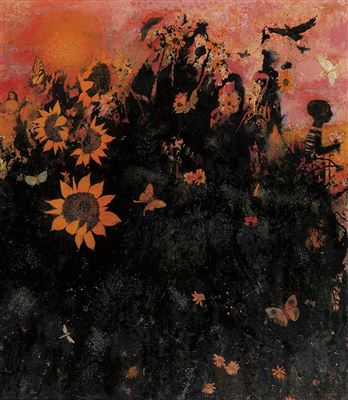
He spent time on Bornholm, an island in the Baltic Sea known as the “sunshine island,” where the dramatic landscape influenced his work. He began to depict birds, butterflies, sunflowers, and watermelons which have been interpreted as symbols of rebirth and freedom. Many years later, in a review of the artist’s work, Driskell explained that Williams has “used nature as metaphor: the birds in flight and the butterflies in his compositions symbolize the freedom that African Americans desired to have to move about freely, undisturbed. The sunflowers symbolize hope of a brighter day ahead, as does the beautiful pink and orange sky so often seen in many of the artist’s works. Sunflowers offer both hope and beauty, while their missing petals suggest the incompleteness of the story–the work still to be done.”
Upon his return to the States, Williams met with some success. In 1958 Ebony magazine featured him in a cover story. Soon after, from 1959 to 1963, he was in Mexico, traveling and painting, and he told a reporter there that “freedom from racial prejudice was essential for his further development.” His work was included in exhibitions in Mexico, as well as in Copenhagen, Stockholm, and Sydney, Australia. In 1963 he was chosen for an award by the Silvermine Guild of Artists of New Canaan, Connecticut.
He returned to Copenhagen where he organized an exhibition, Ten American Negro Artists Living and Working in Europe; Beauford Delaney was one of the artists Williams selected. Back in the United States Williams was recruited by his friend Driskell to join the art department at Fisk University in Nashville, Tennessee, where, accompanied by his wife Marlena, Williams was artist-in-residence from 1968 to 1969. At the end of his appointment at Fisk he returned to Denmark, and ten years later became a Danish citizen. Unfortunately, in 1980 a studio fire destroyed much of his work.
In addition to being a painter, Williams was a printmaker who also made a few three-dimensional pieces. He was commissioned to do a number of prints for the International Graphic Arts Society in editions of 210. Half of these works were sold in the United States and the other half in Europe, with ten proofs reserved for the artist. This gave Williams an international following that allowed him to continue his work as a printmaker. Much of his art is dominated by the same theme, that of a child or children outdoors accompanied by birds and various insects, especially butterflies. Typically, the children have very dark skin and bold faces, while the flowers and background radiate with bright colors. In 1973 Driskell visited Denmark and told a reporter that Williams had explained: “All my life I have been painting one picture. It is one that reflects my own image and the inner thoughts of my mind. I feel the naivete of a child when I paint yet I have the passions of the father that I am. I am an artist who is full of love for the world and all the images it holds.”
The Johnson Collection, Spartanburg, South Carolina
thejohnsoncollection.orgBiography from California African American Museum
Walter Williams was born in Brooklyn, New York, August 11, 1920. He studied art at the Brooklyn Museum Art School under Ben Shahn, Reuben Tam and Gregoria Prestopino. He also spent a summer studying art at the Skowhegan School of Painting and Sculpture in Maine.
About six or seven years after completing his art studies, sometime in the early 1960s, Williams moved to Copenhagen, Denmark. He returned briefly to the United States, where he completed a body of work informed by the experiences of being an African American living in the South.
It was while he was in Copenhagen, however, that he created a series of colorful woodcuts of black children playing in fields of flowers. He died in Copenhagen in June 1998.