Page loaded successfully. Showing biography for Walter Withers.
Walter Withers BIOGRAPHY
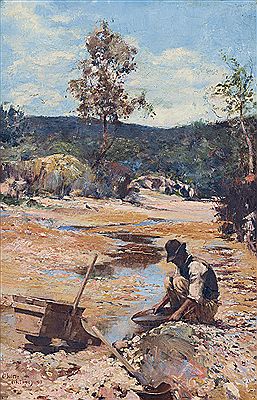
1854 Handsworth, Staffordshire, England - 1914 Eltham, Victoria, Australia. Known for: Impressionist landscape painting.
Walter Herbert Withers was an Australian landscape artist and a member of the Heidelberg School of Australian impressionists*. Withers was born at Handsworth, Staffordshire, the son of Edwin Withers.... Read full biography
Walter Herbert Withers was an Australian landscape artist and a member of the Heidelberg School of Australian impressionists*. Withers was born at Handsworth, Staffordshire, the son of Edwin Withers. He showed an early desire to paint, but objection was made to this by his father. It is not known... Read full biography
Walter Herbert Withers was an Australian landscape artist and a member of the Heidelberg School of Australian impressionists*. Withers was born at Handsworth, Staffordshire, the son of Edwin Withers. He showed an early desire to paint, but objection was made to this by his father. It is not known what occupation he followed in England, but his father objected to his becoming a professional painter. In 1882 Walter arrived in Australia with the intention of working on a farm. After working for... Read full biography
Walter Herbert Withers was an Australian landscape artist and a member of the Heidelberg School of Australian impressionists*. Withers was born at Handsworth, Staffordshire, the son of Edwin Withers. He showed an early desire to paint, but objection was made to this by his father. It is not known what occupation he followed in England, but his father objected to his becoming a professional painter. In 1882 Walter arrived in Australia with the intention of working on a farm. After working for about 18 months on a farm, Withers removed to Melbourne and obtained a position as draughtsman in a firm of printers. During the period of his black and white work, Withers executed, in chalk, portraits for reproduction with that of the Count von... Read full biography
Walter Herbert Withers was an Australian landscape artist and a member of the Heidelberg School of Australian impressionists*. Withers was born at Handsworth, Staffordshire, the son of Edwin Withers. He showed an early desire to paint, but objection was made to this by his father. It is not known what occupation he followed in England, but his father objected to his becoming a professional painter. In 1882 Walter arrived in Australia with the intention of working on a farm. After working for about 18 months on a farm, Withers removed to Melbourne and obtained a position as draughtsman in a firm of printers. During the period of his black and white work, Withers executed, in chalk, portraits for reproduction with that of the Count von Bismark being an especially fine example of his work in this direction. In his spare time Withers sought to cultivate his art, and event... Read full biography
Artist Biography
Biography page for Walter Withers ((1854 - 1914)), known for Impressionist landscape painting. Showing 2 biographical entries and 0 sample artworks.
Walter Withers - Artist Info
About Walter Withers
Biography from the Archives of askART
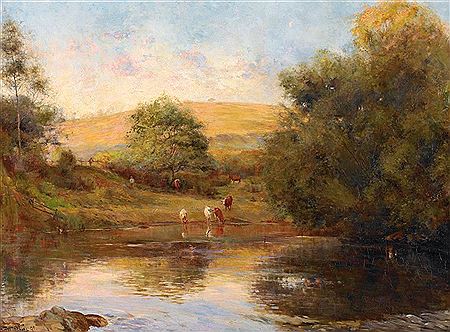 Walter Herbert Withers was an Australian landscape artist and a member of the Heidelberg School of Australian impressionists*.
Withers was born at Handsworth, Staffordshire, the son of Edwin Withers. He showed an early desire to paint, but objection was made to this by his father. It is not known what occupation he followed in England, but his father objected to his becoming a professional painter.
In 1882 Walter arrived in Australia with the intention of working on a farm. After working for about 18 months on a farm, Withers removed to Melbourne and obtained a position as draughtsman in a firm of printers. During the period of his black and white work, Withers executed, in chalk, portraits for reproduction with that of the Count von Bismark being an especially fine example of his work in this direction. In his spare time Withers sought to cultivate his art, and eventually had work accepted for exhibition in the Old Academy, Melbourne.
In 1887 Withers went to Europe, and there he married Miss F. Flinn on 11 October 1887. He and his wife settled in a small flat in Paris, and he studied for some months at the Académie Julian*.
He returned to Australia with his wife in June 1888 having been commissioned to do black and white work for Messrs Fergusson and Mitchell of Melbourne. His most important work in this way will be found in the illustrations to Edmund Finn's, The Chronicles of Early Melbourne.
Withers settled down at first at Kew, a suburb of Melbourne, and then in Eaglemont on the other side of the river Yarra. He became friendly with Arthur Streeton, Charles Conder, Tom Roberts, Frederick McCubbin and other leading artists of the period. He began to sell a few pictures, but the collapse of the land boom put an end to his illustrative work. In 1890 he took out a lease on the south wing of the "Charterisville" mansion in East Ivanhoe, where he and his family lived for four years.
Withers' influence as a painter, upon younger art students of his time, was marked. He obtained some work as a drawing and painting master in schools, and amongst those who were his pupils were Percy Lindsay, and his younger brother Norman Lindsay.
In 1891 he opened a studio in Collins Street West, where he held his first private exhibition. From 1894 Withers spent the next four years in a cottage in Cape Street, Heidelberg, Victoria. It was here that he painted some of his finest work, of the fin de siècle period. In 1894 his masterpiece, Tranquil Winter, was exhibited at the Victorian Artists' Society exhibition and bought by the trustees of the National Gallery of Victoria. The Selector's Home, painted in 1895, was an achievement that won the admiration of Arthur Streeton and Fred McCubbin.
He settled down to a steady career of painting though not at first successful commercially. In 1897 he was awarded the first Wynne Prize* at Sydney for his picture, The Storm, which was in the same year purchased for the National Gallery of New South Wales. He was elected to the council of the Victorian Artists' Society in 1889, and in 1905 held the office of president for a year. His health was deteriorating towards the end of his life but he continued to do a large amount of painting both in oils and in water-colours.
He died in Eltham, Victoria on 13 October 1914 and was survived by his wife and four children.
Source:
http://en.wikipedia.org/wiki/Walter_Withers
* For more in-depth information about these terms and others, see AskART.com Glossary http:www.askart.com/AskART/lists/Art_Definition.aspxBiography from Deutscher and Hackett Melbourne
WALTER WITHERS, (1854 – 1914), Withers was born in Warwickshire, far from the home in Cape Street, Heidelberg, where he and his wife Fanny settled in 1894. The climate was dramatically different. And it was here, many agree, that he painted some of his finest works, from smaller, engaging atmospheric studies, as in The Hot Road, to the major compositions such as Tranquil Winter, 1895, purchased the same year by the National Gallery of Victoria.
His stature as a landscape painter of considerable note was confirmed when, in 1897, he won the first Wynne Prize for the best landscape painting of the year with The Storm, 1896 (Art Gallery of New South Wales, Sydney). He was awarded the prize again in 1900 with Still Autumn.