Page loaded successfully. Showing biography for Ward Lockwood.
Ward Lockwood BIOGRAPHY
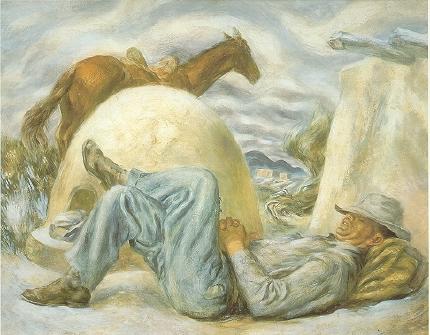
1894 Atchison, Kansas - 1963 Talpa (Taos), New Mexico. Known for: Modernist-leaning landscape, genre, graphics.
Born in Atchison, Kansas, Ward Lockwood became a key painter in the Taos, New Mexico art colony, but diverse modernist art styles including Expressionism*, Cubism*, Surrealism* and Constructivism*... Read full biography
Born in Atchison, Kansas, Ward Lockwood became a key painter in the Taos, New Mexico art colony, but diverse modernist art styles including Expressionism*, Cubism*, Surrealism* and Constructivism* reflected his wide ranging travels in Europe and the United States. From the 1920s to the 1960s, his... Read full biography
Born in Atchison, Kansas, Ward Lockwood became a key painter in the Taos, New Mexico art colony, but diverse modernist art styles including Expressionism*, Cubism*, Surrealism* and Constructivism* reflected his wide ranging travels in Europe and the United States. From the 1920s to the 1960s, his work embraced a series of stylistic changes characteristic of people who influenced him, including John Marin and Andrew Dasburg. He studied at the University of Kansas, and from 1914 to 1917 at the... Read full biography
Born in Atchison, Kansas, Ward Lockwood became a key painter in the Taos, New Mexico art colony, but diverse modernist art styles including Expressionism*, Cubism*, Surrealism* and Constructivism* reflected his wide ranging travels in Europe and the United States. From the 1920s to the 1960s, his work embraced a series of stylistic changes characteristic of people who influenced him, including John Marin and Andrew Dasburg. He studied at the University of Kansas, and from 1914 to 1917 at the Pennsylvania Academy of Fine Arts* where he was introduced to Modernism*. In 1917, he began a two-year enlistment in the Army and served in France, and in 1921, a return visit to France led to his being influenced by Paul Cezanne and Vincent Van Gogh.... Read full biography
Born in Atchison, Kansas, Ward Lockwood became a key painter in the Taos, New Mexico art colony, but diverse modernist art styles including Expressionism*, Cubism*, Surrealism* and Constructivism* reflected his wide ranging travels in Europe and the United States. From the 1920s to the 1960s, his work embraced a series of stylistic changes characteristic of people who influenced him, including John Marin and Andrew Dasburg. He studied at the University of Kansas, and from 1914 to 1917 at the Pennsylvania Academy of Fine Arts* where he was introduced to Modernism*. In 1917, he began a two-year enlistment in the Army and served in France, and in 1921, a return visit to France led to his being influenced by Paul Cezanne and Vincent Van Gogh. During this time, he studied in Paris at the Academie Ranson*, but got bored with the academic climate of that... Read full biography
Artist Biography
Biography page for Ward Lockwood ((1894 - 1963)), known for Modernist-leaning landscape, genre, graphics. Showing 7 biographical entries and 0 sample artworks.
Ward Lockwood - Artist Info
About Ward Lockwood
Name variants
John Ward Lockwood
Biography from the Archives of askART
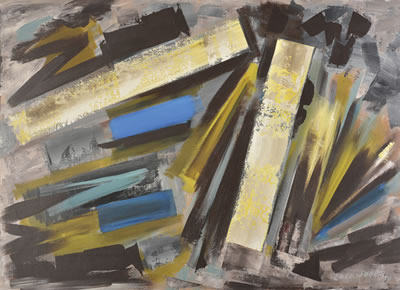 Born Atchison, Sept. 22, 1894; died Taos, NM, July 6, 1963. Painter. Lithographer. Decorator. Teacher.
Worked on the art staff of the Kansas City Star in 1912.
Studied at University of Kansas, Lawrence 1912-14, at the Pennsylvania Academy of Fine Arts in1914-17, and, after service in World War I, at Ransom Academie in Paris in 1921.
In 1922, he returned to Kansas, committed to the idea that an artist does his best painting in his own culture. He worked as a commercial artist and also did portrait commissions. Lockwood moved to Taos in 1926 and, although he traveled widely, he maintained a home and studio there the rest of his life. In summer 1932 and 1933, he taught at the Broadmoor Art Academy, Colorado Springs, CO. In 1936 Lockwood painted a mural for the Wichita Post Office, Pioneer in Kansas.
He was a professor of Art and head of the Department of Art at the University of Texas, Austin from 1938-49 and at the University of California, Berkeley from 1949-61. He served as Rose Morgan Visiting Professor & Artist in residence at University of Kansas, Lawrence, 1957-58 while on leave from the University of California. He retired from teaching and returned to Taos in 1962.Biography from the Archives of askART
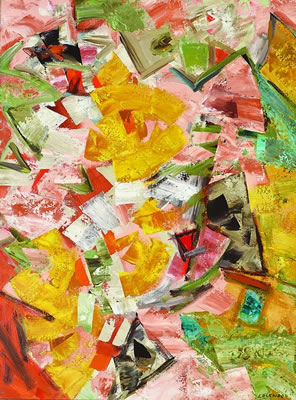 Born in Atchison, Kansas, Ward Lockwood became a key painter in the Taos, New Mexico art colony, but diverse modernist art styles including Expressionism*, Cubism*, Surrealism* and Constructivism* reflected his wide ranging travels in Europe and the United States. From the 1920s to the 1960s, his work embraced a series of stylistic changes characteristic of people who influenced him, including John Marin and Andrew Dasburg.
He studied at the University of Kansas, and from 1914 to 1917 at the Pennsylvania Academy of Fine Arts* where he was introduced to Modernism*. In 1917, he began a two-year enlistment in the Army and served in France, and in 1921, a return visit to France led to his being influenced by Paul Cezanne and Vincent Van Gogh.
During this time, he studied in Paris at the Academie Ranson*, but got bored with the academic climate of that school and spent time at the Louvre and galleries along the Rue de la Boetie. He painted from local models and traveled around France with fellow Kansan, Kenneth Adams. He was much impressed with the diversity of contemporary art movements including Futurism*, Cubism, and Dadaism*. His work from this period shows influences of Geometric Abstraction* and Impressionism.
In 1922, he returned to Kansas, committed to the idea that an artist does best painting in his own culture. He worked as a commercial artist and also did portrait commissions.
In 1926, he and his wife, artist Clyde Bonebrake, moved to Taos, New Mexico because of his friendship with Kenneth Adams, who was already established there. Lockwood became interested in the Taos Society of Artists*, dedicated to a mutual effort of marketing their art work. Major influences there for a loosening of style were modernists Andrew Dasburg and John Marin. Watercolor became Lockwood's preferred medium because he felt that it gave him more freedom of expression.
In the 1930s, he left Taos because of his need to make more money. He did numerous murals for the Federal Arts Project* and accepted teaching positions at the Broadmoor Academy* in Colorado Springs and in 1938, became Chair of the Department of Art at the University of Texas in Austin.
Subsequently he taught at at the University of California at Berkeley and at the University of Kansas at Lawrence. In 1940, he moved to San Francisco and experimented with Abstraction* and Assemblage* but was again in the Army during World War II, advancing to the rank of colonel.
After that, he returned to California to teach and was much influenced by the modernist art environment there, exhibiting with the Abstract-Expressionist painters of the controversial San Francisco Art Association. He made frequent summer trips to Taos, where he settled during his final years.
In 1962, Lockwood retired from teaching and returned to Taos where he died the following year. By the time he died, four hundred paintings were in his estate collection.
Sources include:
John and Deborah Powers, Texas Painters, Sculptors and Graphic Artists
Matthew Baigell, Dictionary of American Artists
Dean Porter, Taos Artists
* For more in-depth information about these terms and others, see AskART.com Glossary http://www.askart.com/AskART/lists/Art_Definition.aspxBiography from the Archives of askART
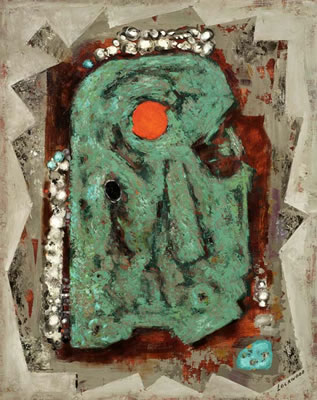 Born on Sept. 22, 1894 in Atchison, KS. From the University of Kansas, Lockwood studied at the PAFA and Académie Ranson in Paris. While based in Taos (NM), he taught at the University of Texas (1938-49) and UC Berkeley (1949-61). He died in Talpa, near Taos, New Mexico on July 6, 1963.
Exh: Salon d'Automne, (Paris), 1922; AIC, 1931 (prize); CPLH, 1932; SFMA, 1932 (prize), 1953; Denver Museum, 1932; Calif. WC Society, 1939; Pasadena Museum, 1960.
In: Denver Museum; PAFA; CPLH; SFMA; Santa Barbara Museum; Wichita (KS) Post Office (mural).Biography from Foltz Fine Art
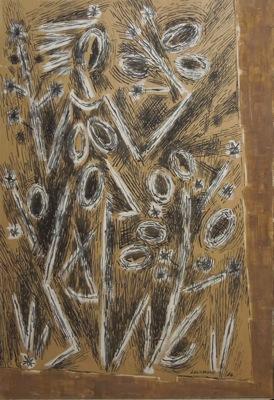 Ward Lockwood
(1894 - 1963)
Born in Atchison, Kansas, Ward Lockwood became a key painter in the Taos, New Mexico art colony, but diverse modernist art styles including Expressionism, Cubism, Surrealism and Constructivism reflected his wide ranging travels in Europe and the United States. From the 1920s to the 1960s, his work embraced a series of stylistic changes characteristic of people who influenced him, including John Marin and Andrew Dasburg.
He studied at the University of Kansas, and from 1914 to 1917 at the Pennsylvania Academy of Fine Arts where he was introduced to Modernism. In 1917, he began a two-year enlistment in the Army and served in France, and in 1921, a return visit to France led to his being influenced by Paul Cezanne and Vincent Van Gogh.
During this time, he studied in Paris at the Academie Ranson, but got bored with the academic climate of that school and spent time at the Louvre and galleries along the Rue de la Boetie. He painted from local models and traveled around France with fellow Kansan, Kenneth Adams. He was much impressed with the diversity of contemporary art movements including Futurism, Cubism, and Dadaism. His work from this period shows influences of Geometric Abstraction* and Impressionism.
In 1922, he returned to Kansas, committed to the idea that an artist does best painting in his own culture. He worked as a commercial artist and also did portrait commissions.
In 1926, he and his wife, artist Clyde Bonebrake, moved to Taos, New Mexico because of his friendship with Kenneth Adams, who was already established there. Lockwood became interested in the Taos Society of Artists, dedicated to a mutual effort of marketing their artwork. Major influences there for a loosening of style were modernists Andrew Dasburg and John Marin. Watercolor became Lockwood's preferred medium because he felt that it gave him more freedom of expression.
In the 1930s, he left Taos because of his need to make more money. He did numerous murals for the Federal Arts Project and accepted teaching positions at the Broadmoor Academy in Colorado Springs and in 1938, became Chair of the Department of Art at the University of Texas in Austin.
Subsequently he taught at the University of California at Berkeley and at the University of Kansas at Lawrence. In 1940, he moved to San Francisco and experimented with Abstraction and Assemblage but was again in the Army during World War II, advancing to the rank of colonel.
After that, he returned to California to teach and was much influenced by the modernist art environment there, exhibiting with the Abstract-Expressionist painters of the controversial San Francisco Art Association. He made frequent summer trips to Taos, where he settled during his final years.
In 1962, Lockwood retired from teaching and returned to Taos where he died the following year. By the time he died, four hundred paintings were in his estate collection.Biography from Altermann Galleries and Auctioneers, II
Born: Atchison, Kansas 1894
Died: Taos, New Mexico 1963
Contemporary Taos painter, illustrator, printmaker, teacher
Ward Lockwood studied at the University of Kansas (1912-14), the Philadelphia Academy of Fine Art (1914-16), and, after service in WWI, in Paris at Academie Ranson. A friend of Kenneth Adams, Lockwood was drawn to Taos in 1926, because it was cheap. He was considered a follower of Dasburg in his simplified landscapes. He also worked with Marin during Marin's visits in 1929 and 1930, and spent the summers of 1932-33 at Colorado Spring Fine Arts Center with Boardman Robinson.
During the Depression, Lockwood painted government-sponsored murals in New Mexico. With the University of New Mexico (1936-37), he was professor of art at University of Texas (1938-49) and University of California at Berkeley (1949-61). A "regionalist" of New Mexico in the 1930s, his work became increasingly abstract. He received more than 45 one-man shows.
Source:
Peggy and Harold Samuels, The Encyclopedia of Artists of the American WestBiography from Mark Sublette Medicine Man Gallery
Ward Lockwood was born in Atchison, Kansas in 1894. Studying at Pennsylvania Academy and in Paris, Lockwood developed a talent for several forms of modernist painting. Moving to Taos in 1926, Lockwood, along with his friends Kenneth Adams, John Marin and Andrew Dasburg, began to take the painting of the region in a more modernist direction. Lockwood himself painted in Cubist, Expressionist, Surrealist and Constructivist style while in Taos, and his pieces often have little in common with each other. Te majority of his pieces are watercolors.
Though Lockwood's career is primarily defined by the work he did while in Taos, he painted and taught for a variety of corporations and universities. He did work for the WPA and the Federal Arts Project before accepting teaching positions at, in chronological order, Broadmoor Academy in Colorado Springs, the University of Texas at Austin and the University of California- Berkeley. He also exhibited with the abstract-expressionist painters of the San Francisco Art Association. In 1963 he moved back to Taos and died the following year.Biography from Canfield Gallery
John Ward Lockwood was a key figure in American painting in the first half of this century; he exhibited widely and he was an influential teacher and writer. Today his work is in most major museums.
Lockwood studied at the Pennsylvania Academy and in Paris, followed by a year painting in the south of France with Kenneth Adams, a fellow Kansan.
In 1926, Lockwood and his wife moved to Taos where Adams had already joined the Taos Society of Artists. Lockwood's work, at first characteristic of the regionalist painting of early Taos, soon began to show the influence of his modernist-mentors and fly-fishing companion, artists John Marin and Andrew Dasburg, and of Cubism. Lockwood had begun a steady progress toward the Modernist style that characterized his mature work. Along with Bert Phillips and Victor Higgins, he painted the Taos County Courthouse murals. Although he maintained a home and studio near Taos for the rest of his life, Lockwood traveled widely.
In 1932 he took a position at the Broadmoor Academy in Colorado Springs, taught painting and lithography, and worked on WPA. public murals with Dasburg. In the 1940s he taught at the University of Texas, where he founded the painting department. During the 1950s he was on the painting faculty at Berkeley and exhibited with the abstract expressionist painters of the then-controversial San Francisco Art Association.
The critic Alfred Frankenstein praised Lockwood as "a magnificent composer and painterly craftsman. The subtleties of his surface are fully equated with the strength of his forms, and the total effect of his work is therefore one of completely ripened statement". A text accompanying a San Francisco Museum of Modern Art exhibition explains the artist's evolution: "Lockwood explored a variety of modern styles, including expressionism, cubism, surrealism, and constructivism, without fully embracing any of them as a signature style. He deftly moved from the figurative to the abstract, the gestural to the geometric, and the linear to the chromatic."
During his life his work was shown in more than forty individual exhibitions.
After Ward Lockwood's death, the University of Texas Art Museum organized a retrospective exhibition that toured five American museums. In 1968, Charles Eldredge wrote a biography, published by the University of Kansas, which has extensive holdings of Lockwood work.