Page loaded successfully. Showing biography for William Closson.
William Closson BIOGRAPHY
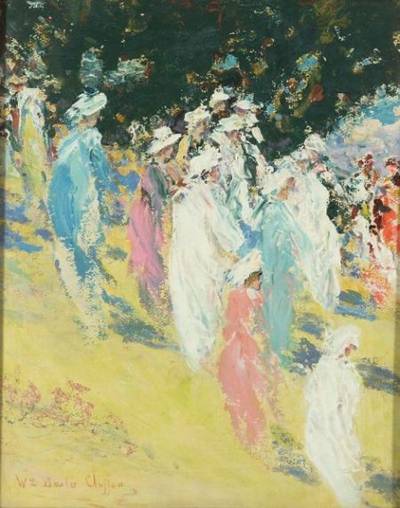
1848 Thetford, Vermont - 1926 Hartford, Connecticut. Known for: Figure-allegory, genre, wood engraver.
A student at the Lowell Institute in Lowell, Massachusetts, William Closson had an early career as an engraver and worked from 1881 to 1883 in Europe where he engraved masterpieces for "Harper's"... Read full biography
A student at the Lowell Institute in Lowell, Massachusetts, William Closson had an early career as an engraver and worked from 1881 to 1883 in Europe where he engraved masterpieces for "Harper's" magazine. In 1888, he created a wood-engraving technique, and he did engraving for Louis Prang. In... Read full biography
A student at the Lowell Institute in Lowell, Massachusetts, William Closson had an early career as an engraver and worked from 1881 to 1883 in Europe where he engraved masterpieces for "Harper's" magazine. In 1888, he created a wood-engraving technique, and he did engraving for Louis Prang. In 1890, he changed his focus from engraving to painting with oils and pastels. Source:. Peter Falk, "Who Was Who in American Art"... Read full biography
A student at the Lowell Institute in Lowell, Massachusetts, William Closson had an early career as an engraver and worked from 1881 to 1883 in Europe where he engraved masterpieces for "Harper's" magazine. In 1888, he created a wood-engraving technique, and he did engraving for Louis Prang. In 1890, he changed his focus from engraving to painting with oils and pastels. Source:. Peter Falk, "Who Was Who in American Art"... Read full biography
A student at the Lowell Institute in Lowell, Massachusetts, William Closson had an early career as an engraver and worked from 1881 to 1883 in Europe where he engraved masterpieces for "Harper's" magazine. In 1888, he created a wood-engraving technique, and he did engraving for Louis Prang. In 1890, he changed his focus from engraving to painting with oils and pastels. Source:. Peter Falk, "Who Was Who in American Art"... Read full biography
Artist Biography
Biography page for William Closson ((1848 - 1926)), known for Figure-allegory, genre, wood engraver. Showing 2 biographical entries and 0 sample artworks.
William Closson - Artist Info
About William Closson
Biography from the Archives of askART
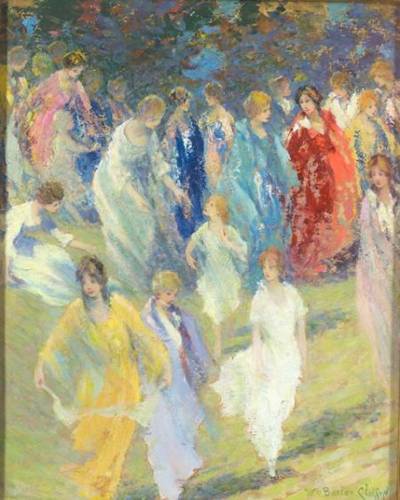 A student at the Lowell Institute in Lowell, Massachusetts, William Closson had an early career as an engraver and worked from 1881 to 1883 in Europe where he engraved masterpieces for "Harper's" magazine. In 1888, he created a wood-engraving technique, and he did engraving for Louis Prang.
In 1890, he changed his focus from engraving to painting with oils and pastels.
Source:
Peter Falk, "Who Was Who in American Art"Biography from Whistler House Museum of Art
The following is from Peter Kostoulakos, ISA ˜ Fine Art Consultant www.pkart.com
William Baxter Palmer Closson, a painter and wood engraver of portraits, genre, landscapes, coastal scenes and gardens, resided and worked in Newton and Magnolia, MA. He was born in Thetford, VT on October 13, 1848 and died in May of 1926 just months before his 78th birthday.
Closson studied at the Lowell Institute in Boston, MA and was a member of the Boston Art Club; Copley Society; Washington Society of Artists; Washington Art Club; Connecticut Academy of Fine Arts; Allied Artists of America; American Institute of Graphic Arts; Union Internationale des Beaux-Arts et des Lettres; National Arts Club; and League of American Artists, Massachusetts.
Closson exhibited and won medals at the Charitable Mechanics Association; the Paris Salon, 1882; the Columbian Exposition in Chicago; and the St. Louis Exposition of 1904.
William B. P. Closson's work is in the collections of the National Gallery of Art, Boston Museum of Fine Arts, New York Public Library, Carnegie Institute, John Herron Art Institute in Indianapolis, Albright-Knox Art Gallery in Buffalo, Gallaudet College, and National Arts Club in New York.
Reference:
Peter Falk, "Who Was Who in American Art", vol. I, page 119; Ray Davenport, "Davenport's Art Reference" 2001/2002, page 418