Page loaded successfully. Showing biography for William Roberts.
William Roberts BIOGRAPHY
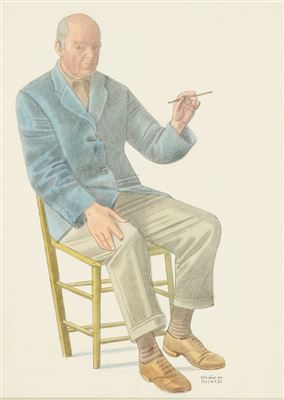
1895 London, England - 1980. Known for: Military theme, figur, genre painting, teaching.
William Roberts (5 June 1895 - 20 January 1980) was an English painter and war artist. Son of a carpenter, Roberts was born in Hackney, London. In 1909 he took up an apprenticeship with the... Read full biography
William Roberts (5 June 1895 - 20 January 1980) was an English painter and war artist. Son of a carpenter, Roberts was born in Hackney, London. In 1909 he took up an apprenticeship with the advertising firm of Sir Joseph Causton Ltd, intending to become a poster designer, and he attended evening... Read full biography
William Roberts (5 June 1895 - 20 January 1980) was an English painter and war artist. Son of a carpenter, Roberts was born in Hackney, London. In 1909 he took up an apprenticeship with the advertising firm of Sir Joseph Causton Ltd, intending to become a poster designer, and he attended evening classes at St Martin's School of Art in London. He won a London County Council scholarship to the Slade School of Art* in 1910. His contemporaries included a number of brilliant young students, among... Read full biography
William Roberts (5 June 1895 - 20 January 1980) was an English painter and war artist. Son of a carpenter, Roberts was born in Hackney, London. In 1909 he took up an apprenticeship with the advertising firm of Sir Joseph Causton Ltd, intending to become a poster designer, and he attended evening classes at St Martin's School of Art in London. He won a London County Council scholarship to the Slade School of Art* in 1910. His contemporaries included a number of brilliant young students, among them Dora Carrington, Mark Gertler, Paul Nash, Christopher Nevinson, Stanley Spencer and David Bomberg. Roberts was intrigued by Post-impressionism* and Cubism*, an interest fuelled by his travels in France and Italy after leaving the Slade in 1913.... Read full biography
William Roberts (5 June 1895 - 20 January 1980) was an English painter and war artist. Son of a carpenter, Roberts was born in Hackney, London. In 1909 he took up an apprenticeship with the advertising firm of Sir Joseph Causton Ltd, intending to become a poster designer, and he attended evening classes at St Martin's School of Art in London. He won a London County Council scholarship to the Slade School of Art* in 1910. His contemporaries included a number of brilliant young students, among them Dora Carrington, Mark Gertler, Paul Nash, Christopher Nevinson, Stanley Spencer and David Bomberg. Roberts was intrigued by Post-impressionism* and Cubism*, an interest fuelled by his travels in France and Italy after leaving the Slade in 1913. Later in 1913 he joined Roger Fry's Omega Workshops for three mornings a week, and the ten shillings a time that Omega... Read full biography
Artist Biography
Biography page for William Roberts ((1895 - 1980)), known for Military theme, figur, genre painting, teaching. Showing 2 biographical entries and 0 sample artworks.
William Roberts - Artist Info
About William Roberts
Biography from the Archives of askART
 William Roberts (5 June 1895 - 20 January 1980) was an English painter and war artist. Son of a carpenter, Roberts was born in Hackney, London. In 1909 he took up an apprenticeship with the advertising firm of Sir Joseph Causton Ltd, intending to become a poster designer, and he attended evening classes at St Martin's School of Art in London.
He won a London County Council scholarship to the Slade School of Art* in 1910. His contemporaries included a number of brilliant young students, among them Dora Carrington, Mark Gertler, Paul Nash, Christopher Nevinson, Stanley Spencer and David Bomberg.
Roberts was intrigued by Post-impressionism* and Cubism*, an interest fuelled by his travels in France and Italy after leaving the Slade in 1913. Later in 1913 he joined Roger Fry's Omega Workshops for three mornings a week, and the ten shillings a time that Omega paid enabled him to create challenging Cubist-style paintings such as The Return of Ulysses (now owned by Castle Museum and Art Gallery, Nottingham).
After leaving Omega he was taken up by Wyndham Lewis, who was forming a British alternative to Futurism*. Ezra Pound had suggested the name Vorticism*, and Roberts's work was featured in both editions of the Vorticist literary magazine BLAST. Roberts himself, however, later preferred the description 'Cubist' for his work of this period.
In 1916 Roberts enlisted in the Royal Artillery as a gunner, serving on the Western Front. Having been told that artists were being chosen to do war paintings for the Canadian War Records Office, he applied, and in 1918 was 'loaned' to the Canadians for six months as an official war artist. He was subsequently also commissioned by the British Ministry of Information, for whom he painted A Shell Dump, France (1918-19; Imperial War Museum, London).
His experiences at the front - touched upon in his memoir '4.5 Howitzer Gunner' - shifted the direction of his work, and significant pieces from his wartime output, such as the powerful Canadian commission The First German Gas Attack at Ypres (1918), dramatically depict the horror of war and are possibly the most acerbic produced by any of the English artists employed under the government's schemes. Indeed they are bitter enough to rival the social realism of the German artists Otto Dix and George Grosz, and are possibly in a class of their own for their portrayal of the arduous - and occasionally deadly - life in the firing lines.
In 1915 he had met Sarah Kramer (1900-92), sister of fellow Slade student Jacob Kramer. Sarah appeared constantly in his work thereafter. They married in 1922, and had one son, John David Roberts (1919-95), who, after studying physics at University College London, became a poet and guitar scholar.
After the war, Roberts's subject matter turned to the documentation of urban life and portraiture - portrait subjects included T. E. Lawrence (1922; Ashmolean Museum, Oxford) and John Maynard Keynes and his wife, Lydia Lopokova (1932; National Portrait Gallery, London) - as well as some scenes from 'Greek Mythology [and] Christian Mythology', as he put it. In 1922-6 he was commissioned to produce illustrations and decorations for D.H. Lawrence's Seven Pillars of Wisdom. In 1923 he held his first one-man exhibition, at the Chenil Gallery in Chelsea, London, and two years later he was appointed visiting lecturer at the Central School of Art, a post he held until 1960.
When the Second World War broke out, in September 1939, Roberts was too old for combat service. He applied for work as a war artist, but fell out with the War Artists' Advisory Committee over transport arrangements, and completed only a few portrait drawings of people involved with the war effort and some studies of life on the home front, including Munitions Factory (1940) and The Control Room, Civil Defence Headquarters (1942) - both now in Salford Art Gallery. He spent the war years in Oxford, where he painted some rural scenes, traveling to London for his teaching work.
In 1946 he and Sarah returned to London and took a room at 14 St Mark's Crescent, a house in multiple occupancy backing on to the Regent's Canal, near Primrose Hill. When other tenants moved out they took over additional rooms, and eventually with financial help from a friend, they were able to buy the whole house, which would remain their home for the rest of their lives and whose neighborhood would provide Roberts with subject matter.
In 1948 he showed work at the Royal Academy summer exhibition for the first time - a self-portrait and a portrait of Sarah in a headscarf as The Gypsy (he had made a number of pictures of gypsies during his Oxford years) - and he would show work there in every subsequent year until his death.
In 1956 the Tate Gallery held an exhibition entitled "Wyndham Lewis and Vorticism", with 150 works by Lewis and a small selection by other artists to give 'an indication of the effect of his immediate impact upon his contemporaries'. Roberts was offended that the catalogue 'would lead the uninitiated to suppose that the artists designated as "Other Vorticists" are in some way subservient to Lewis', and published a series of 'Vortex Pamphlets' in which he railed against the exhibition, the catalogue, the press coverage and the account of his own career contained in Modern English Painters by the Tate's director, Sir John Rothenstein, which appeared at about the same time. Targets of earlier visual satires had included Walter Sickert and Roger Fry. To publicize his own work he also published Some Early Abstract and Cubist Work 1913-1920 (London, 1957), the first of a series of collections of reproductions of his paintings, with somewhat polemical prefaces.
Roberts was often described as reclusive, and he was very wary about interviewers - especially after an Observer journalist who visited him produced an article that Roberts felt was concerned more with his rather spartan lifestyle than with his work. 'What kind of art critic is this, who sets out to criticize my pictures, but criticizes my gas stove and kitchen table instead?' he asked. One admirer of his work has told how she saw him getting on to a number 74 bus and 'Fascinated to gain a sighting of the octogenarian recluse, she followed him to the top deck. Aided by "the chutzpah of youthful inexperience", she respectfully asked him if she were addressing Mr William Roberts. After what felt like an interminable pause, and with his gaze defiantly averted, he replied: "I really do not know."
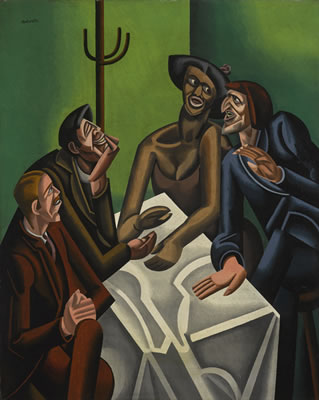
In 1961 Roberts received an award from the Calouste Gulbenkian Foundation 'in recognition of his artistic achievement and his outstanding service to British painting'. In that same year he began painting The Vorticists at the Restaurant de la Tour Eiffel, Spring 1915 (completed 1962; now in the Tate Gallery), a nostalgic recollection of a boisterous Vorticist gathering in 1915. A major retrospective of his work, organized by the Arts Council of Great Britain, opened at the Tate Gallery in 1965, and a smaller version was also shown in Newcastle and Manchester. Roberts was elected a full member of the Royal Academy* in 1966 (he had been an associate member since 1958), and he continued to depict large-scale urban scenes in his paintings until his death in 1980.
After Robert's son had died intestate, The Guardian revealed that the Treasury Solicitor had control of a large number of works by Roberts, which it refused to lend to an exhibition at the Hatton Gallery in Newcastle upon Tyne. Since then it has been announced that 117 of these works have been allocated to the Tate Gallery in lieu of inheritance tax, and the Tate will also house the remainder.
Roberts's account of his early years (written in 1977) appeared posthumously, in 1982, and in 2004 William Roberts: An English Cubist by Andrew Gibbon Williams (Lund Humphries), the standard monograph on this painter, was published. The Nasher Museum of Art at Duke University held an exhibition entitled "The Vorticists: Rebel Artists in London and New York, 1914-18 from 30 September 2010 to 2 January 2011" that included his work; it was then at the Peggy Guggenheim Collection, Venice, from 29 January to 22 May 2011, and at Tate Britain from 22 June to 18 September 2011.
Source:
Wikipedia, http://en.wikipedia.org/wiki/William_Roberts_%28painter%29
* For more in-depth information about these terms and others, see AskART.com Glossary http://www.askart.com/AskART/lists/Art_Definition.aspxBiography from Bonhams Bond Street
William Roberts began his artistic career at a young age, developing the blossoming talent he displayed at his primary school in Hackney, East London. After leaving education at fourteen, he used his portfolio of works made at school and during evening classes at St. Martin's School of Art, to search for gainful employment. Turned down by the department store Liberty, among others, he impressed the firm Joseph Causton Ltd enough to be offered a seven-year apprenticeship. Essentially stationers supplying City law firms, the company also ran a commercial art department employing graphic designers and illustrators. It was here that Roberts honed his acute sense of a picture's design, as can be seen in Billingsgate, and learnt how to transfer small scale works into a larger image, something he would practice throughout his career. Beginning at the most junior level Roberts worked his way up through the ranks whilst still attending his night classes at St. Martin's. 'Routine and hard work, however, were not the only experiences Roberts gained from his spell at Causton's. Apart from the occasional foray to the Tate Gallery with his art mistress he had rarely been outside the East End. Now he found himself at the commercial hub of Edwardian London. Causton's was located in Eastcheap near Billingsgate fish market so, before arriving there at 8 a.m. and after leaving at 6 p.m., Roberts was treated to the colourful spectacle and intense activity of the capital at work. There were the fish porters with their peculiar hats for carrying crates, horse-drawn delivery vans and barges loading and unloading on the Thames.' (Andrew Gibbon William, William Roberts, An English Cubist, Lund Humphries, Aldershot, 2004, p.11).
By 1910 at the age of just fifteen William Roberts won a scholarship to the Slade School of Art after impressing the adjudicators of the London County Council. Its teachings were centered on the importance of draughtsmanship of the French classical tradition using meticulous line and shading to denote form. In his posthumously published Early Years, Roberts wrote, 'In the summer vacations of the following year [1912], I received another invitation to spend a few weeks in the country; this time from Sir Cyril Butler – a friend of Prof. Tonks [of the Slade School] and a patron of the group of artists, members of the New English Art Club. Bourton House, where Butler lived, was a large country mansion near Shrivenham in Berkshire, set in extensive parkland ... Following on from my stay at Bourton, Sir Cyril commissioned me to do six drawings of London markets at two guineas each. But except for two markets, Billingsgate and Leadenhall, the drawings were never carried out. Several years after this, about 1919, I was living in an attic at 32 Percy Street, Tottenham Court Road, and being very hard up I wrote to Sir Cyril, hoping he might feel interested in buying a drawing or perhaps complete that set of London markets. He did not reply; instead, he called one evening; the visit was brief. After asking me what artists I associated with, and who my friends were, without mentioning the market drawings he departed, leaving me no better off than before.' (see online, William Roberts: Catalogue Raisonné, researched and compiled by David Cleall: www.englishcubist.co.uk).
Like Leadenhall Market (1913) in the collection of Tate, Billingsgate focuses on the market traders and fish porters, and the intense activity at the peak of their working day. Robert's use of chiaroscuro is used to bring clarity and volume to the individual figures in a crowded and ambitious composition. It also serves to create a striking depth of field. The arduous nature of the fish porters' work is skillfully rendered by Roberts in the three central figures carrying the produce on their heads. One of them balances six crates. Owing to the heavy loads these men wore specially designed hats for the task known as the 'Billingsgate Bobbin' hat. Made from thick leather weighing five pounds, incorporating four hundred nails, they were coated in tar to repel water and could take up to eight hours to make. The top flat part consisted of four layers of leather which could be replaced much like the sole of a shoe when worn out. Such was their craftsmanship that these Bobbin hats were often handed down, like the job itself, from father to son. The name is thought to derive from the 'bobbin' or payment the porters would receive from the buyers for delivering the catch to the distribution vehicles. The expressions on the faces of the men in the Billingsgate drawing, unlike Tate's example, have been described in impressive detail. Indeed, the intricate work by the draughtsman's hand throughout shows greater attention to detail than Leadenhall Market. As onlookers, we are provided with a fascinating insight to the characters who worked this key industry of early twentieth century Britain. Their working-class roots are laid bare, and with Roberts having been born into the same environment close by it was one he could relate to easily.Billinsgate immediately captivates the observer with its narrative and sophisticated design. It was drawn at a pivotal moment for Roberts, just prior to him leaving The Slade, and embraces everything he was taught there by his tutors Henry Tonks and Philip Wilson Steer. His talents during this time earned him the Melville Nettleship prize for figure painting composition and another award recognizing his aptitude as a draughtsman. Yet despite this it already anticipates the next phase in Roberts' story, the radical departure he made with a handful of his contemporaries towards Cubism and Vorticism. It is this drawing, more than any other made at The Slade, which brilliantly conveys the aesthetic Roberts felt compelled to follow.
Immediately after leaving The Slade he traveled to France, including Paris, and likely absorbed the contemporary Cubist works on display. Back in London whilst working at the Omega Workshops for a source of income Roberts began to experiment with his personal interpretations of Cubism. The earliest surviving example, The Return of Ulysses (Castle Museum and Art Gallery, Nottingham) was painted circa 1913-14, and comparisons can be drawn between this and his good friend David Bomberg's Vision of Ezekiel (Tate Collection) produced the year before, which was exhibited at the 'Cubist Room' in An Exhibition of the Work of English Post-Impressionists, Cubists and others from December 1913 to January 1914 at the Brighton Public Art Galleries. Whilst stylistically Billingsgate may not on the face of it appear linked to Roberts' new artistic vocabulary, similarities are apparent. In particular the poses and exaggerated stretching of some of the Billingsgate men, most noticeable in the figure controlling the water tap and the standing man with arms held aloft far right, relate nicely to the stylisation of the men and women in his earliest Cubist and Vorticist designs. Billingsgate Market is amongst the most famous in the United Kingdom. Situated on the Isle of Dogs in Poplar, East London, it is the country's largest inland fish market. During the 19th Century it was in fact the world's largest. The present site was established as recently as 1982, although the history of the market at its original location, Billingsgate Dock close to Lower Thames Street, can be traced back to the 16th Century. However, its inauguration did not take place until an Act of Parliament in 1699. In 1872 the City of London Corporation, who still runs the market, began rebuilding and enlarging the space following plans by the City of London architect Sir Horace Jones (1819-1887) and it was completed in 1877. The enormous current building complex of thirteen acres sells fish from all over the world and trades five days a week, Tuesday to Saturday and opens for business as early as 4 a.m.