Page loaded successfully. Showing biography for William Strang.
William Strang BIOGRAPHY
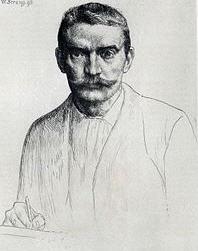
1859 Dumbarton, England - 1921 Bournemonth, England. Known for: Portrait and figure painting, nude drawing, printmaking, book illustration.
William Strang RA (13 February 1859 – 12 April 1921) was a Scottish painter and printmaker, notable for illustrating the works of Bunyan, Coleridge and Kipling. He was born at Dumbarton, the son of... Read full biography
William Strang RA (13 February 1859 – 12 April 1921) was a Scottish painter and printmaker, notable for illustrating the works of Bunyan, Coleridge and Kipling. He was born at Dumbarton, the son of Peter Strang, builder, and educated at the Dumbarton Academy. He worked for fifteen months in the... Read full biography
William Strang RA (13 February 1859 – 12 April 1921) was a Scottish painter and printmaker, notable for illustrating the works of Bunyan, Coleridge and Kipling. He was born at Dumbarton, the son of Peter Strang, builder, and educated at the Dumbarton Academy. He worked for fifteen months in the counting-house of a firm of shipbuilders before going to London in 1875 when he was sixteen. There he studied art under Alphonse Legros at the Slade School of Art* for six years. Strang became assistant... Read full biography
William Strang RA (13 February 1859 – 12 April 1921) was a Scottish painter and printmaker, notable for illustrating the works of Bunyan, Coleridge and Kipling. He was born at Dumbarton, the son of Peter Strang, builder, and educated at the Dumbarton Academy. He worked for fifteen months in the counting-house of a firm of shipbuilders before going to London in 1875 when he was sixteen. There he studied art under Alphonse Legros at the Slade School of Art* for six years. Strang became assistant master in the etching class, and had great success as an etcher. He was one of the original members of the Royal Society of Painter-Etchers*, and his work was a part of their first exhibition in 1881. Some of his early plates were published in The... Read full biography
William Strang RA (13 February 1859 – 12 April 1921) was a Scottish painter and printmaker, notable for illustrating the works of Bunyan, Coleridge and Kipling. He was born at Dumbarton, the son of Peter Strang, builder, and educated at the Dumbarton Academy. He worked for fifteen months in the counting-house of a firm of shipbuilders before going to London in 1875 when he was sixteen. There he studied art under Alphonse Legros at the Slade School of Art* for six years. Strang became assistant master in the etching class, and had great success as an etcher. He was one of the original members of the Royal Society of Painter-Etchers*, and his work was a part of their first exhibition in 1881. Some of his early plates were published in The Portfolio and other art magazines. He worked in many techniques: etching*, drypoint*, mezzotint*, sand-ground mezzotint, bur... Read full biography
Artist Biography
Biography page for William Strang ((1859 - 1921)), known for Portrait and figure painting, nude drawing, printmaking, book illustration. Showing 4 biographical entries and 0 sample artworks.
William Strang - Artist Info
About William Strang
Biography from the Archives of askART
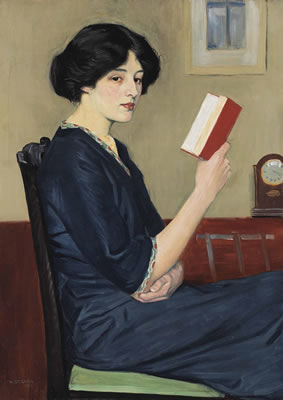 William Strang RA (13 February 1859 – 12 April 1921) was a Scottish painter and printmaker, notable for illustrating the works of Bunyan, Coleridge and Kipling.
He was born at Dumbarton, the son of Peter Strang, builder, and educated at the Dumbarton Academy. He worked for fifteen months in the counting-house of a firm of shipbuilders before going to London in 1875 when he was sixteen. There he studied art under Alphonse Legros at the Slade School of Art* for six years.
Strang became assistant master in the etching class, and had great success as an etcher. He was one of the original members of the Royal Society of Painter-Etchers*, and his work was a part of their first exhibition in 1881. Some of his early plates were published in The Portfolio and other art magazines.
He worked in many techniques: etching*, drypoint*, mezzotint*, sand-ground mezzotint, burin engraving, lithography* and woodcut*. He cut a large wood engraving of a man ploughing, later published by the Art for Schools Association.
A privately produced catalogue of his engraved work contained more than three hundred items. Amongst his earlier works were Tinkers, St. Jerome, A Woman Washing Her Feet, An Old Book-stall with a Man Lighting His Pipe from a Flare, and The Head of a Peasant Woman on sand-ground mezzotint. Later plates such as Hunger, The Bachelor's End and The Salvation Army were also important.
Some of his best etchings were done as series—one of the earliest, illustrating poet William Nicholson's Ballad of Aken Drum, is remarkable for clear, delicate workmanship in the shadow tones, showing great skill and power over his materials, and for strong drawing. Another praised series was The Pilgrim's Progress, revealing austere sympathy with John Bunyan's teaching. Samuel Taylor Coleridge's Ancient Mariner and Strang's own Allegory of Death and The Plowman's Wife, have served him with suitable imaginative subjects.
Some of Rudyard Kipling's stories were also illustrated by him, and his likeness of Kipling was one of his most successful portrait plates. Other etched portraits included those of Ernest Sichel and of J.B. Clark, with whom Strang collaborated in illustrating Baron Munchausen (1895) and Sinbad the Sailor and Ali Baba (1896).
Thomas Hardy, Sir Henry Newbolt and other distinguished men also sat for him. Proofs from these plates have been much valued.
Strang produced a number of paintings, portraits, nude figures in landscapes, and groups of peasant families, which were exhibited at the Royal Academy, The International Society, and several German exhibitions. He painted a decorative series of scenes from the story of Adam and Eve for the library of a Wolverhampton landowner named Hodson; they were exhibited at the Whitechapel exhibition in 1910. He made some drawings of the nude figure in silver point and red and black chalk.
He also painted landscapes, mostly small in size. In later years he developed a style of drawing in red and black chalk, with the whites and high lights rubbed out, on paper stained with water colour. His method gives qualities of delicate modelling and refined form and gradations akin to the drawings of Hans Holbein the Younger. He drew portraits in this manner of many members of the Order of Merit for the royal library at Windsor Castle.
In 1902 Strang retired from the Royal Society of Painter-Etchers, as a protest against the inclusion in its exhibitions of etched or engraved reproductions of pictures. His work was subsequently seen principally in the exhibitions of the Royal Academy, the Society of Twelve and the International Society, to which he was elected in 1905.
Strang was also elected an associate engraver of the Royal Academy when that degree was revived in 1906. William Strang was master of the Art Workers Guild in 1907. His portrait can be seen at the Art Workers Guild 6 Queen Square London WC1N 3AT.
He is buried at Kensal Green Cemetery, London.
Source: Wikipedia, 2020
* For more in-depth information about these terms and others, see AskART.com. Glossary http://www.askart.com/AskART/lists/Art_Definition.aspxBiography from Lyon & Turnbull
William Strang was an artist of many facets. He was both a pre-eminent etcher, pivotal in the medium’s revival at the start of the 20th century, and a popular society portraitist, regularly commissioned to depict key figures of the day. Strang’s diverse frame of artistic reference made it hard for critics to place him canonically. One minute he appeared a Realist, touching on contemporary social issues, the next he seemed more akin to a Symbolist, mining Classical, Biblical and allegorical subjects.
He encompassed these multitudes with much skill and integrity, earning himself a respected position in the turn-of-the-century London art world. The portrait offered here illustrates how these seemingly disparate threads manage to interlace within his work to unique and impactful effect: concurrently truthful to its subject, decoratively appealing and enigmatic in atmosphere.Strang was born in Dumbarton, Scotland in 1859.
The son of a builder, his working-class roots were an important part of his identity, including artistically. Much of his oeuvre (notably his etched works) were Socialist in sympathy and alluded to the struggles of the working and impoverished classes. This, combined with his training at the Slade under the French Realist Alphonse Legros, naturally aligned him with the ideologies of the Arts and Crafts movement with whom he also shared a commitment to the rigour of Life Drawing and a reverence for the Old Masters.
The prominent designer and architect C. R. Ashbee became a major patron.This focus on draughtsmanship is very much evident in Strang’s work within the genre of portraiture. He produced over 500 portrait sketches in the early 1900s, drawn in black and red chalk. This choice of materials was a deliberate and characteristic referential nod to an earlier Master; in this instance Hans Holbein. The technical prowess and incisive ‘truth’ of these sketches proved so popular that Strang was able to make two consecutive trips to New York in 1904 and 1905 to execute drawings of his many American patrons.
Strang also painted many important commissions in oil, notably those with literary connections including Thomas Hardy, Vita Sackville-West and the poet John Masefield. He exhibited oils regularly at the Royal Academy and the International Society, of which he became Vice-President in 1908. In the manner of Whistler, Strang rarely titled his works under the sitter’s names, rather in the guise of subject paintings. An example of this is 1913’s The Opera Cloak, which in fact depicts his beloved daughter Nancy, her cloak held by one of her brothers in the left of the composition.
We believe that the highly attractive portrait offered here for sale, Girl with Fan, also potentially depicts Nancy Strang. Dated 1912, it was executed just one year earlier than The Opera Cloak. The sitter shares the same physical characteristics: the assertive jut of the chin, dark brows and pronounced cupid’s bow of the top lip. Strang clearly revelled in the depiction of women. His female sitters are invariably afforded an elegant sensuality and contemplative demeanour. As the artist once remarked to his patron Ashbee, “I’ve tried all my life to do the pretty-pretty but it’s no good…I can’t”. Instead, his likenesses evoke character, modernity and intellect.Leaning away from the overt, painterly glamour of his peers Sargent and Lavery, Strang’s portraiture was not, as one critic of the day described, “polite”. As we have seen, he was neither categorizable as purely a Traditionalist nor a Modernist; his style referenced broadly from both spheres, resulting in a manner entirely his own.
Strang’s focus was on objective truth married subtly with a decorative aspect, producing an effect that was both distinctive and widely admired. He was critically revered for his exceptional, considered compositions and the way he eschewed anything extraneous in terms of detail or technique. His use of colour too, was praised for being confident and spare. We see that here with the striking choice of gold, purple, pink and green, linked subtly and balanced precisely, the fundamentally discordant hues somehow attaining harmony.
William Strang’s work was featured in prominent exhibitions across many of London’s most respected galleries, including the Grosvenor Gallery, Whitechapel Gallery, Agnews and the Fine Art Society. In 1918 he became President of the International Society of Sculptors, Painters and Gravers and in 1921 was elected an Engraver Member of the Royal Academy. He died suddenly in 1921, shortly after his election as Royal Academician.Biography from Christie's London, King Street
In an Art Journal article about Strang, Frank Newbolt declared that 'In his painting there are two obvious qualities which attract attention besides the effort to eliminated the unnecessary and ineffective. The first is the simplicity of colour; and the second, the almost indescribably effect of fine composition." (Art Journal, 1910, p. 49).Biography from Bonhams Edinburgh
William Strang was one of Scotland's most significant figure painters. This monumental subject recalls the work of his tutor, Alphonse Legros, who was also an important printmaker and formative influence on the Glasgow Boys.