Page loaded successfully. Showing biography for William Tolliver.
William Tolliver BIOGRAPHY
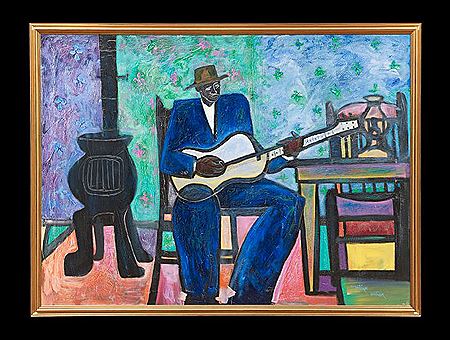
1951 Vicksburg, Mississippi - 2000 Vicksburg, Mississippi. Known for: Landscape, abstract figure and portrait painting.
William Tolliver (1951-2000) . William Tolliver's motifs of the land, of simple people at work, or at leisure are but a framework through which he conveys his real subject, which is his joy in... Read full biography
William Tolliver (1951-2000) . William Tolliver's motifs of the land, of simple people at work, or at leisure are but a framework through which he conveys his real subject, which is his joy in working with color, shapes, textures, line and light. As we view how he manipulates these elements, we are... Read full biography
William Tolliver (1951-2000) . William Tolliver's motifs of the land, of simple people at work, or at leisure are but a framework through which he conveys his real subject, which is his joy in working with color, shapes, textures, line and light. As we view how he manipulates these elements, we are caught up in his emotion of joy and become dazzled with the visual delight before us. The Zigler Collection of his work seeks to demonstrate the progression of Tolliver's art from his earliest... Read full biography
William Tolliver (1951-2000) . William Tolliver's motifs of the land, of simple people at work, or at leisure are but a framework through which he conveys his real subject, which is his joy in working with color, shapes, textures, line and light. As we view how he manipulates these elements, we are caught up in his emotion of joy and become dazzled with the visual delight before us. The Zigler Collection of his work seeks to demonstrate the progression of Tolliver's art from his earliest landscape to his latest figurative semi-abstract work, thereby documenting the development of several styles or techniques using a variety of media. The early landscapes (circa 1983) were of rural Mississippi, Tolliver's boyhood home. These early paintings... Read full biography
William Tolliver (1951-2000) . William Tolliver's motifs of the land, of simple people at work, or at leisure are but a framework through which he conveys his real subject, which is his joy in working with color, shapes, textures, line and light. As we view how he manipulates these elements, we are caught up in his emotion of joy and become dazzled with the visual delight before us. The Zigler Collection of his work seeks to demonstrate the progression of Tolliver's art from his earliest landscape to his latest figurative semi-abstract work, thereby documenting the development of several styles or techniques using a variety of media. The early landscapes (circa 1983) were of rural Mississippi, Tolliver's boyhood home. These early paintings appeared to be of uninhabited areas. However, it was not long before small figures were injected to... Read full biography
Artist Biography
Biography page for William Tolliver ((1951 - 2000)), known for Landscape, abstract figure and portrait painting. Showing 3 biographical entries and 0 sample artworks.
William Tolliver - Artist Info
About William Tolliver
Biography from RoGallery
Artist William Tolliver, born in 1951, in Vicksburg, Mississippi, was the second oldest of fourteen children. Truly a rags-to-riches story, William, reared in abject poverty, had none of the advantages most people take for granted. Lacking both education and art supplies, and with little encouragement from his environment, the gifted Tolliver had to make do with what he could teach himself from books at the public library. Now a veritable master of all media, William Tolliver's successful career bears witness to the fact that talent can and will triumph over the worst odds.
Tolliver is a versatile artist who handles figure studies, portraits, human interest situations, landscapes, and semi-abstracts equally well. He is at home in every painterly medium and uses a diversity of styles, all of which are polished and bear the unmistakeable stamp of his personality.
His works are reminiscent rather than messege oriented, often reflecting experiences from his Mississippi childhood. Recurrent themes in Tolliver's art are people working and living---stevedors, farmers, cotton pickers, women embracing their children, and people playing musical instruments. He portrays his subjects with a pride and dignity that heretofore has been uncommon among modern artists.
William Tolliver has been considered by many to be very likely the next great African American artist in the likeness of Romare Bearden and Jacob Lawrence. As a self taught artist, it is amazing the he has been able to master whatever he attempts.Biography from The Johnson Collection
WILLIAM TOLLIVER (1951-2000)
Primarily a figurative painter, William Tolliver drew inspiration from the world around him, and from artists whose work he saw in books. He admits the painter who influenced him the most was Vincent van Gogh: “Van Gogh painted purely for the love of it. I can relate to that. I also liked his use of color, the way the light was reflected in his paintings, the powerful feeling in his work.”
Tolliver was born in Vicksburg, Mississippi, one of fourteen children whose mother worked in the fields picking cotton, a frequent subject for the artist. Although his school offered no art lessons, Tolliver displayed an early interest in art; he used dime store watercolor sets and paint-by-number kits that he purchased with his earnings from mowing lawns. His mother encouraged her children, often hosting drawing contests between herself and his siblings, and later bringing home art books from the library.
When Tolliver was fourteen, he left school and headed to Los Angeles, California, to join the Job Corps where he learned carpentry and was mentored by an artist. He spent some time in Milwaukee, Wisconsin, as an assistant to a sculptor, an experience that encouraged him to pursue art for himself. Returning to Vicksburg he worked in construction and painted at night. He was married in 1977 and shortly after, around 1980, he moved his family to Lafayette, Louisiana, to take advantage of the oil boom. The post was short-lived, however, as there was an oil glut and he soon lost his job. He still painted as a means of keeping up work, but lacked the confidence to share his work with a dealer. Going behind his back, in 1985 his wife, Debrah, took nine early landscapes to the Live Oak Gallery in Lafayette where they all sold within ten days.
Working in a variety of media—oil, acrylic, watercolor, oil pastel—Tolliver found recognition which in turn ignited his passion. “I love my work and I have worked very hard to portray African Americans with pride and dignity. My goal is to bring to the forefront the seriousness of art as a person’s heritage. I want my art to serve as a history lesson.” His early works were traditional and often featured small figures in vast landscapes. He later frequently depicted jazz musicians, influenced perhaps by an uncle who played. These tend to be colorful renditions of men set against a cubist inflected background. He also created half-length portrayals of women shown close to the picture plane. Often there are heavy black outlines reminiscent of stained glass windows or perhaps the paint-by-number kits of Tolliver’s childhood.
In 1991, the family moved to Georgia and opened an African American art gallery in Atlanta's Buckhead community, which they operated until 1997. Tolliver’s work became collectible, by museums and private collectors. His paintings have been included in the Art in Embassies Program of the United States Department of State and exhibited in the rotunda of the United States Capitol Building in Washington. In 1996 he designed a promotional poster for the Olympic Games in Atlanta showing the state capitol framed on one side by rows of crops and a view of the city’s skyline at the top.
The Johnson Collection, Spartanburg, South Carolina
thejohnsoncollection.orgBiography from Zigler Art Museum
William Tolliver (1951-2000)
William Tolliver's motifs of the land, of simple people at work, or at leisure are but a framework through which he conveys his real subject, which is his joy in working with color, shapes, textures, line and light. As we view how he manipulates these elements, we are caught up in his emotion of joy and become dazzled with the visual delight before us.
The Zigler Collection of his work seeks to demonstrate the progression of Tolliver's art from his earliest landscape to his latest figurative semi-abstract work, thereby documenting the development of several styles or techniques using a variety of media. The early landscapes (circa 1983) were of rural Mississippi, Tolliver's boyhood home. These early paintings appeared to be of uninhabited areas. However, it was not long before small figures were injected to aid in scale and to add life to the countryside. But landscape was still the dominant element and the figures very insignificant.
With the figures, however, came civilization in the form of dirt roads, paths, and work fields. Soon Tolliver started giving us close-up views of his people, their work, their social interaction, and leisure time pursuits. These people were always busy, walking, working, or pursuit a hobby. Particular attention was paid to their hands. The importance of manual labor, or rather work that the hands could do, was emphasized by enlarging them and using them as design elements in themselves. The enlargement of the hands, then the torso, and finally the heads filled his canvases until Tolliver's people became monuments to celebrate the dignity of honest labor and to celebrate life itself.
Tolliver's first paintings were in the traditional manner. The story was landscape and it was very complete. Even in the early paintings, however, he manipulated color to evoke a mood, a time of day or a season. His experimentation at this time was with paint application, small brush, big brush, and palette knife. Because of his excitement while working with color, and the need to find other methods to express the ideas he wished to portray, Tolliver began experimenting with a variety of media and techniques.
Oil, acrylic, watercolor, oil pastel, soft pastel, pencil, woodcuts, sculpture, collage, 3-dimensional reliefs, and multi-media approaches were all explored. During this period the quality of his work remained high and, in fact, continually improved. At the same time, Tolliver was moving from traditional representation toward aesthetic order. First, the background areas were broken into planes of color and the figure(s) remained representational, but soon even the positive shapes changed into arbitrary colors, shapes, planes, and light. the shapes and planes no longer had the primary purpose of identification but instead to produce a feeling of satisfaction from an internal balance. Color no longer needed to move forward and backward in space, but instead shimmered on the surface in arrangements that were meant to be seen rather than understood.
What then is the special appeal of Tolliver's work? Is it the portrayal of man becoming larger than himself, or is it the surface beauty of the color and shapes? Most positively, it is the excellent manner in which he combines the needs of our heart with the needs of our mind.