Page loaded successfully. Showing biography for William Turnbull.
William Turnbull BIOGRAPHY
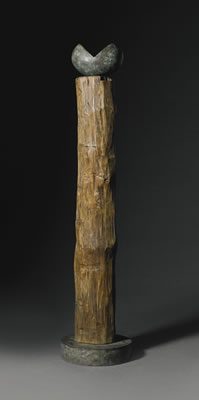
1922 Dundee, Scotland - 2012 London, England. Known for: Modernist sculpture with primitive forms.
Following is the artist's obituary from The New York Times. William Turnbull, Scottish Sculptor, Dies at 90 . By Dennis Hevesi, November 21, 2012 . William Turnbull, a Scotish sculptor known for his... Read full biography
Following is the artist's obituary from The New York Times. William Turnbull, Scottish Sculptor, Dies at 90 . By Dennis Hevesi, November 21, 2012 . William Turnbull, a Scotish sculptor known for his blending of modernism with archaic and primitive forms, died on November 15 in London. He was 90.... Read full biography
Following is the artist's obituary from The New York Times. William Turnbull, Scottish Sculptor, Dies at 90 . By Dennis Hevesi, November 21, 2012 . William Turnbull, a Scotish sculptor known for his blending of modernism with archaic and primitive forms, died on November 15 in London. He was 90. His death was confirmed by Erica Bolton of the public relations firm Bolton & Quinn, which represented him. Mr. Turnbull's nearly seven-decade career traced something of a full circle. From postwar... Read full biography
Following is the artist's obituary from The New York Times. William Turnbull, Scottish Sculptor, Dies at 90 . By Dennis Hevesi, November 21, 2012 . William Turnbull, a Scotish sculptor known for his blending of modernism with archaic and primitive forms, died on November 15 in London. He was 90. His death was confirmed by Erica Bolton of the public relations firm Bolton & Quinn, which represented him. Mr. Turnbull's nearly seven-decade career traced something of a full circle. From postwar European figurative sculpture, as reflected in works by Alberto Giacometti and Henry Moore, he turned toward an organic form of semi-abstraction as displayed by Constantin Brancusi, then to a hard-edged and geometric Minimalist trend before returning to... Read full biography
Following is the artist's obituary from The New York Times. William Turnbull, Scottish Sculptor, Dies at 90 . By Dennis Hevesi, November 21, 2012 . William Turnbull, a Scotish sculptor known for his blending of modernism with archaic and primitive forms, died on November 15 in London. He was 90. His death was confirmed by Erica Bolton of the public relations firm Bolton & Quinn, which represented him. Mr. Turnbull's nearly seven-decade career traced something of a full circle. From postwar European figurative sculpture, as reflected in works by Alberto Giacometti and Henry Moore, he turned toward an organic form of semi-abstraction as displayed by Constantin Brancusi, then to a hard-edged and geometric Minimalist trend before returning to his earlier figurative style. Achieving particular renown in Britain, he was best known for simpl... Read full biography
Artist Biography
Biography page for William Turnbull ((1922 - 2012)), known for Modernist sculpture with primitive forms. Showing 2 biographical entries and 0 sample artworks.
William Turnbull - Artist Info
About William Turnbull
Biography from the Archives of askART
 Following is the artist's obituary from The New York Times.
William Turnbull, Scottish Sculptor, Dies at 90
By Dennis Hevesi, November 21, 2012
William Turnbull, a Scotish sculptor known for his blending of modernism with archaic and primitive forms, died on November 15 in London. He was 90. His death was confirmed by Erica Bolton of the public relations firm Bolton & Quinn, which represented him. Mr. Turnbull's nearly seven-decade career traced something of a full circle.
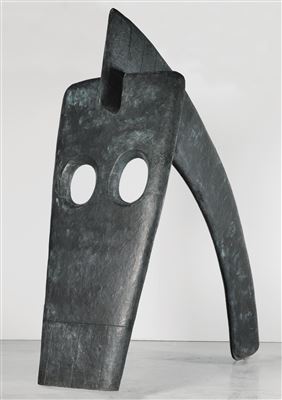
From postwar European figurative sculpture, as reflected in works by Alberto Giacometti and Henry Moore, he turned toward an organic form of semi-abstraction as displayed by Constantin Brancusi, then to a hard-edged and geometric Minimalist trend before returning to his earlier figurative style. Achieving particular renown in Britain, he was best known for simplified, rough-looking forms with tactile surfaces that he distilled from ancient but sophisticated objects like votive goddess figures, masks, totems, stone tools and arrowheads, as well as ancient architecture like the dolmens of Stonehenge.
When an exhibition of his small bronzes came to the Waddington Gallery in Manhattan in 1982, Hilton Kramer wrote in The New York Times that Mr. Turnbull had long been "one of the most distinguished modernists on the British art scene."
"What we are offered in these works is, in effect, a synthesis of primitivism and modernism," Mr. Kramer added. "The result is highly poetic." Over the years Mr. Turnbull's works — paintings and prints as well as sculptures — have been exhibited at galleries like the Hayward and Serpentine in London and the Berggruen in San Francisco. They were also shown at the Tate in London and are in the collections of the National Galleries of Scotland and the Leeds Museum in England.
Nicholas Serota, the director of the Tate, said in a statement that Mr. Turnbull's art had come from his "admiration for the simple forms of ancient and Eastern cultures and his abiding search for the essence in any object," but that it "always had a humanist sensibility that identified it as profoundly European."
Born in Dundee, Scotland, on Jan. 11, 1922, the son of a shipyard engineer, William Turnbull dropped out of school at 15 and worked as a day laborer to help support his family during the Depression. But at night he took arts classes and impressed one of his teachers, who helped him find work as an illustrator at a publishing company. He joined the Royal Air Force in 1941, serving as a pilot in Asia during World War II.
After the war he studied at the Slade School of Fine Art in London, and found his passion in the sculpture department. Mr. Turnbull's wife, the sculptor Kim Lim, died in 1997.
He is survived by two sons, Alex and Johnny, and three grandchildren. Bronze, wood, stone and steel were among the materials that Mr. Turnbull shaped. But he was captivated, he once said, by the idea that with a bag of plaster dust he "could make something out of nothing."Biography from Tobey C. Moss Gallery
WILLIAM TURNBULL 1922-2012
Had Fellowships at the Tamarind Lithograph Workshop in Los Angeles in 1961 and in 1966. He created successful series of color lithographs with two master printers: Bohuslav Horak (in 1961)and Clifford Smith(in 1966).