Page loaded successfully. Showing biography for William Wendt.
William Wendt BIOGRAPHY

1865 Bentzen, Germany - 1946 Laguna Beach, California. Known for: Plein-air landscape and coastal view painting.
One of California's best-known landscape painters of the late 19th and early 20th centuries, William Wendt was called the "Dean of Southern California" artists. His landscapes were especially known... Read full biography
One of California's best-known landscape painters of the late 19th and early 20th centuries, William Wendt was called the "Dean of Southern California" artists. His landscapes were especially known for rich greens and browns. In 1911, he became co- founder of the California Art Club, which he... Read full biography
One of California's best-known landscape painters of the late 19th and early 20th centuries, William Wendt was called the "Dean of Southern California" artists. His landscapes were especially known for rich greens and browns. In 1911, he became co- founder of the California Art Club, which he served as the second and fourth President from 1911 to 1919 and 1917 to 1918 respectively. This organization reflected his commitment to plein-air painting of the California landscape. His style was... Read full biography
One of California's best-known landscape painters of the late 19th and early 20th centuries, William Wendt was called the "Dean of Southern California" artists. His landscapes were especially known for rich greens and browns. In 1911, he became co- founder of the California Art Club, which he served as the second and fourth President from 1911 to 1919 and 1917 to 1918 respectively. This organization reflected his commitment to plein-air painting of the California landscape. His style was impressionism, obviously influenced by the Decorative Style of Arthur Mathews, and his landscapes seldom had figures in them. Indicative of the breadth of his reputation was his election in 1912 as an Associate of the National Academy of Design in New... Read full biography
One of California's best-known landscape painters of the late 19th and early 20th centuries, William Wendt was called the "Dean of Southern California" artists. His landscapes were especially known for rich greens and browns. In 1911, he became co- founder of the California Art Club, which he served as the second and fourth President from 1911 to 1919 and 1917 to 1918 respectively. This organization reflected his commitment to plein-air painting of the California landscape. His style was impressionism, obviously influenced by the Decorative Style of Arthur Mathews, and his landscapes seldom had figures in them. Indicative of the breadth of his reputation was his election in 1912 as an Associate of the National Academy of Design in New York. He was born in Bentzen, Germany, and in 1880, immigrated to Chicago where, largely self taught, he studied br... Read full biography
Artist Biography
Biography page for William Wendt ((1865 - 1946)), known for Plein-air landscape and coastal view painting. Showing 10 biographical entries and 0 sample artworks.
William Wendt - Artist Info
About William Wendt
Biography from the Archives of askART
 One of California's best-known landscape painters of the late 19th and early 20th centuries, William Wendt was called the "Dean of Southern California" artists. His landscapes were especially known for rich greens and browns. In 1911, he became co- founder of the California Art Club, which he served as the second and fourth President from 1911 to 1919 and 1917 to 1918 respectively. This organization reflected his commitment to plein-air painting of the California landscape.
His style was impressionism, obviously influenced by the Decorative Style of Arthur Mathews, and his landscapes seldom had figures in them. Indicative of the breadth of his reputation was his election in 1912 as an Associate of the National Academy of Design in New York.
He was born in Bentzen, Germany, and in 1880, immigrated to Chicago where, largely self taught, he studied briefly at the School of the Chicago Art Institute and worked as a commercial artist. His close friend was artist Gardner Symons, and they made several trips to Southern California between 1894 and 1906. Wendt's adoption of impressionism as a style "can almost be dated to 1896-97" when he and Symons "were painting together on the Malibu Rancho near Los Angeles." (Moure 159) Both men were in the avant-garde of American painters in that they were open to the Impressionist style that had begun in France in the mid 19th century. And Southern California was a perfect location for depicting the bright colors, atmospheric conditions, and shimmering light that were characteristic of Impressionism.
In Chicago, Wendt was not a particularly successful artist, but he was well received in California almost from the time he settled there in 1906. That same year he married sculptress Julia Bracken, and they moved to Los Angeles, buying the studio home of Marion and Elmer Wachtel on Sichel Street. In 1913, he and Julia built a home in Laguna Beach, and they frequently exhibited together.
In California, Wendt was not a studio painter but worked outside, "en plein air", and explored the unique native landscape, often going into the wilderness. He had a deep reverence for nature, especially the unsettled wilderness, which he regarded as a place for silence and contemplation. Art historian Nancy Moure wrote that during the forty years of painting in California, Wendt's work became stronger and bolder and that with his brush, he was carving "out the underlying structure of the mountains, delighting in the folds of the earth. . . .His colors also moved away from the organic to stronger and purer tones; for a period he seems fascinated with a brilliant green. . . .These changes can be interpreted as personal growth or an attempt to update his style with the arrival of European Impressionists in Southern California." (161)
He also painted National Park landscapes in Washington state and in Arizona but, according to Peggy and Harold Samuels, refused to paint the Grand Canyon, saying "it is impossible."
As Los Angeles became increasingly populated, William Wendt pulled away from the active city, and in 1919 settled in Laguna Beach until his death in 1946,
His works are in many collections including the Union Club in Seattle; the Art Institute of Chicago; the Pasadena Art Institute, and the Springville, Utah Museum.
Sources:
Edan Hughes, Artists in California, 1786-1940
Peggy and Harold Samuels, The Illustrated Encyclopedia of Artists of the American West
Nancy Dustin Wall Moure, California Art: 450 Years of Painting & Other MediaBiography from the Archives of askART
 William Wendt (1865-1946) (Los Angeles/Laguna beach)
Landscape painter, close friend of Aaron Kilpatrick, who traveled to and sketched in Morro Bay many times.
Source: Nancy Dustin Wall Moure, MORRO BAY (including LOS OSOS, BAYWOOD PARK and CAYUCOS) ART AND PHOTOGRAPHY BEFORE 1960 (Publications in [Southern] California Art, vol. 13, no. I), Los Angeles: Dustin Publications, 2016.Biography from Steven Stern Fine Arts
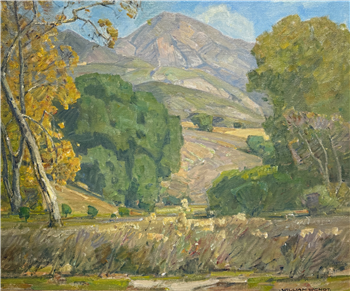 William Wendt is widely regarded as one of the most important founders of the California Impressionist movement and among the most influential interpreters of the Western American landscape. Renowned for his monumental depictions of rolling hills, oak-studded valleys, and sunlit coastal terrain, Wendt developed a distinctive approach to landscape painting that combined structural design, rich color harmonies, and a profound reverence for nature. His work helped define the visual identity of Southern California during the early twentieth century and established him as one of the central figures in the history of California art.
Wendt was born in Bentzen, Germany, in 1865 and immigrated to the United States with his family while still a child. He grew up in Chicago, where he initially worked as a commercial illustrator and staff artist. During the 1890s he began to devote increasing attention to landscape painting, gradually abandoning illustration to pursue fine art full time. Although largely self-taught, Wendt developed a sophisticated understanding of composition and color through careful study of nature and the work of contemporary American and European painters. In the late nineteenth century Wendt traveled extensively throughout the American West, painting in regions including Texas, New Mexico, and Arizona. These journeys exposed him to the dramatic landscapes and luminous light of the Western states, experiences that profoundly shaped his artistic vision. By the early 1900s Wendt had begun to develop a more ambitious and structurally organized approach to landscape painting, emphasizing broad design and the underlying rhythms of the land.
In 1906 Wendt relocated permanently to Southern California, settling first in Los Angeles before eventually making Laguna Beach his home. The rolling hills, coastal vistas, and oak groves of California provided ideal subject matter for his mature work. Unlike many Impressionist painters who focused primarily on fleeting atmospheric effects, Wendt sought to convey the enduring structure and spiritual character of the landscape. His compositions are often organized around sweeping hillsides, clustered trees, and expansive skies, creating a sense of harmony and permanence within the natural world. Wendt’s paintings are distinguished by their powerful compositional structure and sculptural brushwork. Rather than delicate broken color, he frequently applied paint in solid, interlocking masses that build form and emphasize the architectural qualities of the land. This approach lends his landscapes a sense of monumentality, transforming familiar scenes of California countryside into timeless, almost symbolic images of nature’s grandeur. Beyond his accomplishments as a painter, Wendt played a critical role in shaping the institutional foundations of the Southern California art world. In 1909 he became one of the founding members of the California Art Club, an organization that would become the most influential association of painters in the region. Wendt served as the club’s first president and remained an important guiding figure for many years. Through exhibitions and professional advocacy, the California Art Club helped promote the growing reputation of California landscape painting across the United States.
Throughout his career Wendt exhibited widely and received considerable recognition for his landscapes. His work was praised for its strength of design, rich coloration, and its ability to evoke the unique atmosphere of the California countryside. Collectors and institutions increasingly sought his paintings, recognizing their importance in defining a distinctly Western expression of American Impressionism. William Wendt spent the later years of his life in Laguna Beach, where he remained deeply connected to the natural environment that inspired his art. He died there in 1946, leaving behind a body of work that continues to be celebrated as one of the highest achievements of California landscape painting. Today his paintings remain highly regarded for their monumental compositions, luminous color, and their enduring celebration of the beauty and spiritual vitality of the California landscape. © Steven Stern Fine Arts • Los AngelesBiography from The Redfern Gallery
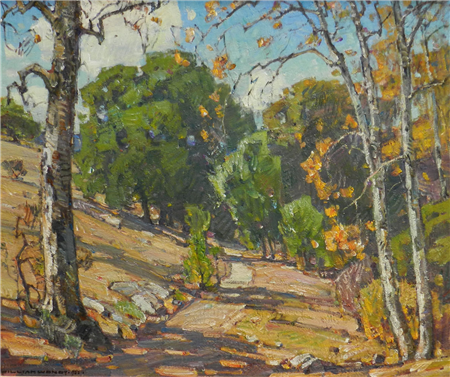 A landscape painter born in Bentzen Germany on February 20, 1865, William Wendt immigrated to Chicago in 1880 and studied briefly at the School of the Art Institute of Chicago while working a commercial art shop. A self-taught painter, he became a great technician through his power of observation. Wendt was a good friend of artist Gardner Symons in Chicago and made several trips to Southern California with him between 1894 and 1906.
After his marriage to sculptress Julia Bracken in 1906, Wendt and his wife moved to Los Angeles and bought the studio home of the Wachtels on Sichel Street. Wendt was a co founder of the California Art Club in 1911 and served as second and fourth president, 1911 to 1914 and 1917 to 1918, respectively. In 1912 he was elected an Associate of the National Academy and in that year built a studio home in Laguna Beach.
Before 1915 his painting were characterized by light short strokes and after that time he used a much broader, bolder brush. Eugen Neuhaus wrote, "He sings of spring in its rich greens and more often of the joyful quality of summer in typical tawny browns, in decorative broad terms."
Wendt, considered a giant among American Artists, is often referred to as "The Dean of Southern California."
Wendt died in Laguna Beach on December 29, 1946.
Associations:
American Federation of Arts; California Art Club (President); Society of Western Artists; Chicago Society of Artists; Laguna Beach Art Association; National Arts Club, New York.Exhibited: Art Institute of Chicago, 1909 (with his wife); Los Angeles County Museum of Art, 1915, 1917, 1918, 1939 (solos); California- Pacific International Expo, 1935, Golden Gate International Exposition, 1939; Los Angeles Art Association, 1947 (memorial)
Awards:
Dozens from 1893 including bronze medal, Buffalo Expo, 1901; silver medal, St. Louis Expo, 1904; silver medal, Panama Pacific International Exposition, 1915; grand prize, Panama-California International Expo, San Diego, 1915; Ranger prize, National Academy of Design, 1926.
Collections:
Union Club, Seattle; Herron Art Institute, Indianapolis; Cliff Dwellers Club, Chicago; Art Institute of Chicago; Cincinnati Art Museum; Laguna Museum; Los Angeles County Museum of Art; Pasadena Art Institute; Pasadena Art Museum; Springville (UT) Museum; Irvine Museum, CA; Fleischer Museum, Scottsdale, AZ..
Source:
Hughes, Edan Milton, Artists in California: 1786-1940, San Francisco: Hughes Publishing Company, 1989.)Biography from Lawrence Beebe Fine Art
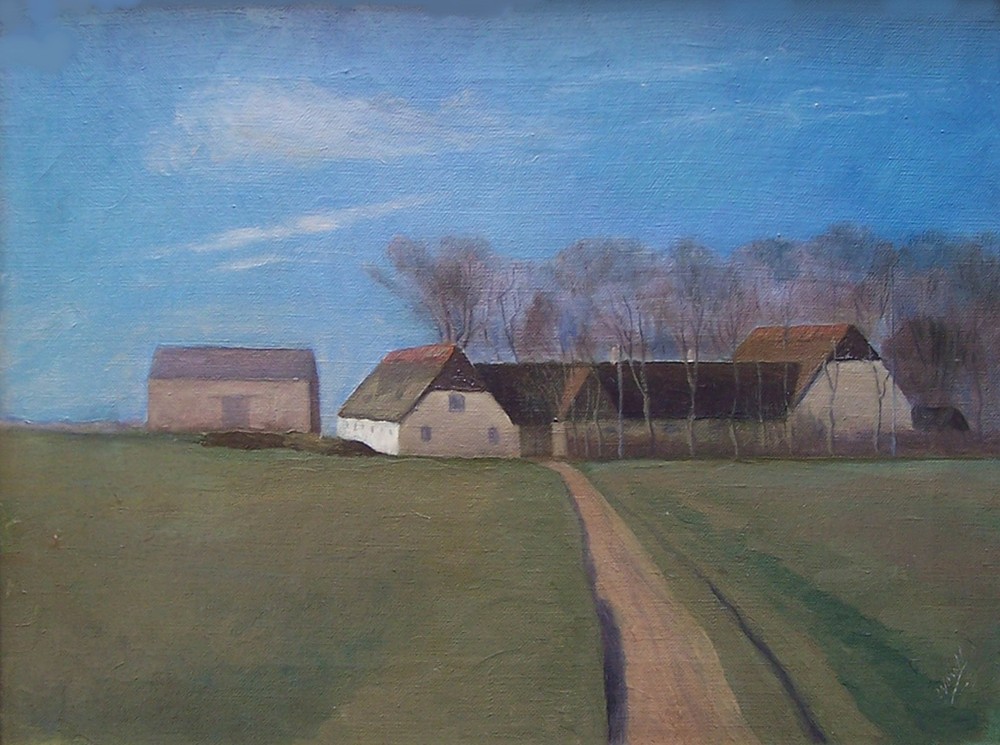 William Wendt was born on February 20, 1865 in Bentzen, Germany and died in Laguna Beach, California on December 29, 1946. In 1880, at the age of fifteen, Wendt immigrated to the United States and worked in Chicago as a staff artist where he painted formula pictures. In his free time the young Wendt displayed a love for easel painting and began to develop a personal style of painting.
In 1894 and 1896, Wendt traveled and painted with his friend George Gardner Symons visting England and California, and later traveled to the East Coast, Germany and France. He married the sculptress Julia Bracken in 1906, and he and his bride then made the decision to move to California.
Traveling to the hard to reach areas of the California countryside for inspiration, Wendt painted canvases graced with trees, rolling hills, blue skies and farmhouses. His earlier works have been termed tranquil and lyrical while his later works evolved to show bold and broad brushstrokes with rich greens and browns.
Highly regarded in California and nationally, he earned the title of "the dean of Southern California artists".
In 1911, William Wendt became the second president of the California Art Club, serving until 1914. From 1917 to 1918, he was the fourth president of this organization. He also held memberships at: the American Federation of Arts, the Chicago Society of Artists, Laguna Beach Art Association, National Academy and the National Arts Club of New York.
He exhibited and sold his works successfully for thirty years at major galleries in California, Chicago, Boston and New York. He won numerous awards during his career:
Second Yerkes Prize,
Chicago Society of Artists,
Bronze Medal, Buffalo Exposition
Cahn Prize, Chicago Art Institute
Kirchberger Prize, Chicago Art Institute
Silver Medal, San Francisco Exposition, 1915
6Black Prize, California Art Club, 1916
Ranger Purchase Prize, National Academy of Design, 1926
His works can be found in the following museums: Irvine Museum, Los Angeles County Museum of Art, San Diego Museum of Art, Smithsonian American Art Museum, Art Institute of Chicago, Dallas Museum of Art, Laguna Beach Art Museum.Biography from THOMAS LAWRENCE FINE ART
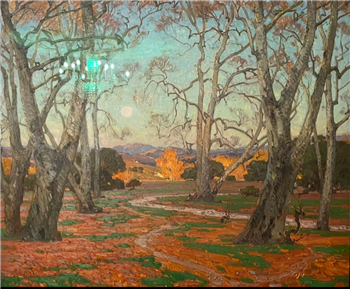 William Wendt (1865-1946) was a landscape painter born in Germany. He emigrated to Chicago in 1880 and studied briefly at the School of the Art Institute. Basically self-taught, he learned to become a great technician by means of his keenly honed skills in the observation of nature. He married Julia Bracken in 1906 and moved to Los Angeles where he helped co-found the California Art Club in 1909.
He was elected an associate of the National Academy of Design in New York in 1912 and that year moved to Laguna Beach where he was very instrumental in establishing the art colony there. His style changed over the years. Initially he painted in the more acceptable American Impressionist manner, but gradually became more involved in a blocky, masculinely-rendered and totally unique form of expression, based on an angular interpretation of nature.
He died in Laguna Beach in 1946.Biography from Altermann Galleries and Auctioneers, VII
William Wendt (1865-1946) was an American landscape painter. He was called the "Dean of Southern California landscape painters."
Wendt was a founding member of the California Art Club, along with his wife Julia Bracken Wendt, and served as its president for six years.
Wendt built his studio in Laguna Beach, California. A Laguna street, Wendt Terrace bears his name.
Awards:
Bronze Medal, Buffalo Exposition 1901;
Kirchberger Prize, Chicago Art Institute, 1913;
Silver Medal, San Francisco Exposition, 1915;
Black Prize, California Art Club,1916;
Ranger Purchase Prize, National Academy of Design,1926
Source: www.wikipedia.comBiography from Helene Halperin (formerly DeRu's Fine Arts)
William Wendt was born in Bentzen, Germany on February 20, 1865. Wendt immigrated to Chicago in 1880 and studied briefly at the School of the Art Institute of Chicago while working at a commercial art shop. A mainly self-taught painter, he became a great technician through his power of observation. Wendt was a good friend of Gardner Symons in Chicago and made several trips to Southern California with him during the years between 1894 and 1906. After his marriage to sculptress Julia Bracken in 1906, the couple moved to Los Angeles and bought the first studio-home of the Wachtel's on Sitchel Street.
Wendt was a co-founder of the California Club in 1911 and served as the organization's second and fourth President in 1911 to 1914, and 1917 to 1918. In 1912 he was elected an Associate Member of the National Academy of Design and in that year built a studio-home in Laguna Beach.
Before 1915, his works were characterized by light, short brush strokes, but later he used a much broader and bolder brush. He is considered a giant among American artists and is often referred to as "The Dean of Southern California".
In describing Wendt's paintings, Eugen Neuhaus wrote "He sings of spring in its rich greens and more often the joyful quality of summer in typical tawny browns."
Wendt died in Laguna Beach on December 29, 1946.Biography from Art Cellar Exchange
Referred to as "the Dean of California artists" William Wendt's paintings epitomize the plein-air style for which California impressionists are so revered. His best-known works demonstrate the feathery brushstrokes and attention to light that are considered the hallmark of a great impressionist painting. These pivotal canvases from the height of Wendt's career are the very definition of a California Impressionist landscape in the minds of most art connoisseurs. It is his work from the early part of his career, however, that demonstrates his connection with his Midwest and East Coast peers. Works from this stage painted in Chicago and on various trips abroad, demonstrate Wendt's ability to create landscape paintings that transcend the current crop of regionalist painters.
Although Wendt is often thought of as a California landscape painter, he was certainly aware of what was going on in other parts of the world. He traveled frequently to Europe and it was in Cornwall, England that he painted, From a Window. This work was completed in the early stages of his career and is one of the earliest examples of the blocky, masculine style that he perfected and for which he was later acclaimed. It is this style that pays homage to the work of other regionalist American painters. A comparison of From a Window to the work of Edward Hopper reveals a similar stillness of mood. In Shore Acres, a work that is akin to that of William Wendt, Hopper demonstrates uncompromising realism and a sense of mood that is more than mere naturalism. Hopper was once quoted as stating "My aim in painting has always been the most exact transcription possible of my most intimate impressions of nature." This idea could easily have come out of the mouth of William Wendt as his focus so closely parallels this expression. Later, artists such as Andrew Wyeth took their lead from Wendt and Hopper and painted works such as, Christina's World with a similar sense of a stolen moment
At the end of his career, it seems that "the Dean of California Artist's" was in fact much more than simply an expert on art of the West Coast. His awareness of many areas of the United States and Europe have lent his paintings to a level of universality that is not frequently achieved by "regional" artists.
William Wendt was born in Germany in 1865. He lived there for the first 15 years of his life before emigrating to the US in 1880. In Chicago, William had the opportunity to study at the School of the Art Institute where he quickly developed a strong technical ability that was an integral part of his innovative style. The infinite pastoral landscape of the Midwest inspired Wendt's intense appreciation of nature that inspired his plein- air style. Between the years of 1894 and 1906, he took several trips the Southern California with fellow artist Gardener Symons. Wendt was so enamored with this area of the country that upon marriage, he and his wife, sculptress Julia Bracken, moved to Los Angeles. Later, the couple relocated to Laguna Beach where Wendt completed and exhibited some of his most highly recognized works. It was here that Wendt, co-founded the California Art Club and served as its second and fourth President. Later, in recognition of his accomplishments, he was elected to the National Academy of Design in New York.
The work of William Wendt can be found in museums all over the country including: The Smithsonian American Art Museum, The Los Angeles County Museum of Art, The San Diego Museum of Art, The Art Institute of Chicago, and The Irvine Museum. From a Window was exhibited at the Art Institute of Chicago in a show entitled "Exhibition of Current American Artists and Sculptors" in 1901.
In the past four years, the average market value for William Wendt paintings has increased dramatically. In 1997, total sales for works by William Wendt was $113,850 jumping to $1,132,213 by the next year. Sales have remained steady since 1998 and paintings by this artist have sold for as high as $530,500.Biography from Fleischer Museum
Called the Dean of California artists, William Wendt spent his mature life painting landscapes of the rolling hills and arroyos of the Southern part of that state. At first he worked with rather tentative, feathery brushstrokes, but later he developed a bold, self-confident style which one critic termed "masculine impressionism." A deeply religious man, Wendt found peace and satisfaction in painting lovely, natural settings.
Born in Germany in 1865, he came to the United States at age 15 to join an uncle in Chicago. His only art training was some evening classes at the School of the Chicago Art Institute, but he managed to find work in a commercial art shop, painting formula pictures and displaying scenery. In his free time he took up easel painting.
When he won the second prize of $200 at the Chicago Society of Artists exhibition in 1893 it was enough, he decided, to allow him to work full-time as an easel painter. He liked to sketch in the field and then return to his studio to paint large landscapes. In 1894, seeking new scenes to paint, he made his first trip to California. He returned there two years later, the second time with George G. Symons, another painter who became a long-time painting companion. In 1898, the two went to England together, visiting galleries and painting for several months along the coast of Cornwall. Afterward, Wendt had an exhibition of his work from California and England, which was enthusiastically received in Chicago.
Over the next few years he made several other trips to California and Europe. In 1906, Wendt married Julia Bracken, a sculptor from Chicago, and then settled into a combination home and studio he had bought in Los Angeles. The two worked harmoniously together, she in the studio and he wandering the hills sketching, then returning to translate his sketches into finished landscapes.
Wendt painted exactly what he saw in nature with warm colors and outstanding effects of light and shadow. The tranquility, strength and sense of well-being of his work appealed to a wide audience. It had a sober sort of poetry about it, one critic wrote, like a fine, familiar hymn. In 1912, Wendt built a studio in Laguna Beach, California, where he worked steadily until his death in 1946. He and his wife shared their knowledge with aspiring artists, and had much to do with the growth of Laguna Beach as a center of the arts.
Credit: American Art Analog, 5072 West Chester Pike, Edgemont, Pennsylvania 19028