Page loaded successfully. Showing biography for Wolf Kahn.
Wolf Kahn BIOGRAPHY

1927 Stuttgart, Germany - 2020. Known for: Abstract landscape and still life painting.
Working within a predominantly abstractionist context, a group of younger artists forged a mode of representational* art in the 1950s and 1960s that made use of Abstract Expressionist* painterly... Read full biography
Working within a predominantly abstractionist context, a group of younger artists forged a mode of representational* art in the 1950s and 1960s that made use of Abstract Expressionist* painterly freedom and spontaneity in order to document the life around them. However, subject matter, including... Read full biography
Working within a predominantly abstractionist context, a group of younger artists forged a mode of representational* art in the 1950s and 1960s that made use of Abstract Expressionist* painterly freedom and spontaneity in order to document the life around them. However, subject matter, including human figures, was recognizable, which was much against the grain of most of their peers. Wolf Kahn, one of the leaders of this group and a native of Stuttgart, Germany, directed this approach toward... Read full biography
Working within a predominantly abstractionist context, a group of younger artists forged a mode of representational* art in the 1950s and 1960s that made use of Abstract Expressionist* painterly freedom and spontaneity in order to document the life around them. However, subject matter, including human figures, was recognizable, which was much against the grain of most of their peers. Wolf Kahn, one of the leaders of this group and a native of Stuttgart, Germany, directed this approach toward the painting of the landscape, which he has steadfastly developed over a period of forty years. With studios in New York and Vermont, he has been a colorist* who uses simplified geometric designs and contrasting, carefully balanced colors. He has a... Read full biography
Working within a predominantly abstractionist context, a group of younger artists forged a mode of representational* art in the 1950s and 1960s that made use of Abstract Expressionist* painterly freedom and spontaneity in order to document the life around them. However, subject matter, including human figures, was recognizable, which was much against the grain of most of their peers. Wolf Kahn, one of the leaders of this group and a native of Stuttgart, Germany, directed this approach toward the painting of the landscape, which he has steadfastly developed over a period of forty years. With studios in New York and Vermont, he has been a colorist* who uses simplified geometric designs and contrasting, carefully balanced colors. He has a fascination with barns that date to 1966 when he did a work titled First Barn Painting. He returned to this subject... Read full biography
Artist Biography
Biography page for Wolf Kahn ((1927 - 2020)), known for Abstract landscape and still life painting. Showing 9 biographical entries and 0 sample artworks.
Wolf Kahn - Artist Info
About Wolf Kahn
Name variants
Wolf Khan
Biography from the Archives of askART
 Working within a predominantly abstractionist context, a group of younger artists forged a mode of representational* art in the 1950s and 1960s that made use of Abstract Expressionist* painterly freedom and spontaneity in order to document the life around them. However, subject matter, including human figures, was recognizable, which was much against the grain of most of their peers.
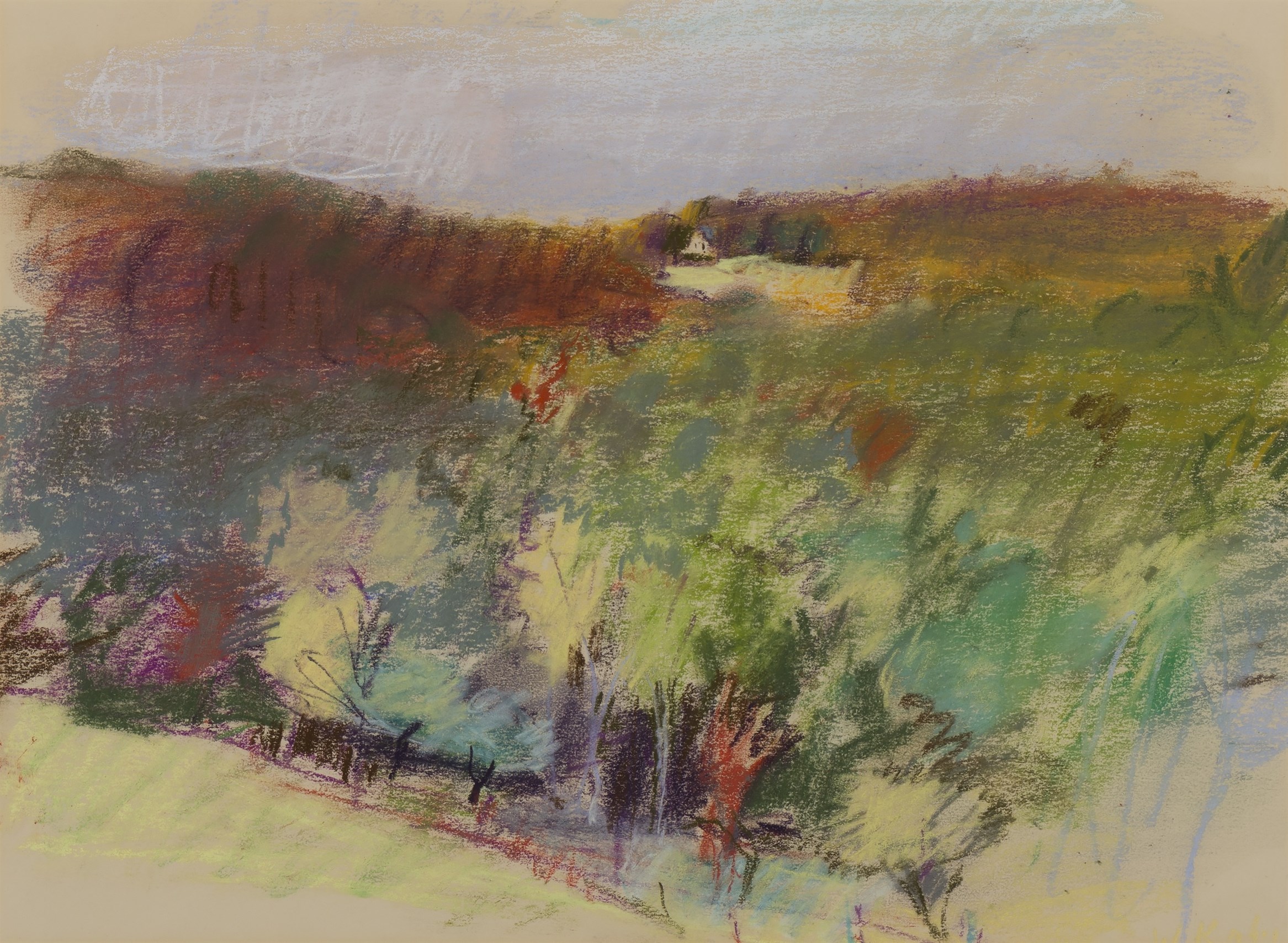
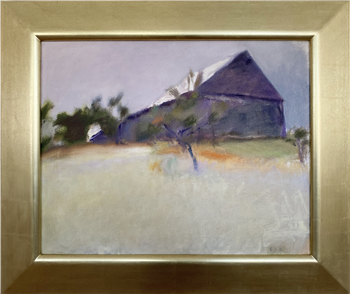
Wolf Kahn, one of the leaders of this group and a native of Stuttgart, Germany, directed this approach toward the painting of the landscape, which he has steadfastly developed over a period of forty years. With studios in New York and Vermont, he has been a colorist* who uses simplified geometric designs and contrasting, carefully balanced colors. He has a fascination with barns that date to 1966 when he did a work titled First Barn Painting. He returned to this subject throughout the 70s and 80s. In 1999, a major exhibition of his work was held at the Morris Museum of Art in Augusta Georgia.
Today Kahn's use of color has placed him at the forefront of American representational Art, and has made him one of the most highly regarded colorists working in America today. He has received Fulbright and Guggenheim* Fellowships, and an Award in Art from the American Academy and Institute for Arts and Letters.
Source:
Web site of Virginia Lynch Gallery. Tiverton Rhode Island
* For more in-depth information about these terms and others, see AskART.com Glossary http://www.askart.com/AskART/lists/Art_Definition.aspxBiography from Spanierman Gallery
An important member of the second generation New York School, Wolf Kahn is renowned for his luminous, richly colored landscapes. Focusing on such thematic imagery as the tended fields, houses and sturdy barns of New England, Kahn's work represents a masterful synthesis of illusionistic representation and abstraction.
Kahn was born in Stuttgart, Germany, in 1927. As a boy, he studied painting and drawing in Frankfurt. In 1939 his family separated by the Nazi upheaval, Kahn was sent to Cambridge, England, with other refugee children. One year later he arrived in New York City, where he was united with his father, a noted musician. Kahn continued his education at the New York High School of Music and Art, graduating in 1945. During 1946 after a brief period of service in the Navy, he worked under Stuart Davis at the New School for Social Research. From 1947 until 1949, Kahn attended Hans Hofmann's School of Fine Art in New York. He also spent a summer as Hofmann's studio assistant in Provincetown.
In 1950 Kahn enrolled at the University of Chicago, receiving his bachelor's degree a year later. After a period of traveling across the continent and working in Oregon as a lumberjack, he returned to New York and resumed painting. In 1956, along with several other of Hofmann's former students, he helped found the Hansa Gallery, one of the first artists' co-operative loft galleries. During these years, Kahn was one of several young artists, including Elaine de Kooning and Robert De Niro, who were influenced by action painting but, at the same time, felt the need to reintroduce nature back into their art.
Kahn's early work consists of still lifes and figure studies, which show the influence of Hofmann's "push-pull" space as well as his gestural energy. However, Kahn's mature style revolves around the portrayal of un-peopled landscapes in which he combines an expressive chromaticism (inspired by Milton Avery and Mark Rothko) with an emphasis on the dynamics of light and atmosphere. Many critics describe him as a Luminist, carrying on the 19th century tradition but with a thoroughly modern sensibility. Kahn draws much of his subject matter from the landscape in and around his farm in Vermont, where he spends his summers.
Kahn has had numerous solo exhibitions, organized by such institutions as the San Diego Museum of Art (1984, 1987), the Munson-Williams-Proctor Institute (1882), the Arts Club of Chicago (1981) and the Rhode Island School of Design Museum (1979). He is also the recipient of many awards and prized, including a Guggenheim Fellowship (1966-67).
Examples of Kahn's work can be found in most of America's major museums, including the Metropolitan Museum of Art, the Museum of Modern Art and the Whitney Museum of American Art, to name only a few.
CL
©The essay herein is the property of Spanierman Gallery LLC and is copyrighted by Spanierman Gallery LLC and may not be reproduced in whole or in part, without written permission from Spanierman Gallery LLC nor shown or communicated to anyone without due credit being given to Spanierman Gallery LLC.Biography from Altermann Galleries and Auctioneers, IV
Born in Stuttgart, Germany in 1927, Wolf Kahn immigrated to the United States by way of England in 1940. In 1945 he graduated from the High School of Music and Art in New York after which he spent time in the Navy. Under the GI Bill he studied with the well-known teacher and abstract expressionist Hans Hoffman, becoming Hofmann's studio assistant. In 1950 he enrolled in the University of Chicago from which he graduated in 1951 with a BA.
Having completed his baccalaureate degree in only one year, Kahn was determined to become a professional artist. He and other former Hofmann students established The Hansa, a cooperative gallery where he had his first one man show. In 1956 he joined the Grace Borgenicht Gallery where he exhibited regularly until 1995. Mr. Kahn has received a Fulbright Scholarship, a John Simon Guggenheim Fellowship, and an Award in Art from the American Academy of Arts and Letters. He is a member of the Nation Academy of Design, as well as the American Academy of Arts and Letters and has recently completed an appointment to the New York City Art Commission. Traveling extensively, he has painted landscapes in such diverse locales as Maine, Mexico, Italy, Greece, Kenya, New Mexico, Hawaii and Egypt. He spends his summers and autumns in Vermont on a hillside farm, which he and his wife, the painter Emily Mason, have owned since 1968. They have two daughters, Cecily and Melany. Cecily Kahn is a painter, married to the painter David Kapp.
The unique blend of Realism and the formal discipline of Color Field painting sets the work of Wolf Kahn apart. Kahn is an artist who embodies the synthesis of his modern abstract training with Hans Hofmann, with the palette of Matisse, Rothko's sweeping bands of color, and the atmospheric qualities of American Impressionism. It is precisely this fusion of color, spontaneity and representation that has produced such a rich and expressive body of work. Wolf Kahn regularly exhibits at galleries and museums across North America. Selected museum collections include Metropolitan Museum of Art, New York, NY, Whitney Museum of American Art, New York, NY, Museum of Fine Arts, Boston, MA, Hirshhorn Museum, Washington, D.C., Los Angeles County Museum, Los Angeles, CA.
Source: artist's website (http://www.wolfkahn.com/index2.html)Biography from Vose Galleries
Born in Stuttgart, Germany, Wolf Kahn immigrated to the United States in 1940, fleeing the growing antisemitic regime in his home country. Kahn had demonstrated an affinity for drawing from a young age and having settled in New York City, he began studying with Abstract Expressionist painter Hans Hofmann at the Hans Hofmann School of Fine Art under the GI Bill. During their time together, Hofmann greatly influenced Kahn’s art, teaching him to seriously reflect upon the role that color played in his work. Years later, Kahn collaborated with a number of fellow Hofmann students to establish the Hansa Gallery, an artist cooperative gallery in New York City. He also studied at the University of Chicago, where he completed his undergraduate degree in only a year.
In 1956, Kahn met Emily Mason at the National Arts Club in New York City. A descendant of Neoclassical American artist John Trumbull and the daughter of Abstract artist Alice Trumbull Mason, Emily Mason was an accomplished artist herself, experimenting with the tenets of Abstract Expressionism in her own work. At the time of her meeting Kahn, Mason had just earned a Fulbright scholarship to paint and study in Venice, Italy. Kahn was so smitten with her that he followed her to Venice, where the two were married a year later in 1957. They remained in Italy for two years, but soon returned after Kahn himself earned a Fulbright to study and work in Rome. At the completion of his scholarship, they returned to New York City, where they lived the rest of their lives, excluding the summer months which they spent at their Vermont farmhouse.
During his nearly seventy-year career, Wolf Kahn met with great success for his unparalleled synthesis of Color Field and Realism painting. He was awarded a Medal of Arts from the US State Department, and he exhibited widely at prestigious venues across the country, such as the Museum of Modern Art, the Whitney Museum of American Art, and the San Diego Museum of Art. Today, his vigorous paintings of New England’s landscape can be found in countless private and public collections, including the Brooklyn Museum, the Museum of Fine Arts, Boston, and the Art Institute of Chicago.Biography from LewAllen Galleries
 Born in Stuttgart, Germany, in 1927, Wolf Kahn immigrated to the United States by way of England in 1940. In 1945, he graduated from the High School of Music & Art in New York, after which he spent time in the Navy. Under the GI Bill, he studied with renowned teacher and Abstract Expressionist painter Hans Hofmann, later becoming Hofmann’s studio assistant. In 1950, he enrolled in the University of Chicago. He graduated in 1951 with a Bachelor of Arts degree.
Having completed his degree in only one year, Kahn was determined to become a professional artist. He and other former Hofmann students established the Hansa Gallery, a cooperative gallery where Kahn had his first solo exhibition. In 1956, he joined the Grace Borgenicht Gallery, where he exhibited regularly until 1995. Kahn has received a Fulbright Scholarship, a John Simon Guggenheim Fellowship, and an Award in Art from the Academy of Arts and Letters.
Traveling extensively, he has painted landscapes in Egypt, Greece, Hawaii, Italy, Kenya, Maine, Mexico, and New Mexico. He spends his summers and autumns in Vermont on a hillside farm, which he and his wife, the painter Emily Mason, have owned since 1968. They have two daughters, Cecily and Melany. Cecily Kahn is also an artist, and is married to the painter David Kapp.
The unique blend of Realism and formal discipline of Color Field painting sets the work of Wolf Kahn apart. Kahn is an artist who embodies a synthesis of artistic traits – the modern abstract training of Hans Hofmann, the palette of Matisse, Rothko’s sweeping bands of color, the atmospheric qualities of American Impressionism. The fusion of color, spontaneity and representation has produced a rich and expressive body of work.
Wolf Kahn's art can be found in the collections of The Metropolitan Museum of Art, New York, NY; the Whitney Museum of American Art, New York, NY; The Museum of Modern Art, New York, NY; the Museum of Fine Arts, Boston, MA; the Hirshhorn Museum and the National Museum of American Art, Washington, D.C.; and the Los Angeles County Museum of Art, Los Angeles, CA.Biography from Taylor Graham
 Wolf Kahn's well-balanced colorist technique of depicting landscapes has made him one of the most influential American artists of our generation. A native of Stuttgart, Germany, he attended the Hans Hofmann School of Fine Arts in New York City. It was here that he and a group of young artists, under the direction of Hans Hofmann, forged a style that was both representational and Abstract Expressionistic. Hans Hofmann's didactic artistic theories proved to be one of the most significant influences upon Kahn's work.
In his own words, "We who studied with Hofmann felt ourselves to be the bearers of a more profound message, one better suited to give content and weight to the calling of 'artist.' We felt we were learning the essence of modernism, art stripped of everything extraneous. What remained was its esthetic/philosophical foundation, its raison d'être."
These progressive artists included Nell Blaine, Jane Freilicher, Allan Kaprow, Jan Muller, and Larry Rivers. They adopted Abstract Expressionistic spontaneity with the idea that the finished piece was an accumulated history of a process, a visual representation of energetic action and reaction. His influences and inspiration can be found in the works of such European artists as Braque, Bonnard, Soutine, and Van Gogh. He embraced the ideas of the Old Masters as well as those of Impressionism, Expressionism, and Post-Impressionism.
Kahn formulated a unique way in which he would employ simplified geometric designs while carefully contrasting numerous colors and tones. Whether it is his landscapes, which he was most recognized for, or his portraits, one may, upon inspection, feel paradoxical feelings of tranquility and brute emotion. With studios in both New York and Vermont, Kahn was able to draw his artistic inspiration from scenes in nature. His paintings are illuminating and beautiful, the colors striking and rich, the process intimately apparent to the observer. Kahn's intuitive sense of color and dedicated pursuit of a new and sincere vision led to moments of youthful pleasure while others appeared delicate, ostensibly capturing the essence of the atmosphere.
Collections:
National Museum of American Art
Boston Museum of Fine Arts
The Brooklyn Museum of Art
Jewish Museum
Metropolitan Museum of Art
Museum of Modern Art
Whitney Museum
Museum of Fine Arts, Houston
Exhibitions:
Hansa Gallery, 1952-53, 1955
Borgenicht gallery, 1956, 1959, 1967
Seligmann Gallery, 1947
"813 Broadway", 1950
Stable Gallery, 1954-5
Whitney Museum, 1960
Awards:
Guggenheim Fellowship, 1967Biography from Jerald Melberg Gallery
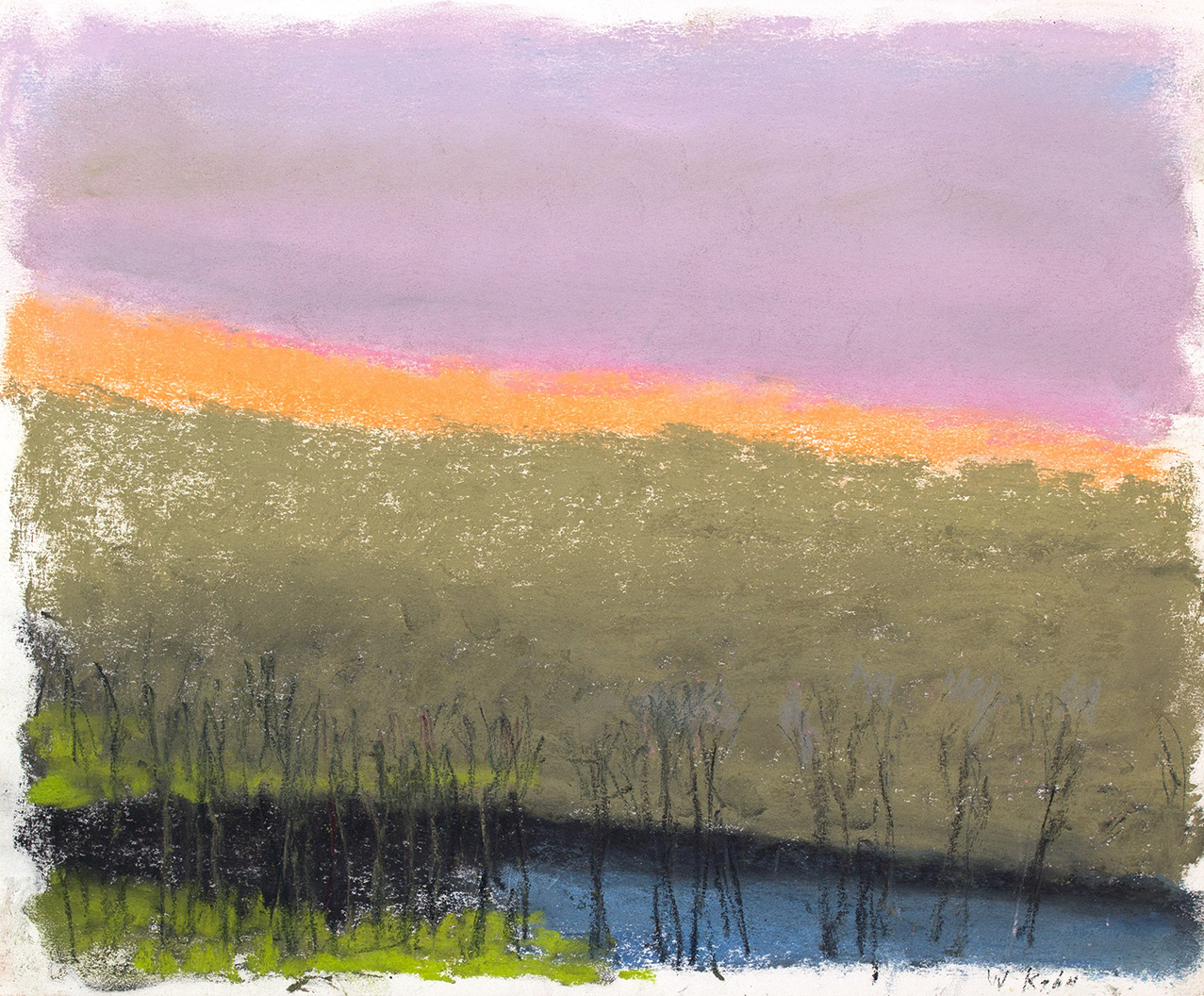 Wolf Kahn is a landscape painter for whom color is his signature. Continually striving for a deeper insight into the possibilities of color, Wolf Kahn makes landscape paintings with techniques of luminism.
Born in Stuttgart, Germany, Kahn emigrated to the U.S. as a child. After attending classes at the New School for Social Research he studied with Hans Hofmann at his School of Fine Art in New York City.
Wolf Kahn has been honored with numerous awards and his work can be found in the permanent collections of over 100 museums, including the Metropolitan Museum of Art, the Museum of Modern Art, the Whitney Museum of American Art in New York and the National Gallery of Art in Washington, D.C.Biography from The Johnson Collection
HANS WOLFGANG KAHN (1927–2000)
Whether working in oil or pastel, it was all about color for Hans Wolfgang Kahn. In a 1983 interview he said: “I am always trying to get to a danger point in color, where color either becomes too sweet or it becomes too harsh, it becomes too noisy or too quiet, and at that point I still want the picture to be strong, forceful, and the carrier of everything that a painting has to have: contrast, drama, austerity.” The final product of this methodology is a well-orchestrated and luminous landscape dominated by trees and often featuring ordinary structures.
Kahn was born in Stuttgart, Germany, but the rise of antisemitism in the Weimar Republic disrupted his childhood and prompted his family’s move to the United States, leaving three-year-old Kahn with his grandmother in Frankfurt. When he was twelve he went to London, and then the following year in 1940, he emigrated to New York. Despite the turmoil, he developed a precocious interest in art; he was drawing when he was four years old, and had private art lessons in the late 1930s often depicting military events and historical figures.
At New York’s High School of Music and Art from 1942 to 1945, Kahn produced mostly caricatures. After a year serving in the United States Navy, Kahn took classes at the New School for Social Research with Stuart Davis. Not satisfied, he moved on and used the GI Bill to study with Hans Hofmann, the great German-American Abstract Expressionist who promulgated his “push-pull” theory of color. Kahn became his studio assistant in Provincetown, Massachusetts, during summer 1947 and subsequently in New York for a total of eighteen months. He then went on to the University of Chicago to study philosophy and in 1951 earned his Bachelor of Arts degree completing it in one year.
Kahn began showing his work in New York in the early 1950s and was active in the Hansa Gallery Cooperative alongside other Hofmann students. His main homestead would continue to be Vermont and New York, but he traveled frequently. Though he had already been visiting New Orleans since 1951, the summer of 1953 was the first time he stayed for longer with his brother, Peter, an art professor at Louisiana State University. He would return to the South frequently to paint and teach workshops in such places as Charleston, South Carolina; Lexington, Kentucky; Columbus, Georgia; Syria, Virginia; and Laurel Mississippi. He also spent time in Tepoztlán, Mexico, and in 1960 he went to the University of California, Berkley as a visiting professor for a year. Returning to New York, Kahn taught at Cooper Union throughout the 1960s, with occasional trips to Rome. Summers were spent in Deer Isle, Maine, until 1968, but then he purchased a farm in West Brattleboro, Vermont. In the 1970s, Kahn worked sporadically in Louisiana to jury art competitions and participate in exhibitions. Then, in 1998 the Morris Museum of Art in Augusta, Georgia, brought Kahn to South Carolina and commissioned a series of paintings of Southern scenery He would travel with Edward Rice to various locations to paint en plein air. Kahn remarked that the “reflective light” in the trees and the “weathered” structures of the rural South were appealingly different from anything he’d seen in the North.
During his long and successful career, Kahn received many honors, including a Fulbright Scholarship in 1962, a John Simon Guggenheim Fellowship in 1966, and an Award in Art from the American Academy of Arts and Letters in 1979. In addition, the Vermont Council on the Arts in 1998 gave him a Lifetime Achievement Award, as did the National Academy in 2006. From his alma mater, he was presented with the University of Chicago Outstanding Alumni Professional Achievement Award in 2012 and the United States State Department awarded him the International Medal of Art in 2017. He has an honorary doctorates from Wheaton College, in Norton, Massachusetts, given in 2000, and from Union College in Schenectady, New York, in 2004. The citation for the latter degree reads as follows: “Asked to describe your paintings, a colleague of yours once compared your work to a string quartet, where the four principal colors, or voices, resonate together in a tightly-structured composition.…You combine landscape and abstraction to create atmospheric and sensual paintings that are refreshments to our souls.”
The Johnson Collection, Spartanburg, South Carolina
thejohnsoncollection.orgBiography from The Columbus Museum (COMU)
Wolf Kahn, the youngest of four siblings, was born into a well-to-do artistic family. His father was the conductor of the Stuttgart Philharmonic Symphony, and his mother came from a family of art collectors.(1) During 1938, Kahn took his first art lessons, but most of his initial drawings were of military or historical events. The next year Kahn was sent to England for safety following the ascendancy of Hitler to power, and in 1940, he immigrated to the United States.
In 1942, he entered New York's High School of Music and Art, and while there, he was employed by a commercial art firm doing illustrations. After a stint in the Navy, Kahn entered Hans Hofmann's school, and among his fellow students were Neil Blaine, Jane Freilicher, Allan Kaprow and Larry Rivers. His initial results were done with a dark palette and abstracted forms, and although Hofmann's style of teaching was difficult, Kahn has consistently praised him for teaching him the value of control and understanding.(2)
Kahn's first exhibition was a 1951 group show in a loft with several other artists in lower Manhattan. From this impromptu show, a group effort evolved called the Hansa Gallery Cooperative.(3) In 1953, Wolf Kahn had a one-man show at this gallery, which was reviewed by Fairfield Porter, and at this same time bolder, more vivid colors began to appear in his work. By the mid-1950's, on a summer trip to Provincetown, Kahn's paintings indicated a new direction of softening warm colors in the manner of Bonnard. He was included in Meyer Shapiro's seminal exhibition, The New York School: The Second Generation at the Jewish Museum, and by the end of the 1950s, he had developed his abstracted landscape style for which he is best known.
In 1966, he made his first "barn" painting on Martha's Vineyard that reduced the complexities of detail of the architecture to a more basic shape, a stylistic convention that is evident in the Museum's painting. Kahn has since commented frequently on his use of color as a unique and specific component of each work as the situation demands, where the gradual buildup of the colors resembles the beauty and translucent nature of pastels.(4) Since then Kahn has had one-person exhibitions at the Kansas City Art Institute, Chrysler Museum, San Diego Museum of Art, Fort Lauderdale Museum of Art and the Columbus Museum, among others. His work is in the permanent collections of numerous museums throughout the United States.
Footnotes:
1. Much of the biographical information is drawn from Justin Spring, Wolf Kahn (New York: Harry N. Abrams, 1996).
2. Spring, 21. Wolf Kahn draws this from a 1973 address to the College Art Association.
3. This group included Jane Wilson, Allan Kaprow, Richard Stankiewicz, John Chamberlain, Lucas Samaras, George Segal and Robert Whitman. The name paid homage to Hans Hofmann.
4. Wolf Kahn, "Notes 1990-1991," Wolf Kahn: New Landscape Paintings and Pastels (Charlotte, NC: Gerald Melberg Gallery, 1991), unpaginated. In a 1995 catalogue, Wolf Kahn, New Paintings - Celebrating Color (New York: Grace Borgenicht Gallery, 1995), Kahn goes on to state that the "use of color, especially bright color, requires the strict exercise of tact and decorum…art must not be allowed to degenerate into stroking."
Submitted by the staff of the Columbus Museum, Georgia