Page loaded successfully. Showing biography for Yanping Yang.
Yanping Yang BIOGRAPHY
Born 1934 Hubei Wenan, China. Known for: Abstraction, ink and oil painting and drawing, architecture.
Yang Yanpin. 1934 | Nanjing, China. Chinese visual artist. Based in New York, Yang Yanping is one of the leading modernist ink and oil painter from China. She trained in architectural design at... Read full biography
Yang Yanpin. 1934 | Nanjing, China. Chinese visual artist. Based in New York, Yang Yanping is one of the leading modernist ink and oil painter from China. She trained in architectural design at Tsinghua University, Beijing and after graduating in 1958, she taught design for a short time before... Read full biography
Yang Yanpin. 1934 | Nanjing, China. Chinese visual artist. Based in New York, Yang Yanping is one of the leading modernist ink and oil painter from China. She trained in architectural design at Tsinghua University, Beijing and after graduating in 1958, she taught design for a short time before entering the Beijing Academy of Fine Arts in 1966. She also studied Chinese traditional painting of her own volition.?. The 1980s were a turning point for Yang and many other artists in China, who began... Read full biography
Yang Yanpin. 1934 | Nanjing, China. Chinese visual artist. Based in New York, Yang Yanping is one of the leading modernist ink and oil painter from China. She trained in architectural design at Tsinghua University, Beijing and after graduating in 1958, she taught design for a short time before entering the Beijing Academy of Fine Arts in 1966. She also studied Chinese traditional painting of her own volition.?. The 1980s were a turning point for Yang and many other artists in China, who began to practice their craft more freely as the country’s stricter policies imposed under Mao’s Cultural Revolution began to lessen. Yang started to create historical paintings for the Museum of Chinese History and the Museum of Chinese Revolution in... Read full biography
Yang Yanpin. 1934 | Nanjing, China. Chinese visual artist. Based in New York, Yang Yanping is one of the leading modernist ink and oil painter from China. She trained in architectural design at Tsinghua University, Beijing and after graduating in 1958, she taught design for a short time before entering the Beijing Academy of Fine Arts in 1966. She also studied Chinese traditional painting of her own volition.?. The 1980s were a turning point for Yang and many other artists in China, who began to practice their craft more freely as the country’s stricter policies imposed under Mao’s Cultural Revolution began to lessen. Yang started to create historical paintings for the Museum of Chinese History and the Museum of Chinese Revolution in Beijing. Her work also saw a shift in style from realism and her earlier monochromatic palette towards a more expressive, personal composit... Read full biography
Artist Biography
Biography page for Yanping Yang ((Born 1934)), known for Abstraction, ink and oil painting and drawing, architecture. Showing 2 biographical entries and 0 sample artworks.
Yanping Yang - Artist Info
About Yanping Yang
Name variants
Yang Yan Ping, Yan Ping Yang
Biography from the Archives of askART
 Yang Yanpin
1934 | Nanjing, China
Chinese visual artist.
Based in New York, Yang Yanping is one of the leading modernist ink and oil painter from China. She trained in architectural design at Tsinghua University, Beijing and after graduating in 1958, she taught design for a short time before entering the Beijing Academy of Fine Arts in 1966. She also studied Chinese traditional painting of her own volition.?
The 1980s were a turning point for Yang and many other artists in China, who began to practice their craft more freely as the country’s stricter policies imposed under Mao’s Cultural Revolution began to lessen. Yang started to create historical paintings for the Museum of Chinese History and the Museum of Chinese Revolution in Beijing. Her work also saw a shift in style from realism and her earlier monochromatic palette towards a more expressive, personal composition, with a colourful and abstract style of painting. She began to exhibit more widely and became a member of OPRA (Oil Painting Research Association), which included many leading mid-generation oil painters, some of whom had attended the Beijing Academy.
Her work Towering Mountain (c. 1981) was shown the exhibition, Chinese Contemporary Painting: An Exhibition from the PRC, for the Chinese Cultural Centre in San Francisco (1984), which toured the United States. She was recommended for the show by the Asian art expert, James Cahill who had first seen her work in Beijing in 1982.?Wang subsequently traveled to the United States in 1986 with her husband, the painter Zeng Shanqing (b. 1932).
The opportunity arose as both were awarded visiting artist fellowships by Stony Brook University in New York.?That same year the couple met the American art historian Joan Lebold Cohen, a seminal figure in the field of documenting modern art from China since the early 1960s, having visited the country a number of times over more than a decade. By this time Yang had moved to the United States permanently, living in Long Island and in New York. J. L. Cohen publish her comprehensive book of interviews with and photographs of Chinese artists, The New Chinese Painting 1949-1986 in 1987.
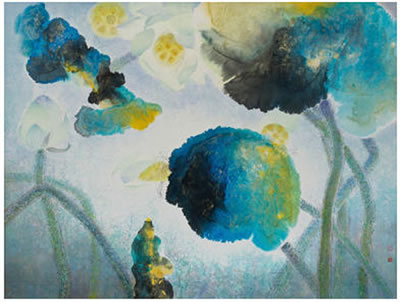
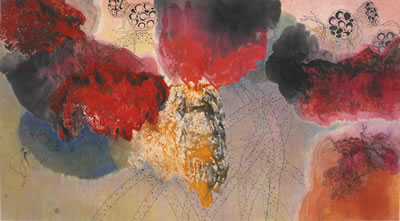
The publication spanned three generations of pioneering ink and watercolour painters, and also featured a profile on Yang, whom J. L. Cohen described as, “An accomplished rising star at the Beijing Print Academy”. Whilst Yang’s early works has always had an affinity with classical Chinese painting, most notably its landscape genre, she is best known through her early embrace of calligraphy and subsequently her multiple renderings of the eternal yet fragile strength of lotus flower.
Yang’s modernist reinterpretation of guohua could also be recognised in her unique approach to depicting mists, clouds and fields. However, it is the lotus, which in its semi-abstract form and gloriously vibrant colourfield hues reveals Yang’s intense feelings towards her subject matter. Other paintings attest to her continued interest in exploring flora and fauna, and specifically the changing seasons; with works such as Brilliant Autumn (1993) and Scent of Summer Night (2000) where the flowers appear to metamorphose from naturalistic pods into bursts of colorful shapes and forms on the surface of the paper.?
Over the ensuing decades Yang has continued to experiment with the multifarious ways materials can be adapted to create new pictorial expressions. Rather than the continued use of traditional brush techniques for applying ink to paper, for example, she is known for her “brushless technique”, an ingenious use of crumbled paper as an alternative material for applying paint. The paper is soaked or pressed like a sponge into a mixture of contrasting washes of watercolour, inks and diluted acrylics then dabbed on to both sides of painted paper.?
Although a celebrated artist in China in the early 1980s, with her work shown internationally, it appears Yang has still to receive such recognition in the United States. The Art Institute of Chicago where Yang’s most recent joint exhibition in 2019 took place, titled, Expressive Ink: Painting By Yang Yanping and Zeng Shanqing (2019), marked the first presentation of both these artists’ works in a major art museum in the United States in over three decades.
Now in her eighties, Yang continues to explore a wide range of hybrid lotus forms and landscape subjects, in ways that continue to reflect what matters most – her embrace of artistic autonomy – and being free to make the art that she wants.
By Pamela Kember, Archivrs of Women Artists, Research and Exhibitions, 2022Biography from Bonhams Bond Street
Yang was born in 1934 in Hubei Wenan, China and graduated from the Architecture Department of Tsinghua University in 1958.
Yang Yanping is famous for her paintings of Autumn and lotus; with impressive compositions of saturated reds, golds and ink on paper, her works strays close to pure abstraction. She studied architecture at Tsinghua University, where she married one of her painting teachers, Zeng Shanqing.
After she graduated in 1958, and a brief spell of teaching factory design, Yang decided to study art at the Oil Painting Department of the Beijing Art Academy. At the same time she studied traditional Chinese painting on her own. In 1986, both Yang and her husband were awarded fellowships from the State University of New York at Stony Brook, and they have remained in America ever since.
Yang is well versed in many traditional styles but has excelled in depicting the lotus flower, a symbol of purity, transience, the fragility of nature, and the potential for regeneration. Yang's ideals of high visual quality and an artistic autonomy allows her to embrace modernism without jettisoning the lessons from the classical Chinese world of high culture. Her recent exhibitions include a major retrospective at The Art Museum of Beijing Fine Art Academy in 2013.