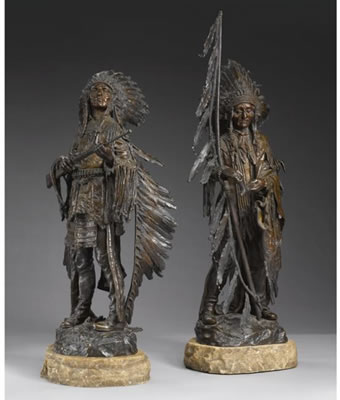
CARL KAUBA. This Austrian sculptor was born in Vienna in 1865. His teachers were Karl Waschmann (1848-1905), known for his ivory sculptures and portrait plaquettes of contemporary celebrities, and... Read full biography
CARL KAUBA. This Austrian sculptor was born in Vienna in 1865. His teachers were Karl Waschmann (1848-1905), known for his ivory sculptures and portrait plaquettes of contemporary celebrities, and Stefan Schwartz (1851-1924), who exhibited in Paris, including the Exposition Universelle of 1900... Read full biography
CARL KAUBA. This Austrian sculptor was born in Vienna in 1865. His teachers were Karl Waschmann (1848-1905), known for his ivory sculptures and portrait plaquettes of contemporary celebrities, and Stefan Schwartz (1851-1924), who exhibited in Paris, including the Exposition Universelle of 1900 where he won a gold medal. Kauba's intricate bronzes, imported to the United States between 1895 and 1912, were cast at the Roman Bronze Works. Kauba was part of the nineteenth-century tradition of... Read full biography
CARL KAUBA. This Austrian sculptor was born in Vienna in 1865. His teachers were Karl Waschmann (1848-1905), known for his ivory sculptures and portrait plaquettes of contemporary celebrities, and Stefan Schwartz (1851-1924), who exhibited in Paris, including the Exposition Universelle of 1900 where he won a gold medal. Kauba's intricate bronzes, imported to the United States between 1895 and 1912, were cast at the Roman Bronze Works. Kauba was part of the nineteenth-century tradition of polychrome bronze sculpture. There were several types of patinas on a single statue: he could render the color of buckskin, variously tinted shirts, blankets, feathers, as well as beaded moccasins. Reportedly, Kauba came to America around 1886. Inspired by... Read full biography
CARL KAUBA. This Austrian sculptor was born in Vienna in 1865. His teachers were Karl Waschmann (1848-1905), known for his ivory sculptures and portrait plaquettes of contemporary celebrities, and Stefan Schwartz (1851-1924), who exhibited in Paris, including the Exposition Universelle of 1900 where he won a gold medal. Kauba's intricate bronzes, imported to the United States between 1895 and 1912, were cast at the Roman Bronze Works. Kauba was part of the nineteenth-century tradition of polychrome bronze sculpture. There were several types of patinas on a single statue: he could render the color of buckskin, variously tinted shirts, blankets, feathers, as well as beaded moccasins. Reportedly, Kauba came to America around 1886. Inspired by the Western tales of German author Karl May, he traveled to the West and made sketches and models. Critics, howeve... Read full biography
Carl Kauba - Artist Info
About Carl Kauba: Books
Books & Publications (11)
Publications based on askART research. List may not be comprehensive.
The Artists Bluebook 34,000 North American Artists to March 2005
2005
AskART.com Inc. - Dunbier, Lonnie Pierson (Editor)
479 pages
Davenport's Art Reference: The Gold Edition
2005
Davenport, Ray
2,421 pages
Who Was Who in American Art, 1564-1975: Three Volumes
1999
Falk, Peter Hastings (Editor)
3,724 pages
American Western Art
1989
Rockwell Museum
84 pages (color)
Mantle Fielding's Dictionary of American Painters, Sculptors & Engravers
1986
Opitz, Glenn B (editor)
1,081 pages
Who Was Who in American Art: Artists Active Between 1898-1947
1985
Falk, Peter Hastings (Editor)
707 pages
Dictionary of American Sculptors: 18th Century to Present
1984
Opitz, Glenn B (editor)
656 pages
The Treasures of Gilcrease (Tulsa OK)
1979
Myers, Fred
106 pages (color)
American Western Art: The Harmsen Collection
1977
Harmsen, Dorothy; Bill Harmsen (Foreward)
256 pages (color)
Bronzes of the American West
1973
Broder, Patricia Janis; Harold McCracken (Intro)
429 pages (color)
The West and Walter Bimson Paintings, Watercolors, Drawings and Sculpture