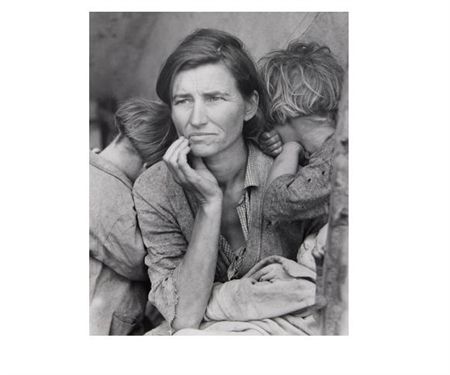
Dorothea Lange was born in Hoboken, New Jersey, in 1895 and studied photography in New York City before the First World War. In 1919, she moved to San Francisco, where she earned her living as a... Read full biography
Dorothea Lange was born in Hoboken, New Jersey, in 1895 and studied photography in New York City before the First World War. In 1919, she moved to San Francisco, where she earned her living as a portrait photographer for more than a decade. During the Depression's early years Lange's interest in... Read full biography
Dorothea Lange was born in Hoboken, New Jersey, in 1895 and studied photography in New York City before the First World War. In 1919, she moved to San Francisco, where she earned her living as a portrait photographer for more than a decade. During the Depression's early years Lange's interest in social issues grew and she began to photograph the city's dispossessed. A 1934 exhibition of these photographs introduced her to Paul Taylor, an associate professor of economics at the University of... Read full biography
Dorothea Lange was born in Hoboken, New Jersey, in 1895 and studied photography in New York City before the First World War. In 1919, she moved to San Francisco, where she earned her living as a portrait photographer for more than a decade. During the Depression's early years Lange's interest in social issues grew and she began to photograph the city's dispossessed. A 1934 exhibition of these photographs introduced her to Paul Taylor, an associate professor of economics at the University of California at Berkeley, and in February 1935 the couple together documented migrant farm workers in Nipomo and the Imperial Valley for the California State Emergency Relief Administration. Copies of the reports Lange and Taylor produced reached Roy... Read full biography
Dorothea Lange was born in Hoboken, New Jersey, in 1895 and studied photography in New York City before the First World War. In 1919, she moved to San Francisco, where she earned her living as a portrait photographer for more than a decade. During the Depression's early years Lange's interest in social issues grew and she began to photograph the city's dispossessed. A 1934 exhibition of these photographs introduced her to Paul Taylor, an associate professor of economics at the University of California at Berkeley, and in February 1935 the couple together documented migrant farm workers in Nipomo and the Imperial Valley for the California State Emergency Relief Administration. Copies of the reports Lange and Taylor produced reached Roy Stryker, who offered Lange a job with the Resettlement Administration in August 1935. Unlike the agency's other photographers, Lange d... Read full biography
Dorothea Lange - Artist Info
About Dorothea Lange: Books
Books & Publications (13)
Publications based on askART research. List may not be comprehensive.
San Francisco Museum of Modern Art 360 Views on the Collection (Exhibition catalog)
2016
Block, Judy and Suzanne Stein, Editors
360 pages (color)
Southwest Art History Conference Abstracts, 1996-2013
2014
Fahlman, Betsy (Editor)
217 pages (color)
Encounters: Photography from the Sheldon Museum of Art
2013
Ruud, Brandon K. (Editor); Jorge Daniel Veneciano (Introduction)
242 pages (color)
A Legacy of Giving: The Anna and Frank Hall Collection (The Sheldon Museum of Art, University of Nebraska, Lincoln) (Exhibition catalog)
2012
Embury, Stuart; Brandon K. Ruud; Norman Geske; Jorge Daniel Veneciano, Introduction
80 pages (color)
Arizona's Pioneering Women Artists: Impressions of the Grand Canyon State Directory Listing of 479 Women Before 1945 (Exhibition catalog)