Fascinated by both art and science, especially astronomy and astrophysics, Dorothea Rockburne believes that art and science originate from a single source and are informed by the same reality. In her... Read full biography
Fascinated by both art and science, especially astronomy and astrophysics, Dorothea Rockburne believes that art and science originate from a single source and are informed by the same reality. In her paintings, many which look like swirling astrological subjects, she expresses her sense of harmony,... Read full biography
Fascinated by both art and science, especially astronomy and astrophysics, Dorothea Rockburne believes that art and science originate from a single source and are informed by the same reality. In her paintings, many which look like swirling astrological subjects, she expresses her sense of harmony, correspondences and patterns that she regards as ultimate beauty with metaphysical significance. Some of her work is also described as minimalist and geometric because she has folded canvas into... Read full biography
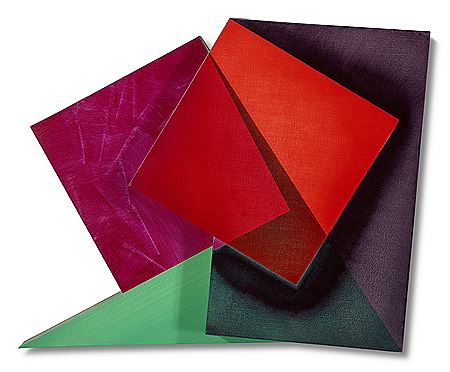
Fascinated by both art and science, especially astronomy and astrophysics, Dorothea Rockburne believes that art and science originate from a single source and are informed by the same reality. In her paintings, many which look like swirling astrological subjects, she expresses her sense of harmony, correspondences and patterns that she regards as ultimate beauty with metaphysical significance. Some of her work is also described as minimalist and geometric because she has folded canvas into parallelograms and triangles with variations of surface texture. In the 1970s and 1980s, Rockburne relied upon the Fibonacci series, a set theory of mathematics of chance as taught by the French mathematician Henri Poincare. She was also inspired by the... Read full biography
Fascinated by both art and science, especially astronomy and astrophysics, Dorothea Rockburne believes that art and science originate from a single source and are informed by the same reality. In her paintings, many which look like swirling astrological subjects, she expresses her sense of harmony, correspondences and patterns that she regards as ultimate beauty with metaphysical significance. Some of her work is also described as minimalist and geometric because she has folded canvas into parallelograms and triangles with variations of surface texture. In the 1970s and 1980s, Rockburne relied upon the Fibonacci series, a set theory of mathematics of chance as taught by the French mathematician Henri Poincare. She was also inspired by the early Italian painters Giotto and Ambrogio Lorenzetti. A Canadian, she attended the Ecole des Beaux Arts in Montreal throughout her child... Read full biography
Dorothea Rockburne - Artist Info
About Dorothea Rockburne: Books
Books & Publications (47)
Publications based on askART research. List may not be comprehensive.
The Artists Bluebook 34,000 North American Artists to March 2005
2005
AskART.com Inc. - Dunbier, Lonnie Pierson (Editor)
479 pages
Davenport's Art Reference: The Gold Edition
2005
Davenport, Ray
2,421 pages
Who Was Who in American Art, 1564-1975: Three Volumes
1999
Falk, Peter Hastings (Editor)
3,724 pages
North American Women Artists of the Twentieth Century A Biographical Dictionary
1995
Heller, Jules and Nancy G. Heller
612 pages
Art Today
1995
Lucie-Smith, Edward
512 pages (color)
The Mystical Now Art and the Sacred
1993
Beckett, Wendy
160 pages (color)
Who's Who in American Art, 1993-1994, 20th Edition (American Federation of Arts)
1993
Bowker R R
1,473 pages
The Artist Observed 28 Interviews with Contemporary Artists
1991
Gruen, John
324 pages
Art Since Mid Century 1945 to the Present
1991
Wheeler, Daniel
344 pages (color)
Cornell Collects: A Celebration of American Art from the Collections of Alumni and Friends, Cornell University (Exhibition catalog)
1990
Leavitt, Thomas (Intro); Richard Schwartz; Frank H.T. Rhodes
196 pages (color)
American Women Sculptors: A History of Women Working in Three Dimensions
1990
Rubinstein, Charlotte Streifer
638 pages
Abstraction, Geometry, Painting Geometric Abstract Painting in America since 1945 (Exhibition catalog)
1989
Auping, Michael
232 pages (color)
Contemporary Artists (3rd Edition)
1989
Naylor, Colin (editor)
1,059 pages
Contemporary Women Artists
1988
Beckett, Wendy
128 pages (color)
A Concise History of Modern Painting
1988
Read, Herbert
418 pages (color)
Making Their Mark: Women Artists Move Into the Mainstream
1988
Rosen, Randy, et al
300 pages (color)
Dictionary of Contemporary American Artists (5th Edition)
1987
Cummings, Paul
653 pages
A Graphic Muse Prints by Contemporary Women
1987
Field, Richard S/Ruth E Fine
163 pages (color)
National Mus of Women in the Arts
1987
National Museum of Women
253 pages (color)
American Watercolors
1986
Finch, Christopher
312 pages (color)
An American Renaissance Painting and Sculpture Since 1940 (Exhibition catalog)
1986
Hunter, Sam
269 pages (color)
Who's Who in American Art-1986 1986
1986
Jaques Cattell Press
1,292 pages
Dorothea Rockburne A Personal Selection 1968-1986 (Exhibition catalog)
1986
O'Doherty, Brian
24 pages (color)
American Painting: The Twentieth Century (Second edition)
1986
Rose, Barbara
170 pages (color)
American Art Now
1985
Lucie-Smith, Edward
160 pages (color)
Dorothea Rockburne Paintings and Drawings 1982-1985 (Exhibition catalog)
1985
Xavier-Fourcade
16 pages
New Art
1984
Freeman, Phyllis
207 pages (color)
The Museum of Modern Art, New York The History and the Collection
1984
Hunter, Sam
599 pages (color)
Eye to Eye Twenty Years of Art Criticism
1984
Pincus-Witten, Robert
232 pages
The Pluralist Era: American Art 1968-1981
1984
Robins, Corrine
246 pages (color)
Art at Work The Chase Manhattan Collection
1984
Severinghaus, J Walter
333 pages (color)
American Art Since 1945
1982
Ashton, Dore
224 pages (color)
The Americans/The Collage (Exhibition catalog)
1982
Contemporary Arts Museum
143 pages (color)
American Women Artists from Early Times to the Present