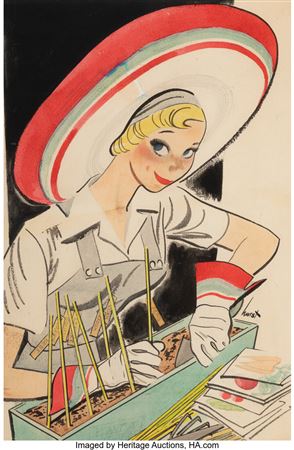
"Study Hurst's line carefully", wrote Ernest Watson in a 1942 profile in American Artist magazine. "You will see how it fluctuates, now full and lush as it accents some dominant action, now delicate... Read full biography
"Study Hurst's line carefully", wrote Ernest Watson in a 1942 profile in American Artist magazine. "You will see how it fluctuates, now full and lush as it accents some dominant action, now delicate as it defines a subtle bit of expression; but always sensitive, directed by complete knowledge and... Read full biography
"Study Hurst's line carefully", wrote Ernest Watson in a 1942 profile in American Artist magazine. "You will see how it fluctuates, now full and lush as it accents some dominant action, now delicate as it defines a subtle bit of expression; but always sensitive, directed by complete knowledge and technical mastery". Watson goes on to say "You will never find a deliberately drawn line in a Hurst illustration: only a swift-moving brush will produce that sense of alive-ness which is the essential... Read full biography
"Study Hurst's line carefully", wrote Ernest Watson in a 1942 profile in American Artist magazine. "You will see how it fluctuates, now full and lush as it accents some dominant action, now delicate as it defines a subtle bit of expression; but always sensitive, directed by complete knowledge and technical mastery". Watson goes on to say "You will never find a deliberately drawn line in a Hurst illustration: only a swift-moving brush will produce that sense of alive-ness which is the essential characteristic of his work". Earl Oliver Hurst was born in Buffalo, New York, in 1898. After a stint in World War I, he took night classes at the Cleveland School of Art while working days at The Plain Dealer, where he drew political cartoons and... Read full biography
"Study Hurst's line carefully", wrote Ernest Watson in a 1942 profile in American Artist magazine. "You will see how it fluctuates, now full and lush as it accents some dominant action, now delicate as it defines a subtle bit of expression; but always sensitive, directed by complete knowledge and technical mastery". Watson goes on to say "You will never find a deliberately drawn line in a Hurst illustration: only a swift-moving brush will produce that sense of alive-ness which is the essential characteristic of his work". Earl Oliver Hurst was born in Buffalo, New York, in 1898. After a stint in World War I, he took night classes at the Cleveland School of Art while working days at The Plain Dealer, where he drew political cartoons and fashion illustrations. From there he took a job as art director at a direct mail house. It was while in this position tha... Read full biography
Earl Oliver Hurst - Artist Info
About Earl Oliver Hurst: Books
Books & Publications (11)
Publications based on askART research. List may not be comprehensive.
The Artists Bluebook 34,000 North American Artists to March 2005
2005
AskART.com Inc. - Dunbier, Lonnie Pierson (Editor)
479 pages
Davenport's Art Reference: The Gold Edition
2005
Davenport, Ray
2,421 pages
The Art of Earl Oliver Hurst
2005
Itkowitz & Budziak (eds)
96 pages (color)
The Illustrator in America, 1860-2000 The Society of Illustrators
2001
Reed, Walt
452 pages (color)
Who Was Who in American Art, 1564-1975: Three Volumes
1999
Falk, Peter Hastings (Editor)
3,724 pages
Mantle Fielding's Dictionary of American Painters, Sculptors & Engravers
1986
Opitz, Glenn B (editor)
1,081 pages
Who Was Who in American Art: Artists Active Between 1898-1947
1985
Falk, Peter Hastings (Editor)
707 pages
The Illustrator in America, 1880-1980: A Century of Illustration
1984
Reed, Walt and Roger
355 pages (color)
The Illustrator in America 1900-1960s
1966
Reed, Walt
272 pages (color)
Forty Illustrators and How They Work
1947
Watson, Ernest W
0 pages (color)
Mallet's Index of Artists: International-Biographical Two Volumes: Includes 1940 Index