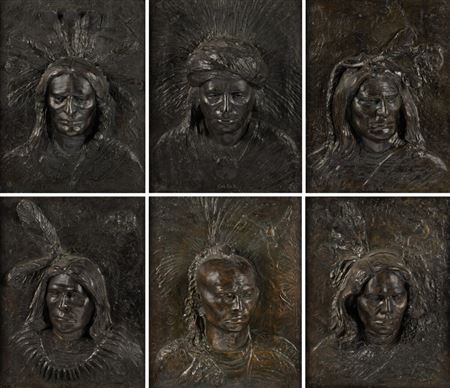
Edward Kemeys was America's first "animalier" or specialist in animal sculpture and is noted for being the sculptor of the lions, which guard the entrance to the Art Institute of Chicago. Kemey's... Read full biography
Edward Kemeys was America's first "animalier" or specialist in animal sculpture and is noted for being the sculptor of the lions, which guard the entrance to the Art Institute of Chicago. Kemey's strength lay in conveying the character of each species, as well as a sense of natural movement. He was... Read full biography
Edward Kemeys was America's first "animalier" or specialist in animal sculpture and is noted for being the sculptor of the lions, which guard the entrance to the Art Institute of Chicago. Kemey's strength lay in conveying the character of each species, as well as a sense of natural movement. He was born in Savannah, Georgia in 1843, but spent his youth in New York City. He received no early formal training in art and was for the most part a self-taught artist. His first job was an iron worker... Read full biography
Edward Kemeys was America's first "animalier" or specialist in animal sculpture and is noted for being the sculptor of the lions, which guard the entrance to the Art Institute of Chicago. Kemey's strength lay in conveying the character of each species, as well as a sense of natural movement. He was born in Savannah, Georgia in 1843, but spent his youth in New York City. He received no early formal training in art and was for the most part a self-taught artist. His first job was an iron worker until the outbreak of the Civil War in which he served in the Union Army attaining the rank of Captain of Artillery. After the war he traveled to Illinois and became a farmer, a venture that failed after a few years. He first became interested in... Read full biography
Edward Kemeys was America's first "animalier" or specialist in animal sculpture and is noted for being the sculptor of the lions, which guard the entrance to the Art Institute of Chicago. Kemey's strength lay in conveying the character of each species, as well as a sense of natural movement. He was born in Savannah, Georgia in 1843, but spent his youth in New York City. He received no early formal training in art and was for the most part a self-taught artist. His first job was an iron worker until the outbreak of the Civil War in which he served in the Union Army attaining the rank of Captain of Artillery. After the war he traveled to Illinois and became a farmer, a venture that failed after a few years. He first became interested in animals when he moved back to New York City and was employed in the construction of Central Park. At the Central Park Zoo he observed someon... Read full biography
Edward Kemeys - Artist Info
About Edward Kemeys: Books
Books & Publications (29)
Publications based on askART research. List may not be comprehensive.
American Wildlife Art
2010
Wagner, David
424 pages (color)
The Artists Bluebook 34,000 North American Artists to March 2005
2005
AskART.com Inc. - Dunbier, Lonnie Pierson (Editor)
479 pages
Davenport's Art Reference: The Gold Edition
2005
Davenport, Ray
2,421 pages
Who Was Who in American Art, 1564-1975: Three Volumes
1999
Falk, Peter Hastings (Editor)
3,724 pages
American Sculpture in the Metropolitan Museum of Art Volume One: A Catalogue of Works by Artists Born Before 1865
1999
Tolles, Thayer (Editor); Lauretta Dimmick, Donna J. Hassler
451 pages (color)
Revisiting the White City American Art at the 1893 World's Fair (Exhibition catalog)
1993
Carr, Carolyn K
408 pages (color)
Master Index 1971-1993 Artists in Southwest Art
1993
Southwest Art
64 pages
The Annual Exhibition Record of the Art Institute of Chicago (Exhibition catalog)
1990
Falk, Peter Hastings (Editor)
1,117 pages
American Art at the Nineteenth Century Paris Salons
1990
Fink, Lois Marie; Albert Boime, Forward; Elizabeth Broun, Preface
430 pages (color)
Annual Exhibition Record, 1876-1913, Pennsylvania Academy of the Fine Arts Volume II (Exhibition catalog)
1989
Falk, Peter Hastings
612 pages
American Western Art
1989
Rockwell Museum
84 pages (color)
Mantle Fielding's Dictionary of American Painters, Sculptors & Engravers
1986
Opitz, Glenn B (editor)
1,081 pages
Who Was Who in American Art: Artists Active Between 1898-1947
1985
Falk, Peter Hastings (Editor)
707 pages
Sculpture in America (new and revised edition)
1984
Craven, Wayne
782 pages
Dictionary of American Sculptors: 18th Century to Present
1984
Opitz, Glenn B (editor)
656 pages
The Quest for Unity American Art between World's Fairs 1876-1893 (Exhibition catalog)
1983
Detroit Institute of the Arts
272 pages (color)
Dictionary of American Art
1979
Baigell, Mathew
390 pages
Arts in America/A Bibliography Volume 1 (Sculpture, the West etc)
1979
Karpel, Bernard/Ruth Spiegel
730 pages
American Art to 1900 Painting, Sculpture, Architecture
1977
Brown, Milton W
631 pages (color)
American Western Art: The Harmsen Collection
1977
Harmsen, Dorothy; Bill Harmsen (Foreward)
256 pages (color)
The Illustrated Biographical Encyclopedia of Artists of the American West
1976
Samuels, Peggy and Harold
549 pages
Bronzes of the American West
1973
Broder, Patricia Janis; Harold McCracken (Intro)
429 pages (color)
Exhibition Record 1861-1900, National Academy of Design (Two Volumes Set) (Exhibition catalog)
1973
Naylor, Maria
1,075 pages
Biographical Sketches of American Artists
1972
Earle, Helen L
370 pages
Mallet's Index of Artists: International-Biographical Two Volumes: Includes 1940 Index
1935
Mallett, Daniel Trowbridge
1,130 pages
A History of American Painting Revised Edition, Two Volumes in One
1932
Hartmann, Sadekichi
363 pages
Panama-Pacific Exposition: Catalogue of the Post-Exposition Exhibit
1915
Walter, John; Pedro Lemos
112 pages
The National Gallery of Art Smithsonian Inst, Bulletin 70
1909
Rathbun, Richard
140 pages
Official Catalogue of Exhibitors Department B, Art (Exhibition catalog)