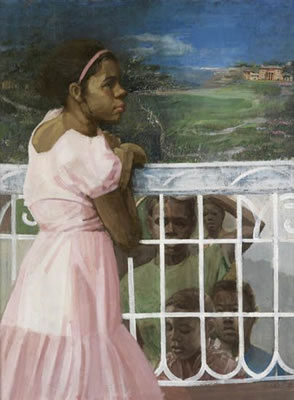
A Harlem-Renaissance painter focused on social injustices before the successes of the civil rights movement, Ernest Crichlow had his studio and home in Brooklyn, New York, his birthplace. Many of his... Read full biography
A Harlem-Renaissance painter focused on social injustices before the successes of the civil rights movement, Ernest Crichlow had his studio and home in Brooklyn, New York, his birthplace. Many of his paintings became highly controversial such as Lovers (1938), which depicted a Ku Klux Klan member... Read full biography
A Harlem-Renaissance painter focused on social injustices before the successes of the civil rights movement, Ernest Crichlow had his studio and home in Brooklyn, New York, his birthplace. Many of his paintings became highly controversial such as Lovers (1938), which depicted a Ku Klux Klan member raping a black woman, and The Flag, a scene with an American flag behind a black woman on a cross. He was criticized for focusing too much attention on serious African-American issues, but believed it... Read full biography
A Harlem-Renaissance painter focused on social injustices before the successes of the civil rights movement, Ernest Crichlow had his studio and home in Brooklyn, New York, his birthplace. Many of his paintings became highly controversial such as Lovers (1938), which depicted a Ku Klux Klan member raping a black woman, and The Flag, a scene with an American flag behind a black woman on a cross. He was criticized for focusing too much attention on serious African-American issues, but believed it was the expression that best represented him. He said: "This is the thing that I feel most at home with". Crichlow's parents were from Barbados, and he had eight brothers and sisters. As a high-school student, he was influenced by Black-American... Read full biography
A Harlem-Renaissance painter focused on social injustices before the successes of the civil rights movement, Ernest Crichlow had his studio and home in Brooklyn, New York, his birthplace. Many of his paintings became highly controversial such as Lovers (1938), which depicted a Ku Klux Klan member raping a black woman, and The Flag, a scene with an American flag behind a black woman on a cross. He was criticized for focusing too much attention on serious African-American issues, but believed it was the expression that best represented him. He said: "This is the thing that I feel most at home with". Crichlow's parents were from Barbados, and he had eight brothers and sisters. As a high-school student, he was influenced by Black-American sculptor Augusta Savage, who had a studio in Harlem, which was a gathering place for artists.&n... Read full biography
Ernie Crichlow - Artist Info
About Ernie Crichlow: Books
Books & Publications (16)
Publications based on askART research. List may not be comprehensive.
The Artists Bluebook 34,000 North American Artists to March 2005
2005
AskART.com Inc. - Dunbier, Lonnie Pierson (Editor)
479 pages
Davenport's Art Reference: The Gold Edition
2005
Davenport, Ray
2,421 pages
Who Was Who in American Art, 1564-1975: Three Volumes
1999
Falk, Peter Hastings (Editor)
3,724 pages
The Art Students League of New York A History (Teachers)
1999
Steiner, Raymond J
0 pages
Collecting African American Art Works on Paper and Canvas
1998
Taha, Halima
270 pages (color)
Black Art and Culture in the 20th Century
1997
Powell, Richard J
256 pages (color)
African American Art (Exhibition catalog)
1994
San Antonio Museum of Art
67 pages (color)
American Paintings/Brooklyn Museum Complete Illustrated Listing of Works
1979
Brooklyn Museum
133 pages (color)
Art & Ethnics Background for Teaching Youth in a Pluralistic Society
1977
Grigsby, Eugene Jr.
147 pages
New Deal for Art: The Government Art Projects of the 1930s (Exhibition catalog)
1977
Park, Marlene/Gerald Markowitz
172 pages
Amistad II Afro-American Art (Exhibition catalog)
1975
Driskell, David C
92 pages
Smithsonian Archives of American Art: Checklist of the Collection
1975
Editor, Smithsonian
0 pages
Afro-American Artists: A Bio-Bibliographical Directory
1973
Cederholm, Theresa Dickason
348 pages
The Negro in Art
1971
Locke, Alain
224 pages
Afro-American Artists New York and Boston (Exhibition catalog)