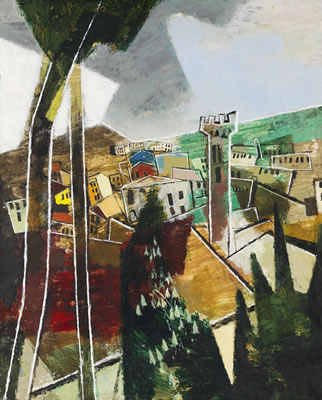
Franz Xaver Fuhr (1898-1973) began his artistic career as an autodidact, being influenced by the art of Paul Cézanne, Vincent van Gogh and the Brücke artists. He later developed his own style, which... Read full biography
Franz Xaver Fuhr (1898-1973) began his artistic career as an autodidact, being influenced by the art of Paul Cézanne, Vincent van Gogh and the Brücke artists. He later developed his own style, which was inspired by Cubism and New Objectivity. His first successes occurred in the 1920s with... Read full biography
Franz Xaver Fuhr (1898-1973) began his artistic career as an autodidact, being influenced by the art of Paul Cézanne, Vincent van Gogh and the Brücke artists. He later developed his own style, which was inspired by Cubism and New Objectivity. His first successes occurred in the 1920s with exhibitions in several German cities. Fuhr painted mainly urban sceneries, industrial plants, figures and landscapes in mostly linear and braid-like compositions with bright colors and strong black and white... Read full biography
Franz Xaver Fuhr (1898-1973) began his artistic career as an autodidact, being influenced by the art of Paul Cézanne, Vincent van Gogh and the Brücke artists. He later developed his own style, which was inspired by Cubism and New Objectivity. His first successes occurred in the 1920s with exhibitions in several German cities. Fuhr painted mainly urban sceneries, industrial plants, figures and landscapes in mostly linear and braid-like compositions with bright colors and strong black and white contrasts. At the time of National Socialism, his work was considered degenerate and partly confiscated; he was banned from exhibiting. From 1936 to 1945, he was dedicated almost exclusively to the watercolor painting. In 1943, he moved to Upper... Read full biography
Franz Xaver Fuhr (1898-1973) began his artistic career as an autodidact, being influenced by the art of Paul Cézanne, Vincent van Gogh and the Brücke artists. He later developed his own style, which was inspired by Cubism and New Objectivity. His first successes occurred in the 1920s with exhibitions in several German cities. Fuhr painted mainly urban sceneries, industrial plants, figures and landscapes in mostly linear and braid-like compositions with bright colors and strong black and white contrasts. At the time of National Socialism, his work was considered degenerate and partly confiscated; he was banned from exhibiting. From 1936 to 1945, he was dedicated almost exclusively to the watercolor painting. In 1943, he moved to Upper Palatinate and Regensburg with his wife. In 1943, parts of his work were destroyed in a bomb attack. In... Read full biography
Franz Xaver Fuhr - Artist Info
About Franz Xaver Fuhr: Books
Books & Publications (1)
Publications based on askART research. List may not be comprehensive.
Who Was Who in American Art, 1564-1975: Three Volumes