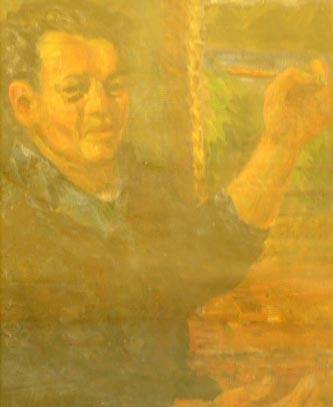
The following biography was provided by Steven Wasser, whose source is www.AmericanJewishArt.com. According to art critic, Alfred Werner, "the pictorial world [Jennings Tofel] bequeathed to us, with... Read full biography
The following biography was provided by Steven Wasser, whose source is www.AmericanJewishArt.com. According to art critic, Alfred Werner, "the pictorial world [Jennings Tofel] bequeathed to us, with its intensity, its mood of gravity, is one that only a Jewish refugee from Eastern Europe could have... Read full biography
The following biography was provided by Steven Wasser, whose source is www.AmericanJewishArt.com. According to art critic, Alfred Werner, "the pictorial world [Jennings Tofel] bequeathed to us, with its intensity, its mood of gravity, is one that only a Jewish refugee from Eastern Europe could have created."[1] The works of Tofel often portray anonymous human figures that emphasize hands and facial expressions. His palette leans toward yellows, reds, blues, and greens. Little attention is paid... Read full biography
The following biography was provided by Steven Wasser, whose source is www.AmericanJewishArt.com. According to art critic, Alfred Werner, "the pictorial world [Jennings Tofel] bequeathed to us, with its intensity, its mood of gravity, is one that only a Jewish refugee from Eastern Europe could have created."[1] The works of Tofel often portray anonymous human figures that emphasize hands and facial expressions. His palette leans toward yellows, reds, blues, and greens. Little attention is paid to clothing or backgrounds. Count Antoni Adam Ostrowski invited Jewish weavers and entrepreneurs to settle in Tomaszów Mazowiecki in the 1820's. Jennings Tofel was born in this Polish town to a Jewish middle-class Jewish family on October 18, 1891 as... Read full biography
The following biography was provided by Steven Wasser, whose source is www.AmericanJewishArt.com. According to art critic, Alfred Werner, "the pictorial world [Jennings Tofel] bequeathed to us, with its intensity, its mood of gravity, is one that only a Jewish refugee from Eastern Europe could have created."[1] The works of Tofel often portray anonymous human figures that emphasize hands and facial expressions. His palette leans toward yellows, reds, blues, and greens. Little attention is paid to clothing or backgrounds. Count Antoni Adam Ostrowski invited Jewish weavers and entrepreneurs to settle in Tomaszów Mazowiecki in the 1820's. Jennings Tofel was born in this Polish town to a Jewish middle-class Jewish family on October 18, 1891 as Idel (Yehudah) Toflevicz. His father, Yakob Yosef Toflevicz (b. 1864) was a woman's dress tailor.&nb... Read full biography
Jennings Tofel - Artist Info
About Jennings Tofel: Books
Books & Publications (11)
Publications based on askART research. List may not be comprehensive.
The Artists Bluebook 34,000 North American Artists to March 2005
2005
AskART.com Inc. - Dunbier, Lonnie Pierson (Editor)
479 pages
Who Was Who in American Art, 1564-1975: Three Volumes
1999
Falk, Peter Hastings (Editor)
3,724 pages
Painting a Place in America Jewish Artists in New York 1900-1945 (Exhibition catalog)
1991
Kleeblatt, Norman L and Susan Chevlowe (Editors)
208 pages (color)
A Guide to the Collections: Smith College Museum of Art
1986
Chetham, Charles; David Grose
312 pages (color)
Mantle Fielding's Dictionary of American Painters, Sculptors & Engravers
1986
Opitz, Glenn B (editor)
1,081 pages
Who Was Who in American Art: Artists Active Between 1898-1947
1985
Falk, Peter Hastings (Editor)
707 pages
Jewish Experience In the Twentieth Century
1984
Kampf, Avram
240 pages (color)
Jennings Tofel
1976
Granick, Arthur
237 pages (color)
Smithsonian Archives of American Art: Checklist of the Collection
1975
Editor, Smithsonian
0 pages
Whitney Museum of American Art Catalogue of the Collection
1974
Baur, John I H
235 pages (color)
Mallet's Index of Artists: International-Biographical Two Volumes: Includes 1940 Index