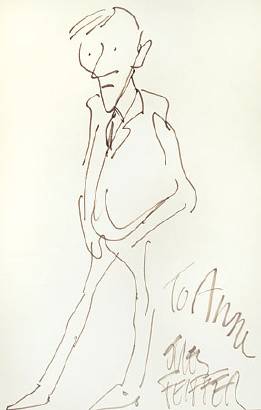
Jules Feiffer was considered the dean of American "intellectual" cartoonists. Jules Ralph Feiffer first introduced his searching graphic vignettes in the "Village Voice" in 1956, and has since grown... Read full biography
Jules Feiffer was considered the dean of American "intellectual" cartoonists. Jules Ralph Feiffer first introduced his searching graphic vignettes in the "Village Voice" in 1956, and has since grown in stature to become one of the leading social, psychological, and political commentators in the... Read full biography
Jules Feiffer was considered the dean of American "intellectual" cartoonists. Jules Ralph Feiffer first introduced his searching graphic vignettes in the "Village Voice" in 1956, and has since grown in stature to become one of the leading social, psychological, and political commentators in the country. He used a narrative sequence of pictures in which, through revealing monologues, the artsy classes of Greenwich Village exposed themselves as essentially hypocritical or somewhat... Read full biography
Jules Feiffer was considered the dean of American "intellectual" cartoonists. Jules Ralph Feiffer first introduced his searching graphic vignettes in the "Village Voice" in 1956, and has since grown in stature to become one of the leading social, psychological, and political commentators in the country. He used a narrative sequence of pictures in which, through revealing monologues, the artsy classes of Greenwich Village exposed themselves as essentially hypocritical or somewhat self-delusional. Editorial cartoonists soon began using multi-panel cartoons occasionally too, and began imparting psychological insight to their views of public issues. Feiffer was born in the Bronx of New York and attended the Art Students League in 1946 and the... Read full biography
Jules Feiffer was considered the dean of American "intellectual" cartoonists. Jules Ralph Feiffer first introduced his searching graphic vignettes in the "Village Voice" in 1956, and has since grown in stature to become one of the leading social, psychological, and political commentators in the country. He used a narrative sequence of pictures in which, through revealing monologues, the artsy classes of Greenwich Village exposed themselves as essentially hypocritical or somewhat self-delusional. Editorial cartoonists soon began using multi-panel cartoons occasionally too, and began imparting psychological insight to their views of public issues. Feiffer was born in the Bronx of New York and attended the Art Students League in 1946 and the Pratt Institute from 1947 to 1951. He assisted comic-book cartoonist Will Eisner, ghosting The Spirit from 1946 to 1951, and from 1... Read full biography
Jules Feiffer - Artist Info
About Jules Feiffer: Books
Books & Publications (15)
Publications based on askART research. List may not be comprehensive.
All the Art That's Fit to Print (And Some That Wasn't): Inside The New York Times Op-Ed Page
2012
Kraus, Jerelle
280 pages (color)
The Artists Bluebook 34,000 North American Artists to March 2005
2005
AskART.com Inc. - Dunbier, Lonnie Pierson (Editor)
479 pages
Davenport's Art Reference: The Gold Edition
2005
Davenport, Ray
2,421 pages
Who's Who in American Art, 2004 2003 - 2004 (25th Edition)
2004
McGowan, Alison C (Editor)
1,512 pages
The Art Students League of New York: A History (Students)
1999
Steiner, Raymond J
187 pages
Who's Who in American Art, 1997-1998
1997
Marquis Who's Who
1,515 pages
Eyes of the Nation A Visual History of the United States
1997
Virga, Vincent/Alan Brinkley
400 pages (color)
Animation, Caricature...Cartoons in the U S A and Canada/A Bibliography
1994
Lent, John A
415 pages
Who's Who in American Art, 1993-1994, 20th Edition (American Federation of Arts)
1993
Bowker R R
1,473 pages
The Encyclopedia of American Comics From 1897 to the Present
1990
Goulart, Ron (Editor)
408 pages (color)
Who's Who in American Art-1986 1986
1986
Jaques Cattell Press
1,292 pages
Critical Vision/A Historyof Social and Political Art in the U S
1982
Von Blum, Paul
165 pages
The Political Cartoon
1981
Press, Charles
389 pages
Editorial and Political Cartooning From Earliest Times to the Present