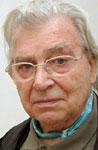
Karel Appel was a painter born on April 25, 1921 in Amsterdam, Holland; his father was a barber. He studied at the Royal Academy in Amsterdam in 1940-43. Appel sought to develop an impulsive formal... Read full biography
Karel Appel was a painter born on April 25, 1921 in Amsterdam, Holland; his father was a barber. He studied at the Royal Academy in Amsterdam in 1940-43. Appel sought to develop an impulsive formal language based on life, in reaction to geometric academicism. He even founded with others an... Read full biography
Karel Appel was a painter born on April 25, 1921 in Amsterdam, Holland; his father was a barber. He studied at the Royal Academy in Amsterdam in 1940-43. Appel sought to develop an impulsive formal language based on life, in reaction to geometric academicism. He even founded with others an experimental group. In Paris in 1949, he focused on mastering creative power and did canvases that "look like they were done in a rage". (Schatz) An action painter, Appel gives full rein to his violent... Read full biography
Karel Appel was a painter born on April 25, 1921 in Amsterdam, Holland; his father was a barber. He studied at the Royal Academy in Amsterdam in 1940-43. Appel sought to develop an impulsive formal language based on life, in reaction to geometric academicism. He even founded with others an experimental group. In Paris in 1949, he focused on mastering creative power and did canvases that "look like they were done in a rage". (Schatz) An action painter, Appel gives full rein to his violent expressionism in numerous mural compositions and in stained glass windows. In 1958, Appel established residence in Paris, and in 1959 he came to New York, where he now spends half the year. He won the UNESCO prize at the Venice Biennale in 1952, in 1956... Read full biography
Karel Appel was a painter born on April 25, 1921 in Amsterdam, Holland; his father was a barber. He studied at the Royal Academy in Amsterdam in 1940-43. Appel sought to develop an impulsive formal language based on life, in reaction to geometric academicism. He even founded with others an experimental group. In Paris in 1949, he focused on mastering creative power and did canvases that "look like they were done in a rage". (Schatz) An action painter, Appel gives full rein to his violent expressionism in numerous mural compositions and in stained glass windows. In 1958, Appel established residence in Paris, and in 1959 he came to New York, where he now spends half the year. He won the UNESCO prize at the Venice Biennale in 1952, in 1956 the Stedelijk Museum in Amsterdam commissioned a large public mural from him which was accepted af... Read full biography
Karel Christiaan Appel - Artist Info
About Karel Christiaan Appel: Books
Books & Publications (13)
Publications based on askART research. List may not be comprehensive.
The Artists Bluebook 34,000 North American Artists to March 2005
2005
AskART.com Inc. - Dunbier, Lonnie Pierson (Editor)
479 pages
Davenport's Art Reference: The Gold Edition
2005
Davenport, Ray
2,421 pages
Who Was Who in American Art, 1564-1975: Three Volumes
1999
Falk, Peter Hastings (Editor)
3,724 pages
Accents on Artists A fact-filled pronunciation guide. Over 800 artist’s names you should know…
1996
Barbara and Peter Toohil
363 pages (color)
The Art Gallery of Hamilton: Seventy-Five Years (1914-1989) (Art Gallery of Hamilton)
1989
Fox, Ross and Grace Inglis
122 pages (color)
A Visual Bestiary: Animals in Art (Stewart Art Centre)
1984
Brice, Megan
61 pages
Acquisitions to the Permanent Collection, 1973-1976 (Norman Mackenzie Art Gallery)