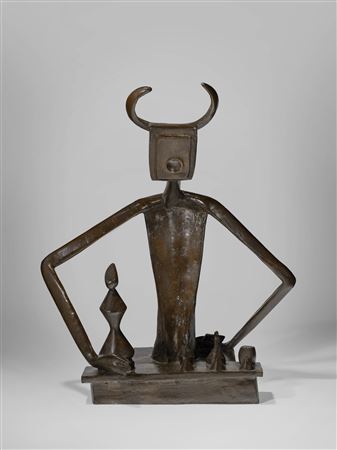
Max Ernst was born on April 2, 1891 in a small Rhineland town called Bruhl, outside Cologne. His father, a fiercely authoritarian Roman Catholic, was an amateur painter who taught at a school for... Read full biography
Max Ernst was born on April 2, 1891 in a small Rhineland town called Bruhl, outside Cologne. His father, a fiercely authoritarian Roman Catholic, was an amateur painter who taught at a school for deaf-mutes. From earliest childhood, Ernst seems to have acquired haunting visual images which became... Read full biography
Max Ernst was born on April 2, 1891 in a small Rhineland town called Bruhl, outside Cologne. His father, a fiercely authoritarian Roman Catholic, was an amateur painter who taught at a school for deaf-mutes. From earliest childhood, Ernst seems to have acquired haunting visual images which became factors in his work throughout his life. He was a nervous impressionable boy, in constant friction with authority. During an illness, Ernst stared at the wood flooring and ended up discovering a new... Read full biography
Max Ernst was born on April 2, 1891 in a small Rhineland town called Bruhl, outside Cologne. His father, a fiercely authoritarian Roman Catholic, was an amateur painter who taught at a school for deaf-mutes. From earliest childhood, Ernst seems to have acquired haunting visual images which became factors in his work throughout his life. He was a nervous impressionable boy, in constant friction with authority. During an illness, Ernst stared at the wood flooring and ended up discovering a new painting technique that he called "frottage." He took paper and pencil, laid them over the textured surface and scribbled away. Allied to this was Ernst's use of paint sponged and knifed on a canvas, with the images it suggested sharpened with a brush.... Read full biography
Max Ernst was born on April 2, 1891 in a small Rhineland town called Bruhl, outside Cologne. His father, a fiercely authoritarian Roman Catholic, was an amateur painter who taught at a school for deaf-mutes. From earliest childhood, Ernst seems to have acquired haunting visual images which became factors in his work throughout his life. He was a nervous impressionable boy, in constant friction with authority. During an illness, Ernst stared at the wood flooring and ended up discovering a new painting technique that he called "frottage." He took paper and pencil, laid them over the textured surface and scribbled away. Allied to this was Ernst's use of paint sponged and knifed on a canvas, with the images it suggested sharpened with a brush. Ernst went to the University of Bonn, studying philosophy and psychiatry at a time, 1909, when the subject was barely a... Read full biography
Max Ernst - Artist Info
About Max Ernst: Books
Books & Publications (26)
Publications based on askART research. List may not be comprehensive.
Southwest Art History Conference Abstracts, 1996-2013
2014
Fahlman, Betsy (Editor)
217 pages (color)
The Artists Bluebook 34,000 North American Artists to March 2005
2005
AskART.com Inc. - Dunbier, Lonnie Pierson (Editor)
479 pages
Davenport's Art Reference: The Gold Edition
2005
Davenport, Ray
2,421 pages
Max Ernst: A Retrospective
2005
Spies, Werner
100 pages (color)
Max Ernst Museum Bruhl Prestel Museum Guide
2005
Spies, Werner (Intro); Andreas Rossmann; Susanne Blocker, et all
80 pages (color)
Peggy Guggenheim: Mistress of Modernism
2004
Dearborn, Mary
448 pages
Surrealism: Desire Unbound
2002
Mundy, Jennifer (Ed)
352 pages (color)
Picasso to Pop: The Richard Weisman Collection
2002
Shea, Patricia (Editor)
124 pages
Between Lives An Artist and Her World
2001
Tanning, Dorothea
378 pages
Masterworks of American Painting and Sculpture from Smith College Museum
1999
Editor, Smith College Museum
307 pages
Who Was Who in American Art, 1564-1975: Three Volumes
1999
Falk, Peter Hastings (Editor)
3,724 pages
Record of the Carnegie Institute International Exhibition, 1896-1996 (Exhibition catalog)
1998
Falk, Peter Hastings (Editor)
3,724 pages
Cellblock Visions: Prison Art in America
1997
Kornfield, Phyllis
86 pages (color)
Accents on Artists A fact-filled pronunciation guide. Over 800 artist’s names you should know…
1996
Barbara and Peter Toohil
363 pages (color)
Biennial Exhibition Record of the Corcoran Gallery of Art (Exhibition catalog)
1991
Falk, Peter Hastings
335 pages
The Annual & Biennial Exhibition Record of the Whitney Museum of Art (Whitney Museum of American Art, 1918-1989) (Exhibition catalog)
1991
Falk, Peter Hastings (Editor); Andrea Ansell Bien
468 pages
The Annual Exhibition Record of the Art Institute of Chicago (Exhibition catalog)
1990
Falk, Peter Hastings (Editor)
1,117 pages
Annual Exhibition Record, 1914-68, Pennsylvania Academy of the Fine Arts (Exhibition catalog)
1989
Falk, Peter Hastings (Editor)
538 pages
A Concise History of Modern Painting
1988
Read, Herbert
418 pages (color)
Visitors to Arizona 1846-1980 (Exhibition catalog)
1980
Ballinger, James K
206 pages (color)
Pennsylvania Academy Moderns 1910-1940 (Exhibition catalog)