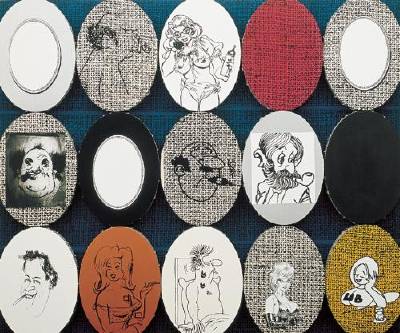
Meyer Vaisman was born in Caracas, Venezuela, attended Parsons School of Design, and currently lives and works in New York. Vaisman's initial proposal was a performance for which he would dress up as... Read full biography
Meyer Vaisman was born in Caracas, Venezuela, attended Parsons School of Design, and currently lives and works in New York. Vaisman's initial proposal was a performance for which he would dress up as a Border Patrol agent, appearing to be "lost" driving his patrol car in Tijuana. However, this... Read full biography
Meyer Vaisman was born in Caracas, Venezuela, attended Parsons School of Design, and currently lives and works in New York. Vaisman's initial proposal was a performance for which he would dress up as a Border Patrol agent, appearing to be "lost" driving his patrol car in Tijuana. However, this proposal posed a high risk for the artist himself due to the violent atmosphere around the border at the time. After a series of investigations, but with the original idea still in mind, the artist... Read full biography
Meyer Vaisman was born in Caracas, Venezuela, attended Parsons School of Design, and currently lives and works in New York. Vaisman's initial proposal was a performance for which he would dress up as a Border Patrol agent, appearing to be "lost" driving his patrol car in Tijuana. However, this proposal posed a high risk for the artist himself due to the violent atmosphere around the border at the time. After a series of investigations, but with the original idea still in mind, the artist created an installation in downtown Tijuana, using the existing tourist attraction of the famous zebra-painted mules. Vaisman suited himself up in the border patrol uniform, and painted the zebra cart as an official vehicle. For one weekend, the... Read full biography
Meyer Vaisman was born in Caracas, Venezuela, attended Parsons School of Design, and currently lives and works in New York. Vaisman's initial proposal was a performance for which he would dress up as a Border Patrol agent, appearing to be "lost" driving his patrol car in Tijuana. However, this proposal posed a high risk for the artist himself due to the violent atmosphere around the border at the time. After a series of investigations, but with the original idea still in mind, the artist created an installation in downtown Tijuana, using the existing tourist attraction of the famous zebra-painted mules. Vaisman suited himself up in the border patrol uniform, and painted the zebra cart as an official vehicle. For one weekend, the burro-patrol was located at one of the corners of Ave. Revolucion and functioned normally as a photograph station for "Tijuana souvenirs". www.in... Read full biography
Meyer Vaisman - Artist Info
About Meyer Vaisman: Books
Books & Publications (12)
Publications based on askART research. List may not be comprehensive.
The Art Prophets: The Artists, Dealers, and Tastemakers Who Shook the Art World
2011
Polsky, Richard
262 pages
The Artists Bluebook 34,000 North American Artists to March 2005
2005
AskART.com Inc. - Dunbier, Lonnie Pierson (Editor)
479 pages
Davenport's Art Reference: The Gold Edition
2005
Davenport, Ray
2,421 pages
The Dakis Joannou Collection
1996
Deitch, Jeffrey
302 pages (color)
True Colors The Real Life of the Art World
1996
Haden-Guest, Anthony
344 pages (color)
Art of the Postmodern Era From the Late 1960s to the Early 1990s
1996
Sandler, Irving
636 pages (color)
Who's Who in American Art, 1993-1994, 20th Edition (American Federation of Arts)
1993
Bowker R R
1,473 pages
Explorations The Visual Arts since 1945
1991
Hoffman, Katherine
400 pages (color)
NY Art Now The Saatchi Collection
1988
Cameron, Dan
250 pages (color)
The Binational American Art of the Late 80s (Exhibition catalog)
1988
Fairbrother, Trevor (others)
226 pages (color)
Natural Genre (Fine Arts Gallery, Florida State University)
1984
Collins, Tricia and Richard Milazzo
48 pages (color)
Neo York Report on a Phenomenon (Exhibition catalog)