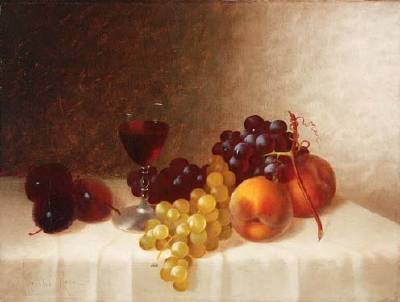
Still life painter, Morston Constantine Ream often depicted fruit and dessert in his paintings. He was born in Lancaster, Ohio. The artist began learning daguerreotyping when he was twenty and worked... Read full biography
Still life painter, Morston Constantine Ream often depicted fruit and dessert in his paintings. He was born in Lancaster, Ohio. The artist began learning daguerreotyping when he was twenty and worked as a photographer's apprentice in Cleveland. He eventually gave this up, as it bothered his health,... Read full biography
Still life painter, Morston Constantine Ream often depicted fruit and dessert in his paintings. He was born in Lancaster, Ohio. The artist began learning daguerreotyping when he was twenty and worked as a photographer's apprentice in Cleveland. He eventually gave this up, as it bothered his health, and moved to New York in 1868 to study painting. His paintings were exhibited in 1870 by James F. Ryder. He was the younger brother of Carducius Plantagenet Ream, who was also well known for his... Read full biography
Still life painter, Morston Constantine Ream often depicted fruit and dessert in his paintings. He was born in Lancaster, Ohio. The artist began learning daguerreotyping when he was twenty and worked as a photographer's apprentice in Cleveland. He eventually gave this up, as it bothered his health, and moved to New York in 1868 to study painting. His paintings were exhibited in 1870 by James F. Ryder. He was the younger brother of Carducius Plantagenet Ream, who was also well known for his still lifes and encouraged Morston to seriously start painting. In addition to still lifes Morston produced landscapes and genre paintings. Morston had various studios on Union Square, and exhibited still lifes at Moore's Art Rooms in the 1870s-80s. He... Read full biography
Still life painter, Morston Constantine Ream often depicted fruit and dessert in his paintings. He was born in Lancaster, Ohio. The artist began learning daguerreotyping when he was twenty and worked as a photographer's apprentice in Cleveland. He eventually gave this up, as it bothered his health, and moved to New York in 1868 to study painting. His paintings were exhibited in 1870 by James F. Ryder. He was the younger brother of Carducius Plantagenet Ream, who was also well known for his still lifes and encouraged Morston to seriously start painting. In addition to still lifes Morston produced landscapes and genre paintings. Morston had various studios on Union Square, and exhibited still lifes at Moore's Art Rooms in the 1870s-80s. He exhibited at the National Academy, Pennsylvania Academy of Fine Art, and the Brooklyn Art Association. Source:. Peter Falk,... Read full biography
Morston Ream - Artist Info
About Morston Ream: Books
Books & Publications (13)
Publications based on askART research. List may not be comprehensive.
The Artists Bluebook 34,000 North American Artists to March 2005
2005
AskART.com Inc. - Dunbier, Lonnie Pierson (Editor)
479 pages
Davenport's Art Reference: The Gold Edition
2005
Davenport, Ray
2,421 pages
Who Was Who in American Art, 1564-1975: Three Volumes
1999
Falk, Peter Hastings (Editor)
3,724 pages
Vose Art Notes: A Guide for Collectors Art and Collecting in America, Part Two
1997
Vose Galleries
35 pages (color)
A Nation's Legacy 150 Years of American Art from Ohio Collections (Exhibition catalog)
1992
Columbus Museum of Art
198 pages (color)
The Annual Exhibition Record of the Art Institute of Chicago (Exhibition catalog)
1990
Falk, Peter Hastings (Editor)
1,117 pages
Art Across America: The South, Near Midwest (Volume Two)
1990
Gerdts, William H
396 pages (color)
Annual Exhibition Record, 1876-1913, Pennsylvania Academy of the Fine Arts Volume II (Exhibition catalog)
1989
Falk, Peter Hastings
612 pages
Museum of Fine Arts The American and European Collections
1979
Springfield Library & Museum
216 pages (color)
Exhibition Record 1861-1900, National Academy of Design (Two Volumes Set) (Exhibition catalog)
1973
Naylor, Maria
1,075 pages
American Still Life Painting
1971
Gerdts, William; Russell Burke
264 pages (color)
The American Scene A Survey of the Life and Landscape of the 19th Century (Exhibition catalog)