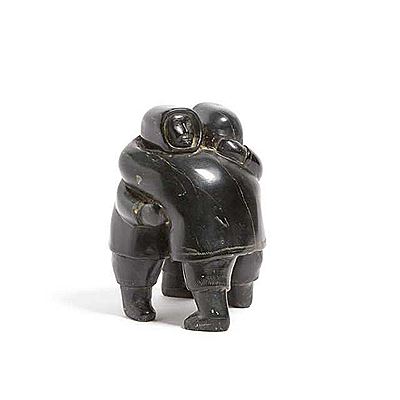
Napatchie Pootoogook was born in 1938 at Sako, a small camp on south Baffin Island. She died in December, 2002, of cancer. Napatchie, also spelled Napachie, was the only daughter of the late... Read full biography
Napatchie Pootoogook was born in 1938 at Sako, a small camp on south Baffin Island. She died in December, 2002, of cancer. Napatchie, also spelled Napachie, was the only daughter of the late Pitseolak Ashoona. Napatchie began to draw in the late 1950's while living at Keakto, a camp near Cape... Read full biography
Napatchie Pootoogook was born in 1938 at Sako, a small camp on south Baffin Island. She died in December, 2002, of cancer. Napatchie, also spelled Napachie, was the only daughter of the late Pitseolak Ashoona. Napatchie began to draw in the late 1950's while living at Keakto, a camp near Cape Dorset. Several people living at the camp, including Napatchie's mother and Kenojuak Ashevak had already begun to draw, encouraged by James Houston. Napachies' early drawing exhibited a free and... Read full biography
Napatchie Pootoogook was born in 1938 at Sako, a small camp on south Baffin Island. She died in December, 2002, of cancer. Napatchie, also spelled Napachie, was the only daughter of the late Pitseolak Ashoona. Napatchie began to draw in the late 1950's while living at Keakto, a camp near Cape Dorset. Several people living at the camp, including Napatchie's mother and Kenojuak Ashevak had already begun to draw, encouraged by James Houston. Napachies' early drawing exhibited a free and uninhibited style, still very evident in her contemporary works. She incorporates many aspects of Inuit culture in her work, usually retrieved from her own personal experience. For all but a few years in the early 1970's, Napatchie had drawn consistently. In... Read full biography
Napatchie Pootoogook was born in 1938 at Sako, a small camp on south Baffin Island. She died in December, 2002, of cancer. Napatchie, also spelled Napachie, was the only daughter of the late Pitseolak Ashoona. Napatchie began to draw in the late 1950's while living at Keakto, a camp near Cape Dorset. Several people living at the camp, including Napatchie's mother and Kenojuak Ashevak had already begun to draw, encouraged by James Houston. Napachies' early drawing exhibited a free and uninhibited style, still very evident in her contemporary works. She incorporates many aspects of Inuit culture in her work, usually retrieved from her own personal experience. For all but a few years in the early 1970's, Napatchie had drawn consistently. In the mid-1970's she experimented with mixed media works using coloured pencil and black felt pen in conjuncti... Read full biography
Napatchie Pootoogook - Artist Info
About Napatchie Pootoogook: Books
Books & Publications (7)
Publications based on askART research. List may not be comprehensive.
The Blind Man and the Loon: The Story of a Tale
2013
Mishler, Craig
285 pages (color)
Canadian Art: From its Beginnings to 2000
2002
Newlands, Anne
355 pages (color)
Three Women, Three Generations: Drawings by Pitseolak Ashoona, Napatchie Pootoogook and Shuvinai Ashoona
1999
Blodgett, Jean, et al.
96 pages (color)
Inuit Women Artists: Voices from Cape Dorseet
1994
Leroux, Odette, Marion E. Jackson and Minnie Aodla Freeman
253 pages (color)
Works from the McCuaig Collection in the Laurentian University Museum (Now Called Art Gallery of Sudbury)
1987
Krueger, Pamela
56 pages
Arctic Vision: Art of the Canadian Inuit (Exhibition catalog)
1984
Lipton, Barbara
107 pages (color)
Cape Dorset (Winnipeg Art Gallery) (Exhibition catalog)