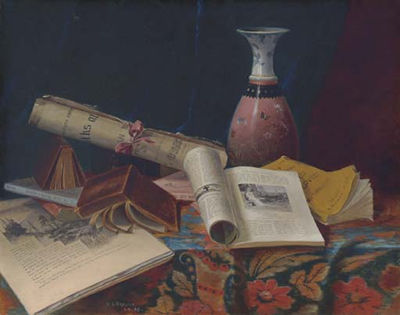
Considerable mystery surrounds the name Nicholas Alden Brooks. Other than having been active in New York City between 1880 and 1904, very little is known about the artist. There are no records of any... Read full biography
Considerable mystery surrounds the name Nicholas Alden Brooks. Other than having been active in New York City between 1880 and 1904, very little is known about the artist. There are no records of any art societies showing him as a member or his having participated in any exhibits. The name Brooks,... Read full biography
Considerable mystery surrounds the name Nicholas Alden Brooks. Other than having been active in New York City between 1880 and 1904, very little is known about the artist. There are no records of any art societies showing him as a member or his having participated in any exhibits. The name Brooks, in fact, could possibly be a pseudonym for Robert Fullington, whose name appears on theatrical memorabilia in Brookss trompe loeil still-life paintings. William Harnett seems to be the source of... Read full biography
Considerable mystery surrounds the name Nicholas Alden Brooks. Other than having been active in New York City between 1880 and 1904, very little is known about the artist. There are no records of any art societies showing him as a member or his having participated in any exhibits. The name Brooks, in fact, could possibly be a pseudonym for Robert Fullington, whose name appears on theatrical memorabilia in Brookss trompe loeil still-life paintings. William Harnett seems to be the source of inspiration for most of Brooks work. Quite often, in fact, Brooks work was mistaken for that of Harnetts, with a counterfeit Harnett signature. Everything in these paintings was calculated to enhance doubts, often with flat objects casting minimal... Read full biography
Considerable mystery surrounds the name Nicholas Alden Brooks. Other than having been active in New York City between 1880 and 1904, very little is known about the artist. There are no records of any art societies showing him as a member or his having participated in any exhibits. The name Brooks, in fact, could possibly be a pseudonym for Robert Fullington, whose name appears on theatrical memorabilia in Brookss trompe loeil still-life paintings. William Harnett seems to be the source of inspiration for most of Brooks work. Quite often, in fact, Brooks work was mistaken for that of Harnetts, with a counterfeit Harnett signature. Everything in these paintings was calculated to enhance doubts, often with flat objects casting minimal shadows, and so providing few visual clues as to whether the source of light in the painting differs at all from the source of light in the room where... Read full biography
Nicholas Brooks - Artist Info
About Nicholas Brooks: Books
Books & Publications (13)
Publications based on askART research. List may not be comprehensive.
The Artists Bluebook 34,000 North American Artists to March 2005
2005
AskART.com Inc. - Dunbier, Lonnie Pierson (Editor)
479 pages
Davenport's Art Reference: The Gold Edition
2005
Davenport, Ray
2,421 pages
Fine American Art from 1845 to 1960 (Spanierman Gallery, LLC (Exhibition catalog)
2005
Reis, Mary Clare; Lisa N. Peters et all
0 pages (color)
Tranquil America: A Century of Painting, 1840-1940 (Exhibition catalog)
2000
Editor, Spanierman Gallery
0 pages
Who Was Who in American Art, 1564-1975: Three Volumes
1999
Falk, Peter Hastings (Editor)
3,724 pages
Trompe l'oeil: The Art of Deception (Exhibition catalog)
1997
Dawson, Nancy
6 pages (color)
Old Money
1988
Chambers, Bruce
0 pages (color)
300 Years of American Art (two volumes)
1986
Zellman, Michael David
1,102 pages (color)
Who Was Who in American Art: Artists Active Between 1898-1947
1985
Falk, Peter Hastings (Editor)
707 pages
A Kennedy Galleries Selection of American Art for Public and Private Collectors
1981
Kennedy Galleries
81 pages (color)
American Still Life Painting
1971
Gerdts, William; Russell Burke
264 pages (color)
After the Hunt: W Harnett and Other American Still Life Painters
1969
Frankenstein, Alfred
202 pages
After the Hunt: William Harnett and Other American Still Life Painters