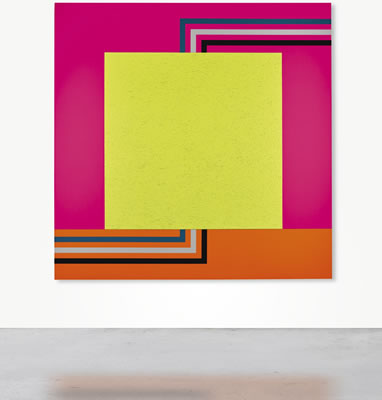
Peter Halley, (b.1953, New York City), is an American artist who came to prominence as a central figure of the Neo-Conceptualist movement of the 1980s. His paintings redeploy the language of... Read full biography
Peter Halley, (b.1953, New York City), is an American artist who came to prominence as a central figure of the Neo-Conceptualist movement of the 1980s. His paintings redeploy the language of geometric abstraction to explore the organization of social space in the digital era. Since the 1980s,... Read full biography
Peter Halley, (b.1953, New York City), is an American artist who came to prominence as a central figure of the Neo-Conceptualist movement of the 1980s. His paintings redeploy the language of geometric abstraction to explore the organization of social space in the digital era. Since the 1980s, Halley’s lexicon includes three elements: “prisons” and “cells”, connected by “conduits”, which are used in his paintings to explore the technologically determined space and pathways that regulate daily... Read full biography
Peter Halley, (b.1953, New York City), is an American artist who came to prominence as a central figure of the Neo-Conceptualist movement of the 1980s. His paintings redeploy the language of geometric abstraction to explore the organization of social space in the digital era. Since the 1980s, Halley’s lexicon includes three elements: “prisons” and “cells”, connected by “conduits”, which are used in his paintings to explore the technologically determined space and pathways that regulate daily life. Using fluorescent color and Roll-a-Tex, a commercial paint additive that provides ready made texture, Halley embraces materials that are anti-naturalistic and commercially manufactured. Halley is known for his essays on art and culture, written... Read full biography
Peter Halley, (b.1953, New York City), is an American artist who came to prominence as a central figure of the Neo-Conceptualist movement of the 1980s. His paintings redeploy the language of geometric abstraction to explore the organization of social space in the digital era. Since the 1980s, Halley’s lexicon includes three elements: “prisons” and “cells”, connected by “conduits”, which are used in his paintings to explore the technologically determined space and pathways that regulate daily life. Using fluorescent color and Roll-a-Tex, a commercial paint additive that provides ready made texture, Halley embraces materials that are anti-naturalistic and commercially manufactured. Halley is known for his essays on art and culture, written in the 1980s and 90s, exploring themes from French critical theory and the influence of burgeoning digital technology. His... Read full biography
Peter Halley - Artist Info
About Peter Halley: Books
Books & Publications (34)
Publications based on askART research. List may not be comprehensive.
The Artists Bluebook 34,000 North American Artists to March 2005
2005
AskART.com Inc. - Dunbier, Lonnie Pierson (Editor)
479 pages
Davenport's Art Reference: The Gold Edition
2005
Davenport, Ray
2,421 pages
Who's Who in American Art, 2004 2003 - 2004 (25th Edition)
2004
McGowan, Alison C (Editor)
1,512 pages
Unpackaging Art of the 1980s
2003
Pearlman, Alison
248 pages (color)
It's All True: Imagining New York's East Village Art Scene of the 1980s
1999
Kirwin, Elizabeth Seton
916 pages
Art at the Turn of the Millennium
1999
Larsen, Lars et all
561 pages (color)
Not Illustration but the Equivalent A Cognitive Approach to Abstract Expressionism
1997
Cernuschi, Claude
172 pages
Visual Arts in the 20th Century
1997
Lucie-Smith, Edward
400 pages (color)
Who's Who in American Art, 1997-1998
1997
Marquis Who's Who
1,515 pages
Addison Gallery of American Art 65 Years A Selective Catalogue (Exhibition catalog)
1996
Addison Gallery
512 pages (color)
The Dakis Joannou Collection
1996
Deitch, Jeffrey
302 pages (color)
True Colors The Real Life of the Art World
1996
Haden-Guest, Anthony
344 pages (color)
Art of the Postmodern Era From the Late 1960s to the Early 1990s
1996
Sandler, Irving
636 pages (color)
Art Today
1995
Lucie-Smith, Edward
512 pages (color)
Critiques of Pure Abstraction (Exhibition catalog)
1995
Rosenthal, Mark
48 pages (color)
Who's Who in American Art, 1993-1994, 20th Edition (American Federation of Arts)
1993
Bowker R R
1,473 pages
Culture or Trash? A Provocative View of Contemporary Painting (etc)
1993
Gardner, James
227 pages
A Nation's Legacy 150 Years of American Art from Ohio Collections (Exhibition catalog)
1992
Columbus Museum of Art
198 pages (color)
Peter Halley Paintings 1989-1992 (Exhibition catalog)
1992
Danoff, Michael (others)
51 pages (color)
The City Influence (Exhibition catalog)
1992
Dayton Art Institute
56 pages (color)
Contemporary Art 1965-1990
1992
Kurtz, Bruce D
256 pages (color)
Modernism in Dispute Art Since the Forties
1992
Wood, Paul (others)
267 pages (color)
Power:Its Myths and Mores in American Art 1961-1991 (Exhibition catalog)
1991
Day, Holliday T
159 pages (color)
Explorations The Visual Arts since 1945
1991
Hoffman, Katherine
400 pages (color)
Art Since Mid Century 1945 to the Present
1991
Wheeler, Daniel
344 pages (color)
Word As Image American Art 1960-1990 (Exhibition catalog)
1990
Bowman, Russell/Dean Sobel
172 pages (color)
Abstraction, Geometry, Painting Geometric Abstract Painting in America since 1945 (Exhibition catalog)
1989
Auping, Michael
232 pages (color)
10 + 10 Contemporary Soviet and American Painters (Exhibition catalog)
1989
Smith, Gordon Dee (others)
170 pages (color)
NY Art Now The Saatchi Collection
1988
Cameron, Dan
250 pages (color)
The Binational American Art of the Late 80s (Exhibition catalog)
1988
Fairbrother, Trevor (others)
226 pages (color)
Artwords 2 Discourse on the Early 80s
1988
Siegel, Jeanne (editor)
319 pages
Blasted Allegories An Anthology of Writings by Contemporary Artists