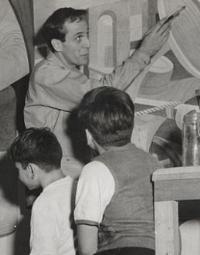
Born in Montreal, Canada, Philip Guston had a career that vacillated between deeply intense figurative painting and totally abstract painting. He remains well known as one of the leading Abstract... Read full biography
Born in Montreal, Canada, Philip Guston had a career that vacillated between deeply intense figurative painting and totally abstract painting. He remains well known as one of the leading Abstract Expressionists of the 1950s and 1960s and for his paintings in the last part of his career that... Read full biography
Born in Montreal, Canada, Philip Guston had a career that vacillated between deeply intense figurative painting and totally abstract painting. He remains well known as one of the leading Abstract Expressionists of the 1950s and 1960s and for his paintings in the last part of his career that combined expressionism and realism. Influences in addition to Abstract Expressionism were paintings by Renaissance Masters, California surrealism and 1930s Mexican muralism. When Guston was six years old, he... Read full biography
Born in Montreal, Canada, Philip Guston had a career that vacillated between deeply intense figurative painting and totally abstract painting. He remains well known as one of the leading Abstract Expressionists of the 1950s and 1960s and for his paintings in the last part of his career that combined expressionism and realism. Influences in addition to Abstract Expressionism were paintings by Renaissance Masters, California surrealism and 1930s Mexican muralism. When Guston was six years old, he moved to Los Angeles with his Russian immigrant parents. In high school, he was a friend of future gestural painter Jackson Pollack, and the two of them got into trouble for circulating a satirical pamphlet and were expelled from school. As an adult... Read full biography
Born in Montreal, Canada, Philip Guston had a career that vacillated between deeply intense figurative painting and totally abstract painting. He remains well known as one of the leading Abstract Expressionists of the 1950s and 1960s and for his paintings in the last part of his career that combined expressionism and realism. Influences in addition to Abstract Expressionism were paintings by Renaissance Masters, California surrealism and 1930s Mexican muralism. When Guston was six years old, he moved to Los Angeles with his Russian immigrant parents. In high school, he was a friend of future gestural painter Jackson Pollack, and the two of them got into trouble for circulating a satirical pamphlet and were expelled from school. As an adult Guston continued his focus on social issues, and joining the John Reed Club, aligned himself with left-wing poli... Read full biography
Philip Guston - Artist Info
About Philip Guston: Books
Books & Publications (231)
Publications based on askART research. List may not be comprehensive.
San Francisco Museum of Modern Art 360 Views on the Collection (Exhibition catalog)
2016
Block, Judy and Suzanne Stein, Editors
360 pages (color)
American Abstract and Figurative Expressionism Style is Timely Art is Timeless
2009
Herskovic, Marika
252 pages (color)
The Artists Bluebook 34,000 North American Artists to March 2005
2005
AskART.com Inc. - Dunbier, Lonnie Pierson (Editor)
479 pages
Davenport's Art Reference: The Gold Edition
2005
Davenport, Ray
2,421 pages
Philip Guston Retrospective (Exhibition catalog)
2003
Auping, Michael
272 pages (color)
American Abstract Expressionism of the 1950s: An Illustrated Survey