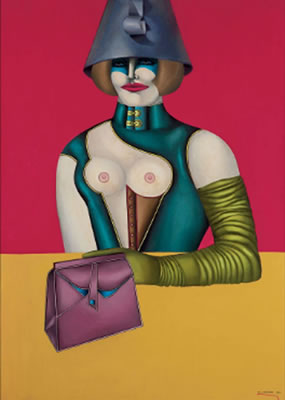
Born in 1901 at Hamburg, Germany, Richard Lindner became a fine-art painter of hard-edge abstract figures, a fashion illustrator and art educator. His signature figural works reflect his perception... Read full biography
Born in 1901 at Hamburg, Germany, Richard Lindner became a fine-art painter of hard-edge abstract figures, a fashion illustrator and art educator. His signature figural works reflect his perception of the un-fulfillment of pop culture and are shown in surreal settings with garish bright colors,... Read full biography
Born in 1901 at Hamburg, Germany, Richard Lindner became a fine-art painter of hard-edge abstract figures, a fashion illustrator and art educator. His signature figural works reflect his perception of the un-fulfillment of pop culture and are shown in surreal settings with garish bright colors, flat forms and faces with severe expressions. Among them are streetwalkers, military personnel, mannequins and circus performers---all looking mechanical and unhappy. Richard Lindner spent his childhood... Read full biography
Born in 1901 at Hamburg, Germany, Richard Lindner became a fine-art painter of hard-edge abstract figures, a fashion illustrator and art educator. His signature figural works reflect his perception of the un-fulfillment of pop culture and are shown in surreal settings with garish bright colors, flat forms and faces with severe expressions. Among them are streetwalkers, military personnel, mannequins and circus performers---all looking mechanical and unhappy. Richard Lindner spent his childhood in Nuremberg and studied there at the Kunstgewerbeschule. From 1924 to 1927 he lived in Munich where he studied from 1925 at the Kunstakademie. He moved to Berlin and stayed there until 1928 and then returned to Munich to become art director of a... Read full biography
Born in 1901 at Hamburg, Germany, Richard Lindner became a fine-art painter of hard-edge abstract figures, a fashion illustrator and art educator. His signature figural works reflect his perception of the un-fulfillment of pop culture and are shown in surreal settings with garish bright colors, flat forms and faces with severe expressions. Among them are streetwalkers, military personnel, mannequins and circus performers---all looking mechanical and unhappy. Richard Lindner spent his childhood in Nuremberg and studied there at the Kunstgewerbeschule. From 1924 to 1927 he lived in Munich where he studied from 1925 at the Kunstakademie. He moved to Berlin and stayed there until 1928 and then returned to Munich to become art director of a publishing firm. He remained there until 1933 when he was forced to flee to Paris, where he became politically engaged, sought contact with French... Read full biography
Richard Lindner - Artist Info
About Richard Lindner: Books
Books & Publications (92)
Publications based on askART research. List may not be comprehensive.
The Artists Bluebook 34,000 North American Artists to March 2005
2005
AskART.com Inc. - Dunbier, Lonnie Pierson (Editor)
479 pages
Davenport's Art Reference: The Gold Edition
2005
Davenport, Ray
2,421 pages
Who Was Who in American Art, 1564-1975: Three Volumes
1999
Falk, Peter Hastings (Editor)
3,724 pages
Surrealist Art The Bergman Collection (Exhibition catalog)
1997
Ades, Dawn
262 pages (color)
Hirshhorn Museum and Sculpture Garden 195 Works of Art
1996
Demetrion, James T (Introduction)
166 pages (color)
Richard Lindner Paintings and Watercolors 1948-1977
1996
Zilczer, Judith
170 pages (color)
American Paintings An Illustrated Catalogue (Exhibition catalog)
1992
National Gallery of Art
545 pages
Art in the Age of Aquarius, 1955-1970
1992
Seitz, William C
250 pages (color)
Cleveland Museum of Art Handbook (of the Collection)
1991
Cleveland Museum of Art
161 pages
The Artist Observed 28 Interviews with Contemporary Artists
1991
Gruen, John
324 pages
Art Since Mid Century 1945 to the Present
1991
Wheeler, Daniel
344 pages (color)
Art of the Golden West
1990
Axelrod, Alan
418 pages (color)
Pop Art A Continuing History
1990
Livingstone, Marco
271 pages (color)
Annual Exhibition Record, 1914-68, Pennsylvania Academy of the Fine Arts (Exhibition catalog)
1989
Falk, Peter Hastings (Editor)
538 pages
Contemporary Artists (3rd Edition)
1989
Naylor, Colin (editor)
1,059 pages
20th Century Drawings from the Whitney Museum of American Art
1987
Cummings, Paul
176 pages (color)
Dictionary of Contemporary American Artists (5th Edition)
1987
Cummings, Paul
653 pages
Varieties of Visual Experience (3rd edition)
1987
Feldman, Edmund Burke
528 pages (color)
Twentieth Century American Painting Thyssen-Bornemisza Collection
1987
Levin, Gail
407 pages (color)
An American Renaissance Painting and Sculpture Since 1940 (Exhibition catalog)
1986
Hunter, Sam
269 pages (color)
Mantle Fielding's Dictionary of American Painters, Sculptors & Engravers
1986
Opitz, Glenn B (editor)
1,081 pages
300 Years of American Art (two volumes)
1986
Zellman, Michael David
1,102 pages (color)
Twentieth Century Artists on Art
1985
Ashton, Dore (Editor)
302 pages
Who Was Who in American Art: Artists Active Between 1898-1947
1985
Falk, Peter Hastings (Editor)
707 pages
Art, Design and the Modern Corporation (Exhibition catalog)
1985
Harris, Neil/Martina R Norelli
135 pages (color)
The Revenge of the Philistines Art and Culture 1972-1984
1985
Kramer, Hilton
445 pages
With an Eye to American Art (Exhibition catalog)
1985
Miller, Dorothy C
16 pages
100 Works by Modern Masters From the Guggenheim Museum
1984
Barnett, Vivian Endicott
211 pages (color)
Dallas Museum of Art Selected Works
1984
Bromberg, Anne R
219 pages (color)
Chicago, Museum of Contemporary Art Selections from Permanent Collection
1984
Chicago, Museum Contemporary
164 pages (color)
The Museum of Modern Art, New York The History and the Collection
1984
Hunter, Sam
599 pages (color)
World Artists 1950-1980
1984
Marks, Claude
912 pages
American Printmaking A Century of American Printmaking 1880-1980