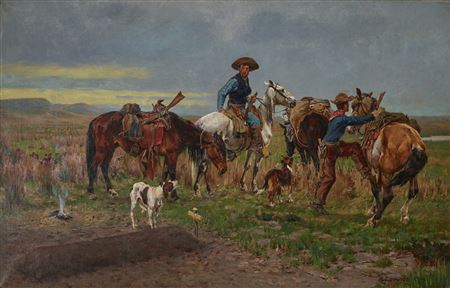
Born on a farm in Voigstaedt, Weimar, Germany, Richard Lorenz became a painter and illustrator of dramatic western scenes, especially of the Plains Indian culture and the consequences of encounters... Read full biography
Born on a farm in Voigstaedt, Weimar, Germany, Richard Lorenz became a painter and illustrator of dramatic western scenes, especially of the Plains Indian culture and the consequences of encounters with the white man's civilization. His most famous pupil was Frank Tenney Johnson. He was also well... Read full biography
Born on a farm in Voigstaedt, Weimar, Germany, Richard Lorenz became a painter and illustrator of dramatic western scenes, especially of the Plains Indian culture and the consequences of encounters with the white man's civilization. His most famous pupil was Frank Tenney Johnson. He was also well known for panoramic* painting and for depictions of horses, genre and landscapes. As a young person in Germany, Lorenz determined to become a Biblical painter because he was fascinated by the subject... Read full biography
Born on a farm in Voigstaedt, Weimar, Germany, Richard Lorenz became a painter and illustrator of dramatic western scenes, especially of the Plains Indian culture and the consequences of encounters with the white man's civilization. His most famous pupil was Frank Tenney Johnson. He was also well known for panoramic* painting and for depictions of horses, genre and landscapes. As a young person in Germany, Lorenz determined to become a Biblical painter because he was fascinated by the subject of wandering, nomadic people in wilderness areas. He grew up in a village twenty-eight miles north of Weimar, and at age 15, began art study in Weimar including at the Royal Academy of Arts, where his work was recognized with several distinguished... Read full biography
Born on a farm in Voigstaedt, Weimar, Germany, Richard Lorenz became a painter and illustrator of dramatic western scenes, especially of the Plains Indian culture and the consequences of encounters with the white man's civilization. His most famous pupil was Frank Tenney Johnson. He was also well known for panoramic* painting and for depictions of horses, genre and landscapes. As a young person in Germany, Lorenz determined to become a Biblical painter because he was fascinated by the subject of wandering, nomadic people in wilderness areas. He grew up in a village twenty-eight miles north of Weimar, and at age 15, began art study in Weimar including at the Royal Academy of Arts, where his work was recognized with several distinguished prizes. One of those prizes was endowed by composer Franz Liszt, and another was the Karl Alexander Prize, which he won twice. It was... Read full biography
Richard Lorenz - Artist Info
About Richard Lorenz: Books
Books & Publications (28)
Publications based on askART research. List may not be comprehensive.
The American West Reimagined: Gems from the Coeur d'Alene Art Auction
2021
Peterson, Dr. Larry Len
528 pages (color)
The Artists Bluebook 34,000 North American Artists to March 2005
2005
AskART.com Inc. - Dunbier, Lonnie Pierson (Editor)
479 pages
Davenport's Art Reference: The Gold Edition
2005
Davenport, Ray
2,421 pages
Famous Wisconsin Artists and Architects
2004
Levy, Hannah Heidi
316 pages
Painters and the American West: The Anschutz Collection
2000
Troccoli, Joan Carpenter
218 pages (color)
Who Was Who in American Art, 1564-1975: Three Volumes
1999
Falk, Peter Hastings (Editor)
3,724 pages
German-American Artists in Early Milwaukee: A Biographyical Dictionary
1997
Merrill, Peter C
165 pages
Revisiting the White City American Art at the 1893 World's Fair (Exhibition catalog)
1993
Carr, Carolyn K
408 pages (color)
Art of the Golden West
1990
Axelrod, Alan
418 pages (color)
The Annual Exhibition Record of the Art Institute of Chicago (Exhibition catalog)
1990
Falk, Peter Hastings (Editor)
1,117 pages
Art Across America: The Far Midwest, Rocky Mountain West, Southwest, Pacific Volume Three
1990
Gerdts, William H
396 pages (color)
Art Across America: The South, Near Midwest (Volume Two)
1990
Gerdts, William H
396 pages (color)
Annual Exhibition Record, 1876-1913, Pennsylvania Academy of the Fine Arts Volume II (Exhibition catalog)
1989
Falk, Peter Hastings
612 pages
Annual Exhibition Record, 1914-68, Pennsylvania Academy of the Fine Arts (Exhibition catalog)
1989
Falk, Peter Hastings (Editor)
538 pages
Mantle Fielding's Dictionary of American Painters, Sculptors & Engravers
1986
Opitz, Glenn B (editor)
1,081 pages
Artists of the American West: Three Volumes A Biographical Dictionary
1985
Dawdy, Doris
1,184 pages
Who Was Who in American Art: Artists Active Between 1898-1947
1985
Falk, Peter Hastings (Editor)
707 pages
Masterpieces of the American West Selections from the Anschutz Collection
1983
Cunningham, Elizabeth
152 pages (color)
Legacy of the West
1982
Hunt, David C; Marsha V. Gallagher
157 pages (color)
The Cowboy (Exhibition catalog)
1981
San Diego Museum of Art
89 pages (color)
Western Masters: A Comprehensive Exhibition Petersen Galleries (Exhibition catalog)
1981
Stern, Jean
124 pages (color)
Johnson County, Kansas: Its History in Paintings and Prose
1976
Editors, Bicentennial Committee
44 pages
The Illustrated Biographical Encyclopedia of Artists of the American West
1976
Samuels, Peggy and Harold
549 pages
Harmsen's Western Americana
1971
Harmsen, Dorothy
212 pages (color)
The Beauty of America in Great American Art (Country Beautiful Foundation)
1965
Goldman, Eric F.; Tracy Atkinson
162 pages (color)
Western Paintings A Distinguished Collection (of)
1956
McCracken, Harold
32 pages
Mallet's Index of Artists: International-Biographical Two Volumes: Includes 1940 Index
1935
Mallett, Daniel Trowbridge
1,130 pages
Who's Who in American Art, 1913 American Art Annual