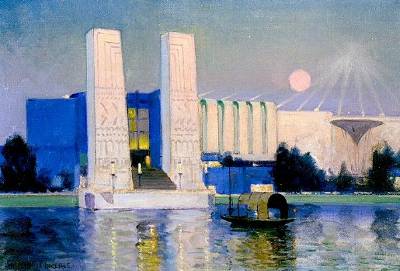
Growing up in Vienna, Austria, Rudolph Ingerle was fascinated by persons he perceived as quaint in the nearby mountains of Moravia. He became committed to painting subjects, primarily landscapes and... Read full biography
Growing up in Vienna, Austria, Rudolph Ingerle was fascinated by persons he perceived as quaint in the nearby mountains of Moravia. He became committed to painting subjects, primarily landscapes and people in those landscapes, that related to his surroundings. He transferred that interest to... Read full biography
Growing up in Vienna, Austria, Rudolph Ingerle was fascinated by persons he perceived as quaint in the nearby mountains of Moravia. He became committed to painting subjects, primarily landscapes and people in those landscapes, that related to his surroundings. He transferred that interest to regions of his adopted country of America where he had a career based in Chicago. Ingerle studied at the Art Institute and then traveled extensively in search of landscapes that appealed to him. Locations... Read full biography
Growing up in Vienna, Austria, Rudolph Ingerle was fascinated by persons he perceived as quaint in the nearby mountains of Moravia. He became committed to painting subjects, primarily landscapes and people in those landscapes, that related to his surroundings. He transferred that interest to regions of his adopted country of America where he had a career based in Chicago. Ingerle studied at the Art Institute and then traveled extensively in search of landscapes that appealed to him. Locations included Brown County, Indiana; the Ozark Mountains of Missouri and the Smoky Mountains of Tennessee and North Carolina. His figural subjects appeared generally untroubled by concerns beyond their own boundaries. HIs style was traditional realism, and... Read full biography
Growing up in Vienna, Austria, Rudolph Ingerle was fascinated by persons he perceived as quaint in the nearby mountains of Moravia. He became committed to painting subjects, primarily landscapes and people in those landscapes, that related to his surroundings. He transferred that interest to regions of his adopted country of America where he had a career based in Chicago. Ingerle studied at the Art Institute and then traveled extensively in search of landscapes that appealed to him. Locations included Brown County, Indiana; the Ozark Mountains of Missouri and the Smoky Mountains of Tennessee and North Carolina. His figural subjects appeared generally untroubled by concerns beyond their own boundaries. HIs style was traditional realism, and he was very popular in Chicago with persons who resisted the encroaching modernist styles. He exhibited at the Art Institute of Chicago... Read full biography
Rudolph Ingerle - Artist Info
About Rudolph Ingerle: Books
Books & Publications (26)
Publications based on askART research. List may not be comprehensive.
The Artists Bluebook 34,000 North American Artists to March 2005
2005
AskART.com Inc. - Dunbier, Lonnie Pierson (Editor)
479 pages
Davenport's Art Reference: The Gold Edition
2005
Davenport, Ray
2,421 pages
Chicago Modern 1893-1945: Pursuit of the New (Exhibition catalog)
2004
Kennedy, Elizabeth (Editor)
176 pages (color)
Union League Club of Chicago Art Collection
2003
Richter, Marianne; Wendy Greenhouse (Essays)
308 pages (color)
The Friedman Collection: Artists of Chicago (Spanierman Gallery, LLC) (Exhibition catalog)
2002
Gerdts, Dr. William H. (essay)
88 pages (color)
Who Was Who in American Art, 1564-1975: Three Volumes
1999
Falk, Peter Hastings (Editor)
3,724 pages
Record of the Carnegie Institute International Exhibition, 1896-1996 (Exhibition catalog)
1998
Falk, Peter Hastings (Editor)
3,724 pages
Master Pieces The Art History of Jigsaw Puzzles
1998
McCann, Chris (Author); Louis Darling (Illustrator)
223 pages (color)
Those Brown County Artists The Ones Who Came; The Ones Who Stayed
1993
Nesbit, Joanne (Editor)
235 pages (color)
Biennial Exhibition Record of the Corcoran Gallery of Art (Exhibition catalog)
1991
Falk, Peter Hastings
335 pages
Annual Exhibition Record, National Academy of Design: 1901-1950 (Exhibition catalog)
1990
Falk, Peter Hastings
622 pages
The Annual Exhibition Record of the Art Institute of Chicago (Exhibition catalog)
1990
Falk, Peter Hastings (Editor)
1,117 pages
Art Across America: The South, Near Midwest (Volume Two)
1990
Gerdts, William H
396 pages (color)
Annual Exhibition Record, 1876-1913, Pennsylvania Academy of the Fine Arts Volume II (Exhibition catalog)
1989
Falk, Peter Hastings
612 pages
Annual Exhibition Record, 1914-68, Pennsylvania Academy of the Fine Arts (Exhibition catalog)
1989
Falk, Peter Hastings (Editor)
538 pages
Mantle Fielding's Dictionary of American Painters, Sculptors & Engravers
1986
Opitz, Glenn B (editor)
1,081 pages
Who Was Who in American Art: Artists Active Between 1898-1947
1985
Falk, Peter Hastings (Editor)
707 pages
Dictionary of American Artists
1982
Opitz, Glenn
372 pages
Role and Impact: The Chicago Society of Artists
1979
Yochim, Louise Dunn
297 pages
Permanent Collection Catalog Springville Museum of Art
1972
Forster, Peggy; Julie Snow Birkhimer; Mae Huntington
75 pages (color)
Paintings in the Art Institute of Chicago/A Catalogue of the Collection
1961
Art Institute of Chicago
490 pages (color)
Who's Who in American Art, 1953
1953
Gilbert, Dorothy B.
557 pages
Who's Who in American Art, 1947
1947
Gilbert, Dorothy, (Editor)
685 pages
First National Exhibition of American Art (Exhibition catalog)
1936
Breckinridge, Mrs. (essay)
32 pages
Mallet's Index of Artists: International-Biographical Two Volumes: Includes 1940 Index
1935
Mallett, Daniel Trowbridge
1,130 pages
A Century of Progress Exhibition of Paintings & Sculpture, Art Institute of Chicago (Exhibition catalog)