Page loaded successfully. Showing keywords for Arnold Brugger.
Artist Keywords
Keywords page for Arnold Brugger ((1888 - 1975)), known for Painting. Showing associated keywords and tags.
Arnold Brugger KEYWORDS
1888 - 1975. Known for: Painting.
Arnold Brügger learned the lithographing trade in the parental art institution from 1904-1908. He subsequently attended the Kunstgewerbeschule Bern for a short time. This was followed by stays in... Read full biography
Arnold Brügger learned the lithographing trade in the parental art institution from 1904-1908. He subsequently attended the Kunstgewerbeschule Bern for a short time. This was followed by stays in Cologne, Berlin, Munich and Paris, which familiarized him with the currents of the international... Read full biography
Arnold Brügger learned the lithographing trade in the parental art institution from 1904-1908. He subsequently attended the Kunstgewerbeschule Bern for a short time. This was followed by stays in Cologne, Berlin, Munich and Paris, which familiarized him with the currents of the international avant-garde. In 1913, he returned for financial reasons to Meiringen, where he had his main residence from then on. While his early work was under the influence of Paul Cézanne, Cubism and German... Read full biography
Arnold Brügger learned the lithographing trade in the parental art institution from 1904-1908. He subsequently attended the Kunstgewerbeschule Bern for a short time. This was followed by stays in Cologne, Berlin, Munich and Paris, which familiarized him with the currents of the international avant-garde. In 1913, he returned for financial reasons to Meiringen, where he had his main residence from then on. While his early work was under the influence of Paul Cézanne, Cubism and German Expressionism, he developed an independent, impasto and flat style of painting and a palette dominated by muted, tonal colors after his return to the native mountains.
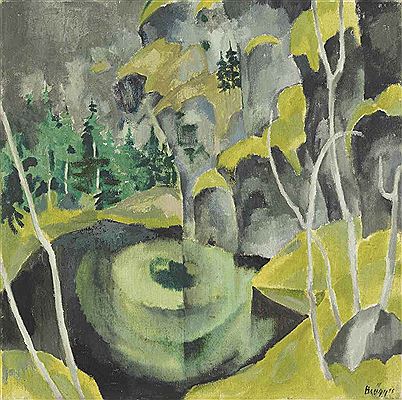
Arnold Brügger learned the lithographing trade in the parental art institution from 1904-1908. He subsequently attended the Kunstgewerbeschule Bern for a short time. This was followed by stays in Cologne, Berlin, Munich and Paris, which familiarized him with the currents of the international avant-garde. In 1913, he returned for financial reasons to Meiringen, where he had his main residence from then on. While his early work was under the influence of Paul Cézanne, Cubism and German Expressionism, he developed an independent, impasto and flat style of painting and a palette dominated by muted, tonal colors after his return to the native mountains.