Page loaded successfully. Showing keywords for Dieter Hacker.
Artist Keywords
Keywords page for Dieter Hacker ((Born 1942)), known for Painting. Showing associated keywords and tags.
Dieter Hacker KEYWORDS
Born 1942 Augsburg. Known for: Painting.
Dieter Hacker was born in Augsburg in 1942. He studied at the Academy of Fine Arts in Munich under Ernst Geiltinger, Gerhard von Graevenitz and Klaus Staudt. In the beginning his works were... Read full biography
Dieter Hacker was born in Augsburg in 1942. He studied at the Academy of Fine Arts in Munich under Ernst Geiltinger, Gerhard von Graevenitz and Klaus Staudt. In the beginning his works were influenced by kinetics and light art, becoming more politically and socially critical in the 1970s. During... Read full biography
Dieter Hacker was born in Augsburg in 1942. He studied at the Academy of Fine Arts in Munich under Ernst Geiltinger, Gerhard von Graevenitz and Klaus Staudt. In the beginning his works were influenced by kinetics and light art, becoming more politically and socially critical in the 1970s. During the 1980s, Hacker eventually gained great success in the wake of the figurative, expressive painting as it was represented by the movement of the ‘Neue Wilde’. Works by Hackert are part of important... Read full biography
Dieter Hacker was born in Augsburg in 1942. He studied at the Academy of Fine Arts in Munich under Ernst Geiltinger, Gerhard von Graevenitz and Klaus Staudt. In the beginning his works were influenced by kinetics and light art, becoming more politically and socially critical in the 1970s. During the 1980s, Hacker eventually gained great success in the wake of the figurative, expressive painting as it was represented by the movement of the ‘Neue Wilde’. Works by Hackert are part of important museum collections, including the Museum für Konkrete Kunst in Ingolstadt, the Hamburger Bahnhof Berlin and the Zentrum für Kunst und Medientechnologie in Karlsruhe.
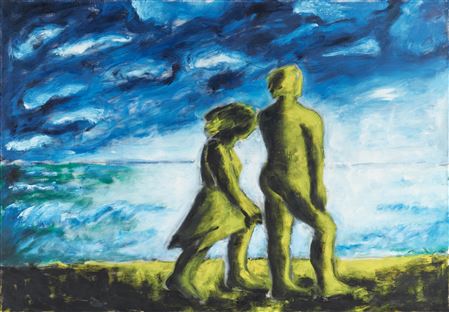
Dieter Hacker was born in Augsburg in 1942. He studied at the Academy of Fine Arts in Munich under Ernst Geiltinger, Gerhard von Graevenitz and Klaus Staudt. In the beginning his works were influenced by kinetics and light art, becoming more politically and socially critical in the 1970s. During the 1980s, Hacker eventually gained great success in the wake of the figurative, expressive painting as it was represented by the movement of the ‘Neue Wilde’. Works by Hackert are part of important museum collections, including the Museum für Konkrete Kunst in Ingolstadt, the Hamburger Bahnhof Berlin and the Zentrum für Kunst und Medientechnologie in Karlsruhe.