Page loaded successfully. Showing keywords for Naum Gabo.
Artist Keywords
Keywords page for Naum Gabo ((1890 - 1977)), known for Constructivist sculpture, collage, drawing. Showing associated keywords and tags.
Naum Gabo KEYWORDS
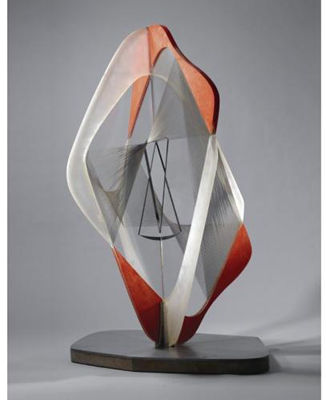
1890 Briansk, Russia - 1977 Waterbury, Connecticut. Known for: Constructivist sculpture, collage, drawing.
Russian born with the name Naum Pevsner, Naum Gabo became a sculptor, painter and educator and changed his name to avert confusion between him and his brother, Antoine Pevsner. He and his brother... Read full biography
Russian born with the name Naum Pevsner, Naum Gabo became a sculptor, painter and educator and changed his name to avert confusion between him and his brother, Antoine Pevsner. He and his brother both became distinguished for their Constructivist sculpture. He left Russia in 1922, lived in Berlin... Read full biography
Russian born with the name Naum Pevsner, Naum Gabo became a sculptor, painter and educator and changed his name to avert confusion between him and his brother, Antoine Pevsner. He and his brother both became distinguished for their Constructivist sculpture. He left Russia in 1922, lived in Berlin for ten years, then Paris for five years and then England from 1937 to 1946, when he emigrated to America and settled in Middlebury, Connecticut. His art education was at the University of Munich in... Read full biography
Russian born with the name Naum Pevsner, Naum Gabo became a sculptor, painter and educator and changed his name to avert confusion between him and his brother, Antoine Pevsner. He and his brother both became distinguished for their Constructivist sculpture. He left Russia in 1922, lived in Berlin for ten years, then Paris for five years and then England from 1937 to 1946, when he emigrated to America and settled in Middlebury, Connecticut. His art education was at the University of Munich in Germany. Gabo had the prime of his career before coming to America but had much influence as an educator on a succeeding generation of sculptors including Jose de Rivera and Richard Lippold. From 1953 to 1954, he taught at the Harvard Graduate School... Read full biography
Russian born with the name Naum Pevsner, Naum Gabo became a sculptor, painter and educator and changed his name to avert confusion between him and his brother, Antoine Pevsner. He and his brother both became distinguished for their Constructivist sculpture. He left Russia in 1922, lived in Berlin for ten years, then Paris for five years and then England from 1937 to 1946, when he emigrated to America and settled in Middlebury, Connecticut. His art education was at the University of Munich in Germany. Gabo had the prime of his career before coming to America but had much influence as an educator on a succeeding generation of sculptors including Jose de Rivera and Richard Lippold. From 1953 to 1954, he taught at the Harvard Graduate School and in 1959, gave Mellon Lectures at the National Gallery of Art, which were later published in 1962... Read full biography
Naum Gabo - Artist Info
About Naum Gabo: Keywords
Keywords (25)
Art Method
- •Collage and/or Decoupage
- •Drawing, Draftsmanship, Draughtsman
- •Graphic Design, Printmaking, Lithography, Etching, Woodblocks
- •Murals: Design, Painting, Fresco, Mosaic, Glass
- •Sculpture, Three Dimensional Forms, Sculptor
Art Media
- •Aluminum/Aluminium
- •Bronze
- •Chalk
- •Engraving, Engraver
- •Mixed Media, Multi Media and/or Multli Styles
Art Style
- •Constructivism, Constructivist
- •Modernist, Modernism (Partially Abstract, Leading Edge)
Art Subject
- •Figure, Figurative Humans
Geography/Places Lived and/or Worked
- •Cornwall, England
- •Europe
- •Russia
Art School
- •Bauhaus Student, Germany and/or US Teacher
Chronology
- •Early 20th Century Before 1950
- •Late 20th Century After 1950
Added Description
- •Art Educator:Teaching, Scholarship, Workshops and/or Writing
Ethnicity of Artist
- •Russian
Exhibition of Museum
- •Art Institute of Chicago
- •Museum of Modern Art, New York
- •Solomon R. Guggenheim Museum/Museum of Non Objective Painting
- •Whitney Biennial Museum of American Art